To save content items to your account,
please confirm that you agree to abide by our usage policies.
If this is the first time you use this feature, you will be asked to authorise Cambridge Core to connect with your account.
Find out more about saving content to .
To save content items to your Kindle, first ensure no-reply@cambridge.org
is added to your Approved Personal Document E-mail List under your Personal Document Settings
on the Manage Your Content and Devices page of your Amazon account. Then enter the ‘name’ part
of your Kindle email address below.
Find out more about saving to your Kindle.
Note you can select to save to either the @free.kindle.com or @kindle.com variations.
‘@free.kindle.com’ emails are free but can only be saved to your device when it is connected to wi-fi.
‘@kindle.com’ emails can be delivered even when you are not connected to wi-fi, but note that service fees apply.
The challenges of defining structures in a new, unprecedented polymer architecture
Characterization methodologies are a critical component for all the natural sciences. Appropriate protocols are required that both identify as well as define new entities within specific systems under investigation. Staudinger originally introduced the concept of polymers as covalent macromolecules [1, 2]. Shortly after his concept gained acceptance the important and seminal question arose: How does one characterize these new polymer entities? Traditional polymers at their inception were viewed as completely new classes of chemical structure and material. Unlike simple, monodisperse structures normally associated with traditional low molecular weight organic and inorganic compounds, these polymers were accessible only as polydisperse mixtures of macromolecular structures. Many traditional analytical/characterization methods developed for small molecules were of very limited use for these new materials. Polymers do not have boiling points. In many cases they were amorphous, not crystalline and were produced with variable compositions that were often dependent on the way they were synthesized. As a consequence, traditional characterization and elemental analyses were often meaningless. Methods developed for characterization of polymers not only reflected the fact that polymers are polydisperse mixtures of covalent compounds, but also that they are large molecules of unprecedented nanoscale dimensions.
In this context, both dendrimers and dendrons may be thought of as well-defined macromolecular compounds that exhibit features reminiscent of both small molecule and macromolecular regimes. More specifically, they are well-defined, quantized molecules in the classical sense of organic chemistry, yet they are also large polymeric, molecules of nanoscale dimensions. As a consequence, both small molecule and large molecule techniques are generally used in a convergent and collective fashion in order to characterize and define all dendrimers and dendrons. In the early, emerging days of the dendritic polymer field, substantial rejection was encountered concerning the very existence of these dendrimer and dendron structures.
The descriptor “dendritic effects” is a collective term widely used since the 1990s to describe unusual physico-chemical property patterns or trends observed for dendrons/dendrimers as a function of their generation level. These properties may be either maximized (i.e. a positive effect) or minimized (i.e. a negative effect) within a dendron/dendrimer series. A dendritic effect is referred to as either a positive or negative effect depending on whether it was accentuated or attenuated as a function of generation level. The term was generally used in an empirical sense to describe generation-dependent physico-chemical property patterns that were initially assumed to be dependent upon nanoscale sizes associated with the generation. However, accumulated evidence now reveals that these effects are dependent on more subtle parameters than mere size variations. The object of this chapter is to analyze these subtle dependences in an effort to gain insights into the cause–effect principles and predictive value of these dendritic effects. Understanding these nano-periodic property relationships should assist in dendrimer design optimization for both function and applications.
Some of the earliest dendritic effects were reported by Tomalia et al. [1–3], Astruc et al. [4] and Seebach et al. [5]. Undoubtedly, there are similar architecturally driven effects associated with the other three major polymer architectures (i.e. linear, crosslinked, and branched); however, they are generally less quantifiable due to their polydisperse structures. In any case, dendrons/dendrimers exhibit architecturally driven properties that are dramatically different to those observed for equivalent architectural isomeric types (i.e. linear, bridged (crosslinked), or branched) possessing common elemental compositions and molecular weights. In the context of a new emerging nano-periodic concept, described later in Chapter 8, dendritic effects may now be viewed as intrinsic and functional nano-periodic property patterns. In all cases they display a first-order dependency upon one of the critical nanoscale design parameters (CNDPs), namely, architecture. However, it must also be noted that dendritic effects are inextricably influenced by one or more interrelated CNDPs such as (a) size, (b) shape, (c) surface chemistry, (d) flexibility/rigidity, or (e) elemental composition, as illustrated in Figure 7.1 and 7.8. Both physical and chemical nanoscale properties are influenced by these well-defined CNDPs. This results in the manifestation of unique, intrinsic features, a few which are listed in the left and right hand columns in Figure 7.1. Many of these issues have been examined extensively elsewhere [73].
Synthesis of dendritic polymers – a fourth major new architectural class
In traditional small molecule chemistry it is widely recognized that their structures may be categorized architecturally as: (I) linear, (II) bridged, and (III) branched types as shown in Figure 3.1. Seminal work by Vögtle and Buhleier [1] provided first examples of new non-traditional cascade type molecules. These structures are now recognized as small molecule examples of a fourth new architectural type, namely dendritic molecules. Since the introduction of Staudinger’s macromolecular hypothesis in the 1920s, three major polymer architectures have defined all traditional polymer types. Paralleling small molecule chemistry, all traditional macromolecular architectures were categorized into three major types, namely; (I) linear, (II) cross-linked (bridged) and (III) branched structures. Since the early 1980s these traditional polymer architectures have been joined by a fourth new major class of macromolecular architecture, namely dendritic macromolecules [2, 3]. This fourth class of dendritic polymers was distinguished from traditional polymer types, based on new intrinsic properties [2, 4–6]. These new properties are unlike any of those found in the three traditional architectural types and are often referred to as “dendritic effects” (see Chapter 7).
A multitude of synthetic strategies has been reported for preparation of dendritic materials since their discovery in the late 1970s-early 1980s and this has led to a broad range of methodologies and structures. Presently, this dendritic architectural class consists of four subclasses, namely: (IVa) random hyperbranched polymers, (IVb) dendrigraft polymers, (IVc) dendrons, and (IVd) dendrimers (Figure 3.2). The order of these subsets, Figure 3.2 from (a) to (d), reflects the polydispersity associated with the methodologies to produce each of these subsets and may be generally referred to as: (IVa) statistical, (IVb) semi-controlled and (IVc,d) controlled dendritic structures [7, 8].
The dense presentation of terminal functional groups found on the surface of dendrimers makes these nano-structures ideal for enhancement of signal amplification in diagnostic applications. For example, in solid-phase bioassays, dendrimers may be used as structural components to increase the density of immobilized detector molecules. This increases the ability to bind smaller amounts of target analytes in a biological sample, thereby increasing assay sensitivity. Furthermore, in monitoring of critical biological events during the assay, dendrimers are interesting candidates as unique scaffolds for fluorophore groups. This is important where the dense fluorophoric surface presentation of the dendrimer may lead to increased quantum yields (i.e. depending on Stokes’ shift), and in turn fluorescence intensity. For this reason, a broad range of assays involving dendrimers is being investigated as critical components in new more highly sensitive assays.
Dendrimers may be used to enhance both the covalent and non-covalent binding capacities of surfaces used for heterogeneous assays. For example, they are being considered in such enzyme-linked immuno-sorbent assays as ELISA, (polystyrene), microarray (glass) types as well as certain biosensor protocols involving gold surfaces and plasmon surface resonance spectroscopy. In all cases these protocols involve non-covalent binding of detection molecules to the surface; however, an alternative, covalent binding may be used to increase the stability and selectivity of the assay. In most cases, however, simply increasing the surface binding capacity markedly enhances the assay sensitivity. Therefore, by introducing higher concentrations of biological detector molecules at these surfaces one may generally expect to enhance both kinetics and analytical sensitivities for these assays. It is from this perspective that polyvalent nano-structures such as dendrimers with their dense multivalent surfaces are expected to be ideal candidates for this purpose.
Pervasive architecture and functional patterns found in nature
The Greek terms dendri-, dendrites, dendritic are root word descriptors for branching or treelike structures. These terms describe some of the most pervasive architectural patterns observed on our planet [1]. Before the early 1980s [2–4] all dendritic architectures and networks were known only as naturally occurring structures/entities found either in the abiotic world (e.g. snow crystals, lightning patterns, erosion/tributary river network fractals) or in the biological realm. In biological systems, these dendritic patterns are found at length scales ranging from meters (trees), millimeters/centimeters (vascular/circulatory systems in plants and animals, Golgi domains (organelles), fungi), microns (neurons) to nanometers (IgM antibodies, amylopectins and proteoglycans) as illustrated in Figure 1.1. Certain randomly branched, dendritic architectures were hypothesized by Nobel Laureate P. Flory as early as the 1940s to describe theoretical polymer intermediates in crosslinking events [5]. However, it was not until the late 1970s that the first examples of such dendritic architecture were intentionally synthesized and rigorously characterized in a laboratory. These first dendritic structures were synthesized both as core-shell-type, small molecules, and macromolecules. The widely recognized terms – dendrimers/dendrons (i.e. dendri [branched] and mer [part of] – were first coined and introduced by Tomalia in 1983 [6] to describe these compositionally broad and diverse categories of precisely defined core-shell, dendritic structures. A typical dendrimer family derived from a core and surrounded by radial shells (i.e. generations) of covalently connected branched monomers is illustrated in Figure 1.1.
It was soon realized that these newly discovered dendritic structures could be synthesized with a very wide range of diverse elemental compositions (i.e. both organic and inorganic). Furthermore, it was found that they could be obtained with unprecedented mono-dispersity and extraordinary structure control as a function of (a) size, (b) shape, (c) surface chemistry, (d) flexibility/rigidity, (e) architecture, and (f) composition. Unlike traditional synthetic polymers, these synthetic macromolecules were routinely synthesized with structure control normally associated only with highly precise biological polymers such as proteins, DNA, and RNA.
Before the early 1980s, the possibility of synthesizing and isolating discrete tree-like, macromolecular structures was considered to be an impossible challenge [1]. However, such hypothetical, tree-like entities were often visualized and proposed as transient intermediates by Flory to explain his pioneering concepts in the area of gelation theory during the early 1940s [2–4]. Flory’s seminal work ultimately led to recognition of the second major macromolecular polymer (architecture) after Staudinger’s linear architecture, namely, cross-linked polymers. The traditional polymer world during this era was quite simple. All synthetic polymers at that time were classified into two major categories based on physico-chemical properties. They were referred to as either (I) thermoplastics or (II) thermosets as described earlier (Chapter 1, Section 1.1.2, Figure 1.3). The very first examples of simple branched polymer architectures were just beginning to emerge. The notion of polymeric architecture consisting of “branches upon branches” was not in the vocabulary of polymer scientists at that time. However, it is noteworthy that Flory occasionally made references to “tree branching” polymeric architecture. He often used this architectural term as a visual for describing transient hyperbranched species that he hypothesized were involved in pathways to the “crosslinked” or “gelation state.” These vague but prophetic concepts were soon demonstrated experimentally toward the end of the 1970s, and led to the fourth major class of macromolecular architecture, namely; “dendritic polymers.”
Metaphorically speaking, dendrons are now referred to as “nanoscale molecular trees.” Anatomically, the tree root is the focal point (i.e. apex) of the dendron, whereas the interior consists of amplified branching layers growing from the root, and these are terminated by the molecular tree leaves (Z) or surface moieties of the dendron. As described in Chapter 1, the term dendrimer, coined by Tomalia et al. [5], is now a widely accepted scientific term or descriptor [6] for multiples or clusters of these nanoscale trees. More specifically, dendrimers are discrete, soft matter nano-building blocks.
While scanning through this book, you can sense the leadership of the inventor of the word that defines this field: the visionary pioneer who bridged the discovery of dendrimers, their first technological applications, the early merger of the fields of medicine and nanoscience into nanomedicine, and the grand vision of a uniform classification of the chemical sciences on all levels and length scales, in a ‘systematic nano-periodic framewok for unifying and defining nanoscience.’
In spite of numerous excellent books in this exciting field, bordering the interface between the most creative science of complex chemical synthesis by covalent and supramolecular bonds, and science fiction, a book like the current one could not have been written by anybody but Donald A. Tomalia, strongly aided and supported by two more recent practitioners in this field, Jørn B. Christensen and Ulrik Boas. Reading through this book, you can feel the dedication and imagination of D. A. Tomalia in the same way that you feel it in his lectures, trying to reach the minds and dreams of the young generation of scientists from the beginning of this new century.
This is not a book for those solely interested in having yet another updated and comprehensive list of publications from this field on their desk. This is a book which has been constructed based on almost a lifetime of dedication to the development of this field. This book provides an in-depth analysis of the state-of-the-art of the most advanced conceptual developments in the field, for those creative contributors or newcomers who want to master the field directly from one of its most creative inventors and visionaries, and who are interested in listening to the authors’ views on its future, and its possible evolution into other new multidisciplinary fields.
Historically, each of the three traditional macromolecular architectural classes (i.e. I. Linear, II. Cross-linked, III. Branched) have opened very rich polymer science frontiers. The importance of each major architectural class is apparent from the recognition they have received based on named Nobel laureates and new emerging applications; as shown in Figure 2.1. These traditional polymer architecture discoveries have been characterized by the emergence of new syntheses, structures, properties, and products that have not only advanced polymer science but also dramatically improved the human condition during this past century [1, 2].
In the past decade, nanotechnology initiatives have created an international focus on new “bottom-up” synthesis strategies. These synthesis strategies are focused on new nanostructures, phenomena and properties associated with dimensional length scales residing between 1–100 nm [3–5]. These dimensions encompass many key biological building blocks (i.e. protein, DNA, RNA, etc.) and critical biological applications (i.e. nanomedicine, drug delivery, nano-pharmaceuticals), as well as abiotic application areas of interest (i.e. nano-photonics, nano-electronics). This chapter focuses on an emerging, fourth major class of polymer architecture, namely, the dendritic architectural state and the implications of its convergence with traditional polymer science and nanoscience [6, 7].
Development of universal biosensors based on electrical readout is currently limited by the difficulty of electrical signal transduction upon capture of neutral analytes. Kelley and co-workers demonstrate an elegant approach wherein an amplified electrical current flows to a multiplexed electrode array in proportion with the binding of nucleic acids, proteins, and small molecules—regardless of their inherent charge. Here we present a commentary on the strengths and limitations of this method.
The role of traditional chemistry as a scientific discipline and its impact on society and the human condition has been immeasurable. The central paradigm for this science is quite simply based on quantized atom building blocks and their discrete electron activity leading to bonding and assembly of these units. The ability to use intrinsic elemental periodic property patterns (i.e. the Mendeleev Periodic Table) for predicting physico-chemical properties, defining risk/benefit boundaries, and designing new molecular structures has rested solidly on the existence of a systematic scientific framework (i.e. central dogma) for the discipline. This systematic framework has not only served to unify and define traditional small molecule chemistry, but has also evolved into a platform of understanding for many related activities in physics, engineering, biology, and medicine. Although opinions may vary concerning the order of importance and content of such a framework, a general consensus usually includes the major discoveries and events set out in Table 8.1 [1–3].
First principles and central dogma for traditional chemistry
Building on A. Lavoisier’s reactive atom hypothesis and J. Proust’s proposal that atoms possess well-defined masses relative to each other, it was possible for J. Dalton to propose his atom/molecular theory, which is described in a simplified form below [3]. These statements are a modern paraphrase of Dalton’s revolutionary publication, A New System of Chemical Philosophy (1808), that launched traditional chemistry as it is recognized today.
The development of substoichiometric TiO2-based nanostructured materials with high aspect ratios for future proton exchange membrane fuel cells is investigated. Nanostructures were manufactured using atomic layer deposition of TiO2 over both anodic aluminum oxide templates and silicon nanowires. It was observed in this work that nanostructures with aspect ratios of 100:1 can be fabricated using both methods. The conductivity of TiO2 films was enhanced following a postdeposition reducing anneal (at 450 °C in H2). Liquid phase-deposited Pt and plasma-enhanced atomic layer deposition of Pt were both found to be appropriate suited for metallization of TiO2 structures.
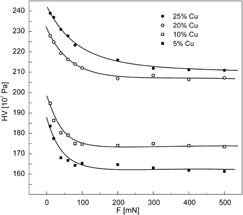
In this research, we performed experimental investigations of the influence of copper presence on hardness of arsenic triselenide (As2Se3)–arsenic triiodide (AsI3) pseudobinary glasses. The samples belong to the group of chalcogenide glasses, that, when compared with oxide glasses, can be synthesized much more easily in a wide variety of compositions, allowing also fine-tuning of their properties. Here, presence of iodine (I) facilitates glass formation, whereas addition of copper (Cu) creates possibility for interesting optoelectronic properties. As it is important to study mechanical properties of materials with respect to their fabrication and manipulation, we report results of instrumented indentation testing (IIT) of bulk samples of Cux[(As2Se3)0.9(AsI3)0.1]100−x with x = 5, 10, 20, and 25 at.% of Cu. This technique enables fast determination of indentation hardness, hardness value according to Vickers and indentation modulus directly from the indentation load–displacement curves. It was shown that all these parameters increase linearly with the increase of copper content. Improvement of the mechanical properties justifies the addition of Cu into the glass matrix.
Nanohybrid shish kebab (NHSK) structure, in which fibrous carbon nanotubes (CNTs) act as shish, while polymer lamellae as kebab, is of particular interest both scientifically and technologically. In this work, two types of CNTs with the same diameter range and different topography structure, namely multiwalled carbon nanotubes (MWNTs) with a relatively smooth surface and double-walled carbon nanotubes (DWNTs) bundles with a groove structure, were used to induce polyethylene (PE) crystallization for the formation of NHSK. For PE/MWNTs system, NHSK was formed only at a relatively low crystallization temperature (Tc), and PE lamellae are not completely perpendicular to the long axis of MWNTs. However, for PE/DWNTs bundles system, NHSK could be obtained even at a much higher Tc, and almost all the PE lamellae are perpendicular to CNTs long axis, due to the unique “groove structure” formed by DWNTs bundles. The enhanced nucleation ability and the facilitated lamellae orientation by using DWNTs bundles are not only of great crystallography interest but also are very important for functional design in nanodevice applications.
Phase structures and electrical properties of lead-free piezoelectric (1−x)(Bi0.5Na0.5)TiO3–x(K0.5Na0.5)NbO3 (BNT–xKNN) ceramics with 0.08 ≤ x ≤ 0.19 were systematically investigated. Results showed that a phase transition from a tetragonal to a pseudocubic phase occurred in this system, as KNN content increases. The addition of KNN shifted both the depolarization temperature Td and rhombohedral–tetragonal phase transition temperature TR-T to lower temperatures and tended to enhance the relaxor behavior of the ceramics, which was well explained by the microdomain–macrodomain transition theory with calculating criterion K. At x = 0.10–0.11, Td reached room temperature (RT), which accordingly induced an enhancement of the unipolar strain that peaks at a value of 0.22% was obtained. Furthermore, as the compositions (x = 0.12–0.15) have Td below RT, samples exhibited high electrostrictive response with large electrostrictive coefficient Q33 (0.017–0.019 m4/C2) and good thermostability comparable with that of traditional Pb-based electrostrictors.
Semiconductor quantum dots (QDs)-doped polystyrene (PS) microspheres with high luminescence were prepared using a self-assembly approach. Hydrophobic CdSe/ZnS QDs were first carboxylized by ligand exchange using mercaptocarboxylic acid. PS microspheres were separately encapsulated with polyethyleneimine via electrostatic interactions and then adsorbed with the carboxyl QDs to form QDs-doped microspheres. We then characterized the combinations using optical, electrical, and mechanical approaches and obtained the following findings: (i) microspheres can be fully coated by QD nanoparticles with a coverage rate of 1.0 pmole/cm2, in which QDs were evenly distributed on the surfaces; (ii) the anchored QDs exhibited similar optical property as they performed in isolated suspension; and (iii) the fluorescence of QDs-doped microspheres remained intact after stressed by ultrasound-induced cavitation, demonstrating the robustness of interactions between QDs and microspheres. The self-assembly approach developed in this study offered a facile and controllable strategy for preparation of QDs-encoded microparticles with high luminescence and stability.
Molsidomine is one of the sydnonimine class of antianginal drugs that due to its structure exhibits both dipolar nature and aromatic properties. To select efficient carrier for the drug, unmodified and modified mesoporous silica materials were synthesized using phenyltriethoxysilane and 3-aminopropyltriethoxysilane via cocondensation and grafting routes. Synthesis of the mesoporous silica materials via cocondensation was carried out in the presence of D-glucose as pore-forming agent. Equilibrium isotherms for the adsorption of mesoionic compound molsidomine on the mesoporous silica materials were analyzed by the Langmuir, Freundlich, Redlich-Peterson and Langmuir–Freundlich (Sips) models. Langmuir model is found to be the best to explain the equilibrium data. Comparative study of the adsorption properties of the unmodified and modified mesoporous silica materials demonstrated that the phenyl-modified silica materials are the most efficient adsorbents for molsidomine. They exhibit the highest adsorption capacity and affinity in relation to the mesoionic compound.
A new approach has been proposed to determine the interfacial toughness of soft-film hard-substrate systems based on wedge indentation experiments. In this approach, a comprehensive finite element study was undertaken to correct de Boer’s solutions, which were used to measure the wedge-indented interfacial toughness. Two-dimensional indentation simulations were first performed to systematically study the effects of the plastic properties of the films and the interfacial toughness itself on the correction factor for de Boer’s equations, which were used as closed-form solutions to evaluate the interfacial toughness. Further, three-dimensional simulations were used to investigate the effects of stress states on the interfacial toughness, which depends on the ratio of the indenter length to the film thickness. A universal correction expression for de Boer’s equations was obtained using a regression method. With this expression, a reverse algorithm was proposed to determine the interfacial toughness, and extensive numerical calculations were performed to verify that the present approach accurately evaluates the interfacial toughness. Finally, this new approach was applied to analyze the wedge indentation of low-k dielectric films, namely, methylsilsesquioxane and black diamond (BDTM) films, on a Si substrate.