To save content items to your account,
please confirm that you agree to abide by our usage policies.
If this is the first time you use this feature, you will be asked to authorise Cambridge Core to connect with your account.
Find out more about saving content to .
To save content items to your Kindle, first ensure no-reply@cambridge.org
is added to your Approved Personal Document E-mail List under your Personal Document Settings
on the Manage Your Content and Devices page of your Amazon account. Then enter the ‘name’ part
of your Kindle email address below.
Find out more about saving to your Kindle.
Note you can select to save to either the @free.kindle.com or @kindle.com variations.
‘@free.kindle.com’ emails are free but can only be saved to your device when it is connected to wi-fi.
‘@kindle.com’ emails can be delivered even when you are not connected to wi-fi, but note that service fees apply.
The main methods for treating the defect elasticity problems considered in this book are introduced. The chapter begins by reviewing the requirements that any solution for a defect elasticity problem must satisfy. A basic differential equation for the displacements whose solutions automatically satisfy these requirements is then formulated, and useful methods of solving it are described. These include its direct solution and various formalisms that expedite its solution under different conditions, including the Fourier transform approach, the Green's function method, and the sextic and integral formalisms.
Following this, the transformation strain method, which is applicable for many defect problems, is described. Here, the defect is introduced in the form of an appropriate stress-free transformation strain. The resulting elastic field is then found by methods involving the use of Green's functions or Fourier transforms.
Next, the stress function method for solving problems is introduced, and the Airy stress function method, which is applicable when plane strain conditions prevail, is described. Finally, the problem of finding solutions for defects in finite homogeneous regions bounded by interfaces, rather than in infinite regions, is outlined. The methods by which the boundary conditions at the interfaces, which exist in such cases, can be satisfied by the method of images and use of appropriate Green’s functions are described.
In Chapter 10, the force multipole and small inhomogeneous models for point defects in infinite homogeneous regions were described. The interaction of inhomogeneous inclusions with various types of stresses has been treated in Chapters 7 and 8. Consequently, there is no need in this chapter to devote further attention to interactions between point defects and stress in terms of the small inhomogeneous inclusion model. Attention is therefore focused on these interactions in terms of the force multipole model.
Section 11.2 includes a treatment of the interaction between a single point defect (represented by a force multipole) and a general internal or applied stress. In Section 11.3, the force multipole model is used to investigate the volume change due to a single point defect in a finite body possessing a traction-free surface, where the defect image stress can play an important role. Then, with Section 11.3 in hand, Section 11.4 takes up the particularly interesting problem of the behavior of a finite traction-free body filled with a statistically uniform distribution of point defects, which may, for example, be vacancies in thermal equilibrium or solute atoms dispersed throughout a solid solution. Analyses are given of the volume changes, macroscopic shape changes and lattice parameter changes (as measured by X-ray diffraction) produced by the defects. A demonstration is given of the intuitive result that a uniform concentration of point defects in a finite body with a traction-free surface produces a uniform average strain throughout the body. If the centers are spherically symmetric and act as centers of pure dilatation, the macroscopic body either expands or contracts uniformly throughout the body (depending upon whether the centers possess positive or negative strengths) with no change in body shape. If the centers possess lower symmetry, the body again expands or contracts uniformly but undergoes a macroscopic shape change, reflecting the symmetry of the defects.
Point defects in crystals can exist in many configurations. Substitutional point defects occupy substitutional lattice sites and include single vacancies (unoccupied substitutional sites) and single foreign solute atoms occupying substitutional sites in dilute solution. Interstitial point defects correspond to atoms occupying interstitial sites, i.e., sites in the interstices between substitutional sites. The interstitial atoms may be either foreign solute atoms, or the host atoms themselves: defects of the latter type are often referred to as self-interstitial defects. Small clusters at the atomic scale of any of these defect types also qualify as point defects. These clusters may consist entirely of substitutional atoms or entirely of interstitial atoms or may be of mixed character. For example, an undersized solute atom of one type may occupy a substitutional site and be bound to an undersized atom of another type occupying an adjacent interstitial site.
A common feature of all these defects is that they generally distort the host lattice and generate corresponding long-range stress and strain fields around them. If, for example, an embedded solute atom has a larger ion core radius than its host atoms it will, on average, push outwards against its near neighbors, causing a net expansion of the surrounding crystal, i.e., it will act as a positive center of dilatation. Conversely, a smaller solute atom will behave as a negative center. An interstitial atom is usually larger than the interstice in the lattice that it occupies and therefore acts as a positive center. On the other hand, the atoms around a vacancy often tend to relax inwards towards the vacant site causing the vacancy to act as a negative center. The symmetry of the surrounding stress field depends upon the symmetry of the point defect, as discussed later.
A unified introduction to the theory of anisotropic elasticity for static defects in crystals is presented. The term “defects” is interpreted broadly to include defects of zero, one, two, and three dimensionality: included are
Point defects (vacancies, self-interstitials, solute atoms, and small clusters of these species),
Line defects (dislocations),
Planar defects (homophase and heterophase interfaces),
Volume defects (inhomogeneities and inclusions).
The book is an outgrowth of a graduate course on “Defects in Crystals” offered by the author for many years at the Massachusetts Institute of Technology, and its purpose is to provide an introduction to current methods of solving defect elasticity problems through the use of anisotropic linear elasticity theory. Emphasis is put on methods rather than a wide range of applications and results. The theory generally allows multiple approaches to a given problem, and a particular effort is made to formulate and compare alternative treatments.
Anisotropic linear elasticity is employed throughout. This is now practicable because of significant advances in the theory of anisotropic elasticity for crystal defects that have been made over the last 35 years or so, including the development of Green's functions for unit point forces in infinite anisotropic spaces, half-spaces and joined dissimilar half-spaces. The use of anisotropic theory (rather than the simpler isotropic theory) is important, since, even though the results obtained by employing the two approaches often agree to within 25%, or so, there are many phenomena that depend entirely on elastic anisotropy. Unfortunately, however, the results obtained with the anisotropic theory are usually in the form of lengthy integrals that can be evaluated only using numerical methods and so lack transparency. To assist with this difficulty, isotropic elasticity is employed in parallel treatments of many problems where sufficiently simple conditions are assumed so that tractable analytic solutions can be obtained that are more transparent physically. Sections in the book where isotropic elasticity is employed are clearly distinguished to avoid confusion.
Fabrication of thin film nanocomposites via decomposition and self-assembly from the vapor phase is a promising path for cost-effective fabrication of multifunctional materials. In particular, oxides as a new class of energy materials allow for rich functionalities, e.g., by combining p- and n-doped systems in catalytic or light harvesting units. Combining A-site doped perovskites ABO3 with CoFe2O4 spinel, we have investigated thin film phase composition and nanocomposite morphology in the pseudobinary system La0.6Sr0.4BO3–CoFe2O4 for B = Fe, Co, and Mn. We observe formation of an epitaxial two-phase nanocomposite for B = Fe, i.e., the coexistence of La0.6Sr0.4FeO3 and CoFe2O4. In contrast, for B = Co or Mn nanocomposites are formed, where perovskite La0.6Sr0.4BO3 solid solutions coexists with Co-rich spinel and periclase phases. We derive conclusions for the preparation of perovskite-spinel nanocomposites with well-designed doping levels.
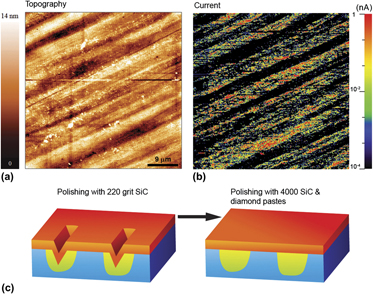
Electrical and electrochemical properties of the passive layer formed on 304L austenitic stainless steel are investigated by means of both conductive atomic force microscopy in air and electrochemical atomic force microscopy in chloride-containing media. The maps of local electrical conductivity of the oxide overlayer exhibit different patterns depending on the surface conditions after mechanical or electrochemical polishing. In particular, the passive film covering strain-hardened regions reveals a higher electrical conductivity. The local enhancement of the electrical conduction is explained by local changes of the stoichiometry of the passive film. Moreover, the highly conductive regions lead to a local breakdown of the native oxide in chloride-containing media and favor the initiation of localized pits.