To save content items to your account,
please confirm that you agree to abide by our usage policies.
If this is the first time you use this feature, you will be asked to authorise Cambridge Core to connect with your account.
Find out more about saving content to .
To save content items to your Kindle, first ensure no-reply@cambridge.org
is added to your Approved Personal Document E-mail List under your Personal Document Settings
on the Manage Your Content and Devices page of your Amazon account. Then enter the ‘name’ part
of your Kindle email address below.
Find out more about saving to your Kindle.
Note you can select to save to either the @free.kindle.com or @kindle.com variations.
‘@free.kindle.com’ emails are free but can only be saved to your device when it is connected to wi-fi.
‘@kindle.com’ emails can be delivered even when you are not connected to wi-fi, but note that service fees apply.
To improve the thermoelectric properties of LaCeFe3CoSb12 skutterudite materials, the LaCeFe3CoSb12 nanopowders of disordered structure were fabricated through a laser melting and quenching process and then were hot pressed into bulk pellets with the coexistence of ordered and disordered structures by mixing the disordered powders with the raw LaCeFe3CoSb12 crystalline materials. The results suggest that the introduced disordered structure can increase Seebeck coefficient from 57 to 179 μV/K while reduce thermal conductivity from 3.1 to 1.5 W/(m·K), although electrical conductivity can be decreased from 98,000 to 43,000 S/m, and consequently, figure of merit can be enhanced from 0.11 to 0.90 at 773 K. Therefore, fabricating a material with the coexistence of disordered and ordered structures can be considered as an effective way to obtain a high figure of merit, and this strategy can be also applied to other thermoelectric alloys.
Synchrotron time-resolved small-angle x-ray scattering studies were carried out on extruded sheets of linear low-density polyethylene (LLDPE) under tension. Stress–strain traces obtained simultaneously exhibited a double yield behavior. LLDPE initially exhibited lamellar morphology with a long period of 21.5 nm. Initial deformation increased the long period due to flow-induced crystallization. Between the first and second yield points, the lamellae were axially deformed by a slip process toward the tensile direction; off-meridional scattering was produced. In the second yield point region, there was a gradual rotation and thinning of the off-meridional scattering indicating that a shear process was destroying the lamellae. Simultaneously, amorphous scattering arise due to microvoids. Second, a weak meridional scattering was also produced. Strikingly, further deformation in the second yield region (SYR) increased the meridional long period suggesting a recrystallization process. From the cold-drawing region the long period decreased monotonically. The results suggest a melting and recrystallization process in the SYR.
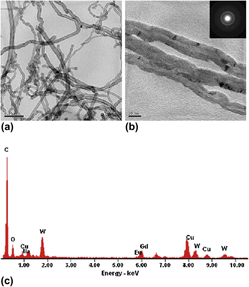
NaGd(WO4)2:Eu3+ nanotubes have been successfully synthesized by the hydrothermal method using carbon nanotubes (CNTs) as removable templates. X-ray diffraction, thermogravimetric and differential thermal analysis, transmission electron microscopy, and photoluminescence were used to characterize the product. It is demonstrated that CNTs are fully coated with an amorphous NaGd(WO4)2:Eu3+ layer, which is about 7 nm thick and almost continuous and uniform. After the NaGd(WO4)2:Eu3+/CNTs composites have been calcined at 500 or 600 °C, NaGd(WO4)2:Eu3+ nanotubes are obtained by removing the CNTs templates, and the outer diameter of that is about 40 nm. The luminescence properties of the NaGd(WO4)2:Eu3+ nanotubes calcined at various temperatures have been investigated. The results indicate that the products exhibit a characteristic red emission peak of Eu3+ ions at 615 nm. The emission intensity decreases with the increasing of annealing temperature, which is probably because a few residual carbons doped in NaGd(WO4)2:Eu3+ nanotubes and many oxygen vacancies could promote the intensity of red emission of Eu3+.
We report on the mechanical and electrical response of VO2 nanowires during the application of uniaxial tensile strain at room temperature. Stress–strain curves exhibit plateaus, which are characteristic of reversible transformations. The mechanical data are also discussed in terms of size effects, which is important for applications where the structural integrity is key to the performance of devices. Electrical measurements during straining show a distinct increase in resistivity at the M1–M2 transition, and a strong piezo-resistive effect for the M2 phase, disclosing new opportunities for future nanostructured devices. To our knowledge, this is the first time that piezoresistivity in the M2 phase has been reported.
The Berry phase, the existence of a topologically protected zero-energy level andthe anomalous quantum Hall effect are striking manifestations of the peculiar,‘ultrarelativistic’ character of charge carriers in graphene.
Another amazing property of graphene is the finite minimal conductivity, which isof the order of the conductance quantum e2/h per valley per spin (Novoselov etal., 2005a; Zhang et al., 2005). Numerousconsiderations of the conductivity of a two-dimensional massless Dirac fermiongas do give us this value of the minimal conductivity with an accuracy of somefactor of the order of one (Fradkin, 1986; Lee, 1993; Ludwig etal., 1994; Nersesyan, Tsvelik & Wenger, 1994; Ziegler, 1998;Shon & Ando, 1998; Gorbar et al., 2002; Yang &Nayak, 2002; Katsnelson, 2006a; Tworzydlo et al., 2006; Ryuet al., 2007).
It is really surprising that in the case of massless two-dimentional Diracfermions there is a finite conductivity for an ideal crystal,that is, in the absence of any scattering processes (Ludwig etal., 1994; Katsnelson, 2006a; Tworzydlo et al.,2006; Ryu et al., 2007). This was first noticed by Ludwiget al. (1994) using a quite complicated formalism ofconformal field theory (see also a more detailed and complete discussion in Ryuet al., 2007). After the discovery of the minimalconductivity in graphene (Novoselov et al., 2005a; Zhanget al., 2005) I was pushed by my experimentalist colleaguesto give a more transparent physical explanation of this fact, which has beendone in Katsnelson (2006a) on the basis of the concept ofZitterbewegung (Schrödinger, 1930) and the Landauerformula (Beenakker & van Houten, 1991; Blanter & Büttiker,2000).
Carbon is the sixth element in the Periodic Table. It has two stable isotopes,12C (98.9% of natural carbon) with nuclear spin I= 0 and, thus, nuclear magnetic momentμn = 0, and 13C (1.1% ofnatural carbon) with I = ½ andμn =0.7024μN(μN is the nuclear magneton), see Radzig& Smirnov (1985). Like most of the chemical elements, it originates fromnucleosynthesis in stars (for a review, see the Nobel lecture by Fowler (1984)).Actually, it plays a crucial role in the chemical evolution of the Universe.
The stars of the first generation produced energy only by proton–protonchain reaction, which results in the synthesis of one α-particle (nucleus4He) from four protons, p. Further nuclear fusion reactions mightlead to the formation of either of the isotopes 5He and5Li (p + α collisions) or of 8Be (α +α collisions); however, all these nuclei are very unstable. As was firstrealized by F. Hoyle, the chemical evolution does not stop at helium only due toa lucky coincidence – the nucleus 12C has an energy levelclose enough to the energy of three α-particles, thus, thetriple fusion reaction 3α → 12C,being resonant, has a high enough probability. This opens up a way to overcomethe mass gap (the absence of stable isotopes with masses 5 and 8) and providesthe prerequisites for nucleosynthesis up to the most stable nucleus,56Fe; heavier elements are synthesized in supernovaexplosions.
I do not think that I need to explain, in the preface to a book that is all aboutgraphene, what graphene is and why it is important. After the Nobel Prize forphysics in 2010, everybody should have heard something about graphene. I doneed, however, to explain why I wrote this book and what is special aboutit.
I hope it will not be considered a disclosure of insider information if I tellyou that Andre Geim is a bit sarcastic (especially with theoreticians). Everytime I mentioned that I was somewhat busy writing a book on graphene, he alwaysreplied ‘Go to amazon.com and search for“graphene”.’ Indeed, there are many books on graphene, manymore reviews and infinitely many collections of papers and conferenceproceedings (well, not really infinitely many . . . in the maintext I will use the mathematical terminology in a more rigorous way, I promise).Why, nevertheless, has this book been written and why may it be worthwhile foryou to read it?
Of course, this is a personal view of the field. I do love it, and it has been mymain scientific activity during the last seven years, from 2004 when graphenestarted to be the subject of intensive and systematic investigations. Luckily, Iwas involved in this development almost from the very beginning. It was afantastic experience to watch a whole new world coming into being and toparticipate in the development of a new language for this new world. I wouldlike to try to share this experience with the readers of this book.