To save content items to your account,
please confirm that you agree to abide by our usage policies.
If this is the first time you use this feature, you will be asked to authorise Cambridge Core to connect with your account.
Find out more about saving content to .
To save content items to your Kindle, first ensure no-reply@cambridge.org
is added to your Approved Personal Document E-mail List under your Personal Document Settings
on the Manage Your Content and Devices page of your Amazon account. Then enter the ‘name’ part
of your Kindle email address below.
Find out more about saving to your Kindle.
Note you can select to save to either the @free.kindle.com or @kindle.com variations.
‘@free.kindle.com’ emails are free but can only be saved to your device when it is connected to wi-fi.
‘@kindle.com’ emails can be delivered even when you are not connected to wi-fi, but note that service fees apply.
Over the next few decades, the challenge of water scarcity is expected to grow more acute as water demands from the power generation, agriculture, industrial, and municipal sectors all increase. Energy production requires copious amounts of water, with the volume of water used by power generation ranking second only to that used for agriculture. This article reviews options for managing the water requirements associated with power generation. Although the effects of both existing and emerging modes of power generation on water use trends are explored, the primary focus is on thermal systems, which account for the majority of existing capacity.
Energy-critical elements (ECEs) are chemical and isotopic species that are required for emerging sustainable energy sources and that might encounter supply disruptions. An oft-cited example is the rare-earth element neodymium used in high-strength magnets, but elements other than rare earths, for example, helium, are also considered ECEs. The relationships among abundance, markets, and geopolitics that constrain supply are at least as complex as the electronic and nuclear attributes that make ECEs valuable. In an effort to ensure supply for renewable-energy technologies, science decision makers are formulating policies to mitigate supply risk, sometimes without full view of the complexity of important factors, such as unanticipated market responses to policy, society’s needs for these elements in the course of basic research, and a lack of substitutes for utterly unique physical properties. This article places ECEs in historical context, highlights relevant market factors, and reviews policy recommendations made by various studies and governments. Actions taken by the United States and other countries are also described. Although availability and scarcity are related, many ECEs are relatively common yet their supply is at risk. Sustainable development requires informed action and cooperation between governments, industries, and researchers.
Perhaps the greatest challenge of the 21st century is to sustain the developmental needs of the world. The economic growth that occurred in developing countries over the past two decades is unprecedented. Materials science and engineering (MSE) innovations will continue to have a pivotal role as an enabling resource to address sustainable development needs. This article focuses on the opportunities for MSE in five key thematic areas: energy, transportation, housing, materials resources, and health.
Preparing the next generation of materials scientists and engineers requires more than teaching them knowledge of material properties and behaviors. Materials science and engineering must also take into account materials sustainability in the context of society and the environment, as discussed throughout this issue. Including topics such as sustainability in a materials curriculum is not new. Issues of ethics, costs, and so on have long been an integral part of our education. Although detailed treatment of all such topics cannot be included in a general materials education curriculum, the concepts of sustainable development and the role of materials in a sustainable future can be introduced. Indeed, many materials science programs are beginning to include these topics in their curricula. This article discusses three such programs that the authors have helped design and implement in the United States, each taking a different approach to engaging students in these topics. The intention is not to provide an exhaustive overview of education in sustainable development, but rather to describe a range of strategies that are currently being applied and to raise pertinent issues in materials science education.
Flowerlike hierarchical Bi2MoO6 and Bi2MoO6:Er3+ microspheres were synthesized by a hydrothermal method. The crystalline size of microspheres decreases with increasing Er3+ concentration. The incorporation of Er3+ has no evident influence on the morphology of Bi2MoO6. The photocatalytic activity of microspheres was evaluated by the degradation of rhodamine B (RhB) aqueous solution under simulated solar light. The best photocatalytic performance was observed when the Er3+ concentration was 0.5%. In addition to the aforementioned high photocatalytic activity, the Bi2MoO6:Er3+ microspheres can emit pure green upconversion (UC) luminescence (2H11/2/4S3/2 → 4I15/2) under 980 nm excitation. We suggest that the enhancement of photocatalytic activity of Bi2MoO6:Er3+(0.5%) is related to the UC luminescence of Er3+ ions. In addition, the BET surface areas of samples increased with increasing Er3+ concentration, which is also benefit for RhB adsorption.
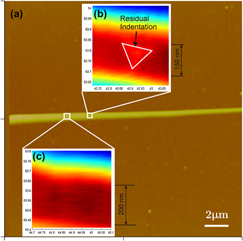
In this study, nanoindentation was utilized to measure the local, three-dimensional properties of Kevlar 49 and Kevlar KM2 on the length scales of the fiber microstructure. First, atomic force microscopy-based methods were used to explore the extent of property changes with respect to radial position in the fibers’ axial and hoop planes. From these measurements, no significant change in response was found for Kevlar 49 fibers, consistent with transverse isotropy. However, a reduced stiffness “shell” region (up to ∼300–350 nm thick) was observed for KM2 fibers. Instrumented indentation was then used to evaluate fiber response with respect to orientation and contact size and establish a critical contact size above which the response is independent of indenter size (i.e., “homogeneous” behavior). A previously proposed analytical method for indentation of a transversely isotropic material was used to estimate the local material properties of the Kevlar fibers from the measured homogeneous response.
A hyperbranched epoxy resin has been synthesized by using epichlorohydrin, bisphenol-A, and hyperbranched polyether polyol by a low-temperature polycondensation technique in the presence of a base. The reaction parameters of this polycondensation reaction were optimized, and 5 N aqueous sodium hydroxide solution, (54 ± 1) °C reaction temperature and 3 h reaction time were found to be the best. The degree of branching of the resin was found to be 0.57 as determined from 13C nuclear magnetic resonance spectroscopy (Fig. 3). This hyperbranched epoxy resin was cured with poly(amido amine) hardener at 120 °C for a specified period of time. The resin exhibits very good crosscut adhesive strength (100%). The cured films showed moderate impact strength (60 cm), good scratch resistance (5.5 kg), good gloss (82 at 60°), thermostability up to 270 °C, and good chemical resistance in various chemical media. All these results indicate its suitability to be used as an advanced surface coating material.
The divalent alkaline-earth metal hexaboride MB6 (M = Ca, Sr, Ba) one-dimensional (1D) nanostructures are promising n-type thermoelectric materials for high temperature power generation. Understanding fundamental physical and mechanical properties of these new nanostructures is critical for their future applications. Current work focuses on reliable study of mechanical properties of MB6 1D nanostructures by nanoindentation. Factors affecting the measured nanostructure-on-substrate system modulus, such as the stiffness of a supporting substrate, the width and cross section of a nanostructure, the interaction between a nanostructure and a substrate, were systematically studied by both experimental investigation and numerical simulation. The intrinsic modulus of a nanostructure, extracted from the measured system modulus, was determined between two bounds set by the receding contact and the perfect bond interaction between a nanostructure and a substrate, respectively. The extracted modulus increases as the width-to-thickness ratio of a nanostructure increases from 1 to 2.
Thin films of Ni-49 at.%Ti were deposited by DC magnetron sputtering on silicon substrates at 300 °C. The as-deposited amorphous films were annealed at a vacuum of 10−6 mbar at various temperatures between 300 and 650 °C to study the effect of annealing on microstructure and mechanical properties. The as-deposited films showed partial crystallization on annealing at 500 °C. At 500 °C, a distinct oxidation layer, rich in titanium but depleted in Ni, was seen on the film surface. A gradual increase in thickness and number of layers of various oxide stoichiometries as well as growth of triangular shaped reaction zones were seen with increase in annealing temperature up to 650 °C. Nanoindentation studies showed that the film hardness values increase with increase in annealing temperature up to 600 °C and subsequently decrease at 650 °C. The results were explained on the basis of the change in microstructure as a result of oxidation on annealing.
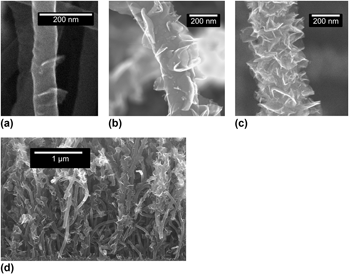
Graphene and carbon nanotubes (CNTs) are fascinating materials, both scientifically and technologically, due to their exceptional properties and potential use in applications ranging from high-frequency electronics to energy storage devices. This manuscript introduces a hybrid structure consisting of graphitic foliates grown along the length of aligned multiwalled CNTs. The foliate density and layer thickness vary as a function of deposition conditions, and a model is proposed for their nucleation and growth. The hybrid structures were studied using electron microscopy and Raman spectroscopy. The foliates consist of edges that approach the dimensions of graphene and provide enhanced charge storage capacity. Electrochemical impedance spectroscopy indicated that the weight-specific capacitance for the graphenated CNTs was 5.4× that of similar CNTs without the graphitic foliates. Pulsed charge injection measurements demonstrated a 7.3× increase in capacitance per unit area. These data suggest that this unique structure integrates the high surface charge density of the graphene edges with the high longitudinal conductivity of the CNTs and may have significant impact in charge storage and related applications.
Optimizing thermoelectric (TE) materials and modules are important factors, which can lead to widespread adoption of waste heat recovery systems. The analytic co-optimization of the TE leg, heat sink, and the load resistance shows that all parameters entering the figure-of-merit (Z) do not have the same impact on cost/performance trade-off. Thermal conductivity of the TE material plays a more important role than the power factor. This study also explores the impact of heat losses and the required contact resistances. Finally, we present the theoretical cost performance ($/W) of TE waste heat recovery systems for vehicle waste heat recovery application, assuming hot side gas temperature of 600 °C and a cooling water temperature of 60 °C.
Load-bearing, mechanically active tissues are routinely subjected to nonlinear mechanical deformations. Consequently, these tissues exhibit complex mechanical properties and unique tissue organizations. Successful engineering of mechanically active tissues relies on the integration of the mechanical sensing mechanism found in the native tissues into polymeric scaffolds. Intelligent biomaterials that closely mimic the structural organizations and multi-scale responsiveness of the natural extracellular matrices, when strategically combined with multipotent cells and dynamic culture devices that generate physiologically relevant physical forces, will lead to the creation of artificial tissues that are mechanically robust and biologically functional.
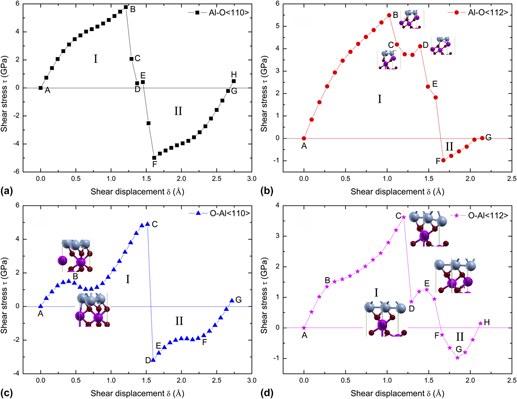
First-principle calculations are performed to investigate the mechanical shear strength and sliding characteristic of Ni(111)/α-Al2O3(0001) interfaces. Two types of interface models are considered, i.e., Al-terminated O-site and O-terminated Al-site models. Mechanical properties such as theoretical shear strength, unstable stacking energy, and critical displacement are examined. It is found that the shear deformation of the Ni/Al2O3 interfaces takes place by a process of successive breaking and rebonding of the Al–O bonds near the Al2 or Al3 atom inside the α-Al2O3 block accompanying the sliding of Ni atomic layer, and finally the Ni/Al2O3 interfaces fail between the Ni atomic layer. Relatively, the Al–O interface possesses a superior shear resistance than the O–Al interface. In addition, the mechanical shear strength and tensile strength are discussed, together with the potential usage of these theoretical results that could offer in fabricating actual thermal barrier coating systems and in analyzing their mechanical response.
Supercritical fluid (SCF) N2 was used as a physical foaming agent to fabricate microcellular injection-molded poly(hydroxybutyrate-co-hydroxyvalerate) (PHBV)–poly(butylene adipate-co-terephthalate) (PBAT)–hyperbranched-polymer (HBP)–nanoclay (NC) bionanocomposites. The effects of incorporating HBP and NC on the morphological, mechanical, and thermal properties of both solid and microcellular PHBV–PBAT blends were studied. NC exhibited intercalated structures in solid components, but showed a mixture of exfoliated and intercalated structures in the corresponding microcellular nanocomposites. The addition of NC improved the thermal stability of the resulting nanocomposites. The addition of HBP and NC reduced the cell size and increased the cell density of microcellular components. The addition of HBP and NC enhanced the degree of crystallinity for both solid and microcellular components. Moreover, with the addition of HBP, the area under tan δ curve, specific fracture toughness, and strain-at-break of the PHBV-based nanocomposite increased significantly whereas the storage modulus, specific Young’s modulus, and specific tensile strength decreased.
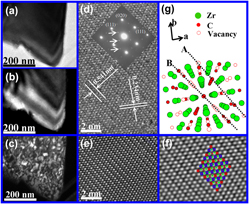
We report here investigations on the superstructure modulation induced by the ordering of carbon vacancies in the nonstoichiometric zirconium carbide of ZrC0.61, which was prepared by spark plasma sintering (SPS) of the mechanochemically synthesized ZrCx nanopowders. The sintered ZrC0.61 is found to exhibit an interesting microstructure of interlaced laminated sheets. In contrast to the previous long duration post annealing for realization of the ordered carbon vacancies in the rocksalt-structured transition metal carbide, the ordered carbon vacancies are directly obtained during the SPS process, and no post-annealing period is necessary. With the help of transmission electron microscopy, the superstructural nanodomains with the average size of ∼30 nm are identified.
In this study, crystal orientation and polymorphism formation in electrospun poly(vinylidene fluoride) (PVDF)/polyacrylonitrile (PAN) blend fibers after melt-recrystallization were studied. To achieve uniform alignment of electrospun fibers, mechanical stretching was applied to the as-spun nonwoven fibers at 110 °C. Pure ferroelectric β-PVDF crystals in the PAN matrix were achieved, and both polar β-PVDF and polar PAN crystals oriented with their chain axes parallel to the fiber axes. After melt-recrystallization of PVDF, a significant amount of ferroelectric β crystals was retained in addition to the formation of nonpolar α crystals. A polarized Fourier transform infrared study showed that the degree of orientation of ferroelectric β-PVDF crystals was higher than that of nonpolar α crystals, suggesting that the β-PVDF crystals should form at the PVDF/PAN interfaces because of strong dipolar and hydrogen bonding interactions between vinylidene fluoride and acrylonitrile units. The nonpolar α-PVDF crystals should form in the center of PVDF domains.
This study investigated the performance of membrane electrode assembly (MEA) fabricated with various loadings of platinum catalyst on carbon nanotubes (CNTs) and sulfonated membrane at constant conditions of duration, temperature and pressure. The fabricated MEA was tested in a single proton exchange membrane (PEM) fuel cell unit using hydrogen and oxygen as fuel and oxidant gases respectively. The results obtained show that the performance of the MEA in the cell improves with increase in loading of the catalyst on the electrodes. The results obtained on kinetics of the fuel cell indicate that the MEA samples fabricated with 30 and 40 wt% Pt catalyst electrodes conform to the Tafel equation whereas the remaining MEA fabricated with 10 and 20 wt% catalyst samples do not obey the Tafel equation due to large values of their overpotential. Hirschenhofer and Tafel equations were used to model the performance of the catalyst electrodes in the cell and the simulated voltage obtained from the former showed better conformity with the experimental voltage than the latter.
Poly(lactide) (PLA) composites filled with electrospun nylon 6 fibers were prepared. This allowed us to simultaneously improve the mechanical properties and tune the degradation of the PLA matrix. The interfacial adhesion between the PLA matrix and the nylon fibers was good. The major effect of electrospun fibers on the matrix was that of modifying the semicrystalline framework, thickening the polymer lamellae. This allowed an increase in the mechanical properties of the material, and on the other hand to modify its degradation behavior. The modulus of the composites was increased up to 3-fold with respect to neat PLA. The peculiar morphology of matrix–filler interaction moreover slowed down the degradation rate of the material and improved the dimensional stability of the specimens during the degradation process. This shows the potential of electrospun fibers as a way to tune the durability of PLA-based products, widening the range of application of this promising material.