To save content items to your account,
please confirm that you agree to abide by our usage policies.
If this is the first time you use this feature, you will be asked to authorise Cambridge Core to connect with your account.
Find out more about saving content to .
To save content items to your Kindle, first ensure no-reply@cambridge.org
is added to your Approved Personal Document E-mail List under your Personal Document Settings
on the Manage Your Content and Devices page of your Amazon account. Then enter the ‘name’ part
of your Kindle email address below.
Find out more about saving to your Kindle.
Note you can select to save to either the @free.kindle.com or @kindle.com variations.
‘@free.kindle.com’ emails are free but can only be saved to your device when it is connected to wi-fi.
‘@kindle.com’ emails can be delivered even when you are not connected to wi-fi, but note that service fees apply.
We report on the synthesis of unique tetragonal nanostructures from porous anodic aluminum oxide that enables geometrical three-dimensional (3D) microdesign of the porous surfaces. Scanning electron microscopy study revealed self-organization of hollow oxide nanostructures into hierarchical arrays. The formation of these structures has a localized nature and is associated with local electrical break-down during hard anodization of aluminum in oxalic acid solution. Moreover, in this communication we propose the mechanism of the nucleation and growth of complex 3D structures from porous anodic alumina.
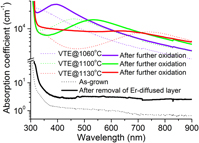
Intense broad absorption bands centered around 1.7, 2.5, 3.1, and 3.7 eV take place in Er3+-diffused layer formed near MgO (5 mol%)-doped LiNbO3 crystal surface by in-diffusion of Er metal under Li-poor atmosphere. These bands are tentatively attributed to the defect absorption of small polarons, bipolarons, F-centers, and Q-polarons created due to Er3+ in-diffusion and Li2O loss from the crystal. It is interesting that the number, type, area, and peaking position of the bands can be controlled by the diffusion temperature and further oxidation treatment. Such material is a promising medium for data storage based upon two-color holography.
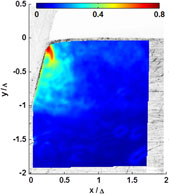
We study strain fields and deformation patterns produced by wedge indentation of metals using high-resolution imaging, image correlation and simulation. A long-standing problem associated with simulation of narrow angle wedge indentation is overcome by introducing a weak form of the symmetry boundary conditions. The simulated deformation fields show good agreement with experiment. Based on strain localization, three distinct modes of deformation largely cover the range of wedge angles. Importantly, narrow angle wedge indentation is characterized by intense strain localization at points close to the free surface and thus offers a possible new tool to probe strain gradient effects.
The ground-state structural, electronic, magnetic, optical and dielectric properties of MnTiO3 are calculated using density functional theory within the generalized gradient approximation. The structure parameters obtained agree well with experimental results. The electronic structure results show that the G-type antiferromagnetic phase of LN-type MnTiO3 has an indirect band gap of 0.85 eV. The calculated local magnetic moment of Mn ion is 4.19 μB. The calculated Born effective charges (BECs, denoted by tensor Z*) show that the Z* of Ti and O atoms are significantly and anomalously large. Interestingly, ferroelectric spontaneous polarization of large magnitude is predicted to be along [111] direction with a magnitude of 87.95–105.22 μC/cm2. B-site Ti ions in 3 d0 state dominate ferroelectric polarization of multiferroic MnTiO3, whereas A-site Mn ions having partially filled 3 d5 orbitals are considered to contribute to its antiferromagnetic properties. Furthermore, it is predicted that multiferroic MnTiO3 shows good dielectric and optical properties.
Organic–inorganic interfaces exist in many natural or synthetic materials, such as mineral–protein interfaces found in bone and epoxy–silica interfaces found in concrete construction. Here, we report a model to predict the intrinsic strength between organic and inorganic materials, based on a molecular dynamics simulation approach combined with the metadynamics method, used to reconstruct the free energy surface between attached and detached states of the bonded system and scaled up to incorporate it into a continuum model. We apply this technique to model an epoxy–silica system that primarily features nonbonded and nondirectional van der Waals and Coulombic chemical interactions. The intrinsic strength between epoxy and silica derived from the molecular level is used to predict the structural behavior of epoxy–silica interface at the macroscopic length scale by invoking a finite element approach using a cohesive zone model which shows a good agreement with existing experimental results.
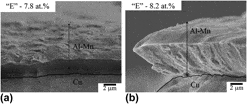
Nanostructured Al–Mn alloys are proposed as high-strength low-density materials, which can be electroformed (i.e., produced electrolytically and removed from the substrate) from ionic liquid. A variety of current waveforms, including direct current (DC) and pulsed current (PC), are used to electrodeposit nanostructured Al–Mn alloys, with some PC methods producing significant improvements in film ductility. Transmission electron microscopy observations point to a number of structural advantages induced by PC that apparently ductilize the Al–Mn alloys: (i) grain refinement to the nanocrystalline range without the introduction of a competing amorphous phase, (ii) unimodal nanocrystalline grain size distribution, and (iii) more homogeneous structure. The significant increase in apparent ductility in the PC alloys is also apparently related to stress- or deformation-induced grain growth, which leads to alloys with unique combinations of specific hardness and film ductility.
Low-carbon sheet steel may be finished by hot rolling or cold rolling. Hot-rolled steel has a rougher surface finish that limits its use to applications in which surface appearance is not important (e.g., auto underbodies and firewalls). Cold-rolled steels are almost always recrystallized before sale to fabricators. They are therefore softer than hot-rolled steels and have a much better surface finish.
Usually aluminum is added to molten low-carbon steel as it is poured. Without the addition of aluminum, dissolved oxygen would react with dissolved carbon to from CO. This reaction is violent, the CO bubbles causing steel droplets to fly into the air where they ignite. This process is called killing the steel and the steel called killing. AKDQ (aluminum-killed, drawing quality) is the designation for most of the steel sheet used in forming operations. The amount of oxygen that can dissolve in molten steel decreases with increasing carbon contents, as shown in Figure 15.1. Therefore, killing is not required for higher carbon contents. Today almost all low-carbon steel is continuously cast. AKDQ sheets usually contain 0.03% C or less.
Throughout history, magnetism has seemed a mysterious phenomenon. The discovery of lodestone (Fe3O4) led to many myths (Figure 22.1). Probably the first real use of the magnetic phenomenon should be attributed to the Vikings. Their development of the magnetic compass enabled them to travel far at sea even in foggy conditions. The term magnetic behavior usually means ferromagnetic behavior. There are actually two other types of magnetic behavior: diamagnetic behavior, which is a weak repulsion of a magnetic field, and paramagnetism, which is a weak attraction of a magnetic field.
Ferromagnetism, in contrast, is a strong attraction of a magnetic field. There are only a few ferromagnetic elements. The important ones are iron, nickel, and cobalt. A few rare earths are ferromagnetic at low temperatures. Table 22.1 lists all of the ferromagnetic elements and the temperature above which they cease to be ferromagnetic (Curie temperature).
The terms iron and steel are often confusing to the general public. Iron is an element (26 on the periodic table). The word iron comes from the Scandinavian word iarn. The chemical symbol Fe comes from the Latin word for iron, ferrum. The French word for iron is fer, the German word, Eisen. The Dutch word is ijzeret, and the Spanish is hierro.
The word steel is used to describe almost all alloys of iron. It is often said that steel is an alloy of iron and carbon. However, many steels contain almost no carbon. Carbon contents of some steels are as low as 0.002% by weight. The most widely used steels are low-carbon steels that have less than 0.06% carbon. Low-carbon steels are used for automobile bodies, appliances, cans, and cabinets. Higher carbon contents are used in steel with higher strengths. Tools are made from steels containing up to about 1.2% carbon.
The Sanskrit word for steel is stakati. The German word is Stahl; the Russian, stalin; the French, acier; the Spanish acero and the Dutch, staal. Chalybs is the Latin word for steel.
Stainless steels are characterized by a very good aqueous corrosion resistance and by a very good resistance to oxidation at high temperatures. All stainless steels contain at least 11% Cr. Many contain nickel as well. For the aqueous corrosion resistance, the steels must contain a minimum of 11.5% chromium, which makes them passive in oxidizing solutions. Even more chromium is required for passivity in nonoxidizing solutions. Unless the chromium content is sufficient for passivity, the corrosion resistance of stainless steels is similar to steels without any chromium. Table 19.1 is a galvanic series of alloys. It shows that stainless steels may occupy two positions corresponding to the active and passive conditions.
There are five major types of stainless steels: ferritic, martensitic, austenitic, duplex, and precipitation hardenable.