Refine search
Actions for selected content:
106129 results in Materials Science
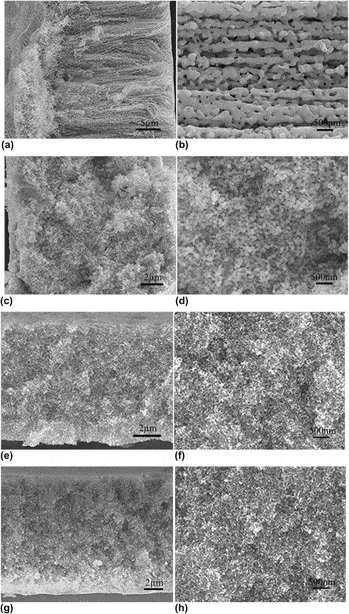
Formation and control of nanoporous Ag through electrochemical dealloying of the melt-spun Cu-Ag-Ce alloys
-
- Journal:
- Journal of Materials Research / Volume 27 / Issue 12 / 28 June 2012
- Published online by Cambridge University Press:
- 10 May 2012, pp. 1612-1620
- Print publication:
- 28 June 2012
-
- Article
- Export citation
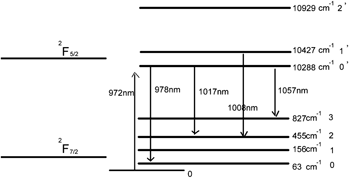
The spectroscopic investigation of ZnWO4: Yb3+ single crystal
-
- Journal:
- Journal of Materials Research / Volume 27 / Issue 16 / 28 August 2012
- Published online by Cambridge University Press:
- 10 May 2012, pp. 2096-2100
- Print publication:
- 28 August 2012
-
- Article
- Export citation
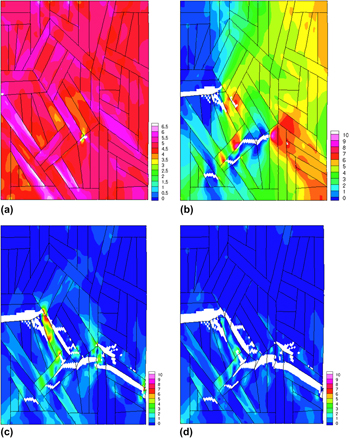
Optimal microstructures for martensitic steels
-
- Journal:
- Journal of Materials Research / Volume 27 / Issue 12 / 28 June 2012
- Published online by Cambridge University Press:
- 10 May 2012, pp. 1598-1611
- Print publication:
- 28 June 2012
-
- Article
- Export citation

Thermal conductivity of tunable lamellar aluminum oxide/polymethyl methacrylate hybrid composites
-
- Journal:
- Journal of Materials Research / Volume 27 / Issue 14 / 28 July 2012
- Published online by Cambridge University Press:
- 09 May 2012, pp. 1869-1876
- Print publication:
- 28 July 2012
-
- Article
- Export citation

Interfacial defects distribution and strain coupling in the vertically aligned nanocomposite YBa2Cu3O7-X/ BaSnO3 thin films
-
- Journal:
- Journal of Materials Research / Volume 27 / Issue 13 / 14 July 2012
- Published online by Cambridge University Press:
- 09 May 2012, pp. 1763-1769
- Print publication:
- 14 July 2012
-
- Article
- Export citation

Effects of PbO insert layer on the microstructure and energy storage performance of (042)-preferred PLZT antiferroelectric thick films
-
- Journal:
- Journal of Materials Research / Volume 27 / Issue 13 / 14 July 2012
- Published online by Cambridge University Press:
- 09 May 2012, pp. 1770-1775
- Print publication:
- 14 July 2012
-
- Article
- Export citation

Silicon carbide-induced piezoelectric β-phase in poly(vinylidene fluoride) and its properties
-
- Journal:
- Journal of Materials Research / Volume 27 / Issue 14 / 28 July 2012
- Published online by Cambridge University Press:
- 09 May 2012, pp. 1838-1845
- Print publication:
- 28 July 2012
-
- Article
- Export citation
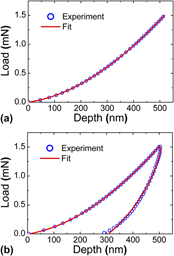
Determination of shear creep compliance of linear viscoelastic solids by instrumented indentation when the contact area has a single maximum
-
- Journal:
- Journal of Materials Research / Volume 27 / Issue 12 / 28 June 2012
- Published online by Cambridge University Press:
- 09 May 2012, pp. 1565-1572
- Print publication:
- 28 June 2012
-
- Article
- Export citation
Iron and Steel
-
- Published online:
- 05 May 2012
- Print publication:
- 23 April 2012
Graphene
- Carbon in Two Dimensions
-
- Published online:
- 05 May 2012
- Print publication:
- 05 April 2012
Introduction to Elasticity Theory for Crystal Defects
-
- Published online:
- 05 May 2012
- Print publication:
- 12 April 2012
-
- Book
- Export citation

Influence of the deposition temperature on electronic transport and structural properties of radio frequency magnetron-sputtered Zn1-xMgxO:Al and ZnO:Al films
-
- Journal:
- Journal of Materials Research / Volume 27 / Issue 17 / 14 September 2012
- Published online by Cambridge University Press:
- 04 May 2012, pp. 2249-2256
- Print publication:
- 14 September 2012
-
- Article
- Export citation
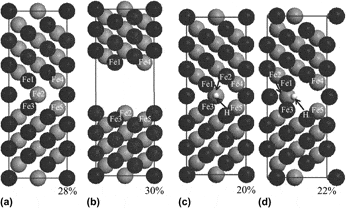
Enhanced grain boundary embrittlement of an Fe grain boundary segregated by hydrogen (H)
-
- Journal:
- Journal of Materials Research / Volume 27 / Issue 12 / 28 June 2012
- Published online by Cambridge University Press:
- 04 May 2012, pp. 1589-1597
- Print publication:
- 28 June 2012
-
- Article
- Export citation
-
First-principles fully relaxed tensile and shear test simulations were performed on
![$\Sigma {\rm{3(111)/[1{ \overline 1} 0]}}$](//static.cambridge.org/binary/version/id/urn:cambridge.org:id:binary:20151128093111623-0891:S0884291412001112_inline1.gif?pub-status=live) tilt Fe grain-boundaries (GBs) with and without hydrogen (H) segregation, to investigate the mechanisms of GB embrittlement enhanced by H segregation. Premature fracture was found in the H-segregated GB, compared with the clean GB, in the tensile test simulations. The Fe–H bond showed covalent-like and ion-like characteristics. The covalent-like characteristics reinforced the Fe–Fe bonds, but the ion-like characteristics weakened the Fe–Fe bonds as a result of charge transfer. The effect of the latter increased with increasing strain, and prevailed over the former, resulting in GB embrittlement. In the shear test simulations, variation in the GB energy for the H-segregated GB was almost the same as that for the clean GB. This is because bond-breaking and rebonding occur concurrently in GB shearing and the variations in charge transfer during shear straining are less than those during tensile straining.
tilt Fe grain-boundaries (GBs) with and without hydrogen (H) segregation, to investigate the mechanisms of GB embrittlement enhanced by H segregation. Premature fracture was found in the H-segregated GB, compared with the clean GB, in the tensile test simulations. The Fe–H bond showed covalent-like and ion-like characteristics. The covalent-like characteristics reinforced the Fe–Fe bonds, but the ion-like characteristics weakened the Fe–Fe bonds as a result of charge transfer. The effect of the latter increased with increasing strain, and prevailed over the former, resulting in GB embrittlement. In the shear test simulations, variation in the GB energy for the H-segregated GB was almost the same as that for the clean GB. This is because bond-breaking and rebonding occur concurrently in GB shearing and the variations in charge transfer during shear straining are less than those during tensile straining.
![$\Sigma {\rm{3(111)/[1{ \overline 1} 0]}}$](http://static.cambridge.org/binary/version/id/urn:cambridge.org:id:binary:20151128093111623-0891:S0884291412001112_inline1.gif?pub-status=live) tilt Fe grain-boundaries (GBs) with and without hydrogen (H) segregation, to investigate the mechanisms of GB embrittlement enhanced by H segregation. Premature fracture was found in the H-segregated GB, compared with the clean GB, in the tensile test simulations. The Fe–H bond showed covalent-like and ion-like characteristics. The covalent-like characteristics reinforced the Fe–Fe bonds, but the ion-like characteristics weakened the Fe–Fe bonds as a result of charge transfer. The effect of the latter increased with increasing strain, and prevailed over the former, resulting in GB embrittlement. In the shear test simulations, variation in the GB energy for the H-segregated GB was almost the same as that for the clean GB. This is because bond-breaking and rebonding occur concurrently in GB shearing and the variations in charge transfer during shear straining are less than those during tensile straining.
tilt Fe grain-boundaries (GBs) with and without hydrogen (H) segregation, to investigate the mechanisms of GB embrittlement enhanced by H segregation. Premature fracture was found in the H-segregated GB, compared with the clean GB, in the tensile test simulations. The Fe–H bond showed covalent-like and ion-like characteristics. The covalent-like characteristics reinforced the Fe–Fe bonds, but the ion-like characteristics weakened the Fe–Fe bonds as a result of charge transfer. The effect of the latter increased with increasing strain, and prevailed over the former, resulting in GB embrittlement. In the shear test simulations, variation in the GB energy for the H-segregated GB was almost the same as that for the clean GB. This is because bond-breaking and rebonding occur concurrently in GB shearing and the variations in charge transfer during shear straining are less than those during tensile straining.Transparent conductive materials head toward the post-Si era: http://www.tcm2012.org
-
- Journal:
- MRS Bulletin / Volume 37 / Issue 5 / May 2012
- Published online by Cambridge University Press:
- 09 May 2012, p. 530
- Print publication:
- May 2012
-
- Article
-
- You have access
- HTML
- Export citation
Course on “Materials for renewable energy” to be held in Italy: http://www.ct.infn.it/∼terrasi/erice2012.html
-
- Journal:
- MRS Bulletin / Volume 37 / Issue 5 / May 2012
- Published online by Cambridge University Press:
- 09 May 2012, p. 530
- Print publication:
- May 2012
-
- Article
-
- You have access
- HTML
- Export citation
EC releases report analyzing strategic energy technologies: http://ec.europa.eu/dgs/jrc
-
- Journal:
- MRS Bulletin / Volume 37 / Issue 5 / May 2012
- Published online by Cambridge University Press:
- 09 May 2012, p. 467
- Print publication:
- May 2012
-
- Article
-
- You have access
- HTML
- Export citation

Computational aspects of many-body potentials
-
- Journal:
- MRS Bulletin / Volume 37 / Issue 5 / May 2012
- Published online by Cambridge University Press:
- 09 May 2012, pp. 513-521
- Print publication:
- May 2012
-
- Article
- Export citation
Meet our Authors
-
- Journal:
- MRS Bulletin / Volume 37 / Issue 5 / May 2012
- Published online by Cambridge University Press:
- 09 May 2012, pp. 474-476
- Print publication:
- May 2012
-
- Article
-
- You have access
- HTML
- Export citation
Nano Focus: Nanoporous carbon electrode supercapacitors store more charge by efficiently adsorbing electrolyte ions
-
- Journal:
- MRS Bulletin / Volume 37 / Issue 5 / May 2012
- Published online by Cambridge University Press:
- 09 May 2012, p. 463
- Print publication:
- May 2012
-
- Article
-
- You have access
- HTML
- Export citation
Congressional Fellows Povlich and Nekuda Malik shape their interests in policy: http://www.mrs.org/congressional-fellows
-
- Journal:
- MRS Bulletin / Volume 37 / Issue 5 / May 2012
- Published online by Cambridge University Press:
- 09 May 2012, p. 528
- Print publication:
- May 2012
-
- Article
-
- You have access
- HTML
- Export citation
