Refine search
Actions for selected content:
26077 results in Abstract analysis
Mean-values of the Riemann zeta-function
- Part of
-
- Journal:
- Mathematika / Volume 42 / Issue 1 / June 1995
- Published online by Cambridge University Press:
- 26 February 2010, pp. 158-174
- Print publication:
- June 1995
-
- Article
- Export citation
-
Let
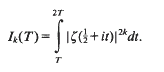
Asymptotic formulae for Ik(T) have been established for the cases k=1 (Hardy-Littlewood, see [13]) and k = 2 (Ingham, see [13]). However, the asymptotic behaviour of Ik(T) remains unknown for any other value of k (except the trivial k = 0, of course). Heath-Brown, [6], and Ramachandra, [10], [11], independently established that, assuming the Riemann Hypothesis, when 0≤K≤2, Ik(T) is of the order T(log T)k2 One believes that this is the right order of magnitude for Ik(T) even when k = 2 and indeed expects an asymptotic formula of the form

where Ck is a suitable positive constant. It is not clear what the value of Ck should be.
A lattice without a basis of minimal vectors
- Part of
-
- Journal:
- Mathematika / Volume 42 / Issue 1 / June 1995
- Published online by Cambridge University Press:
- 26 February 2010, pp. 175-177
- Print publication:
- June 1995
-
- Article
- Export citation
Baire trees, bad norms and the Namioka property
- Part of
-
- Journal:
- Mathematika / Volume 42 / Issue 1 / June 1995
- Published online by Cambridge University Press:
- 26 February 2010, pp. 30-42
- Print publication:
- June 1995
-
- Article
- Export citation
MTK volume 42 issue 1 Cover and Front matter
-
- Journal:
- Mathematika / Volume 42 / Issue 1 / June 1995
- Published online by Cambridge University Press:
- 26 February 2010, pp. f1-f4
- Print publication:
- June 1995
-
- Article
-
- You have access
- Export citation
Infima of hyperspace topologies
- Part of
-
- Journal:
- Mathematika / Volume 42 / Issue 1 / June 1995
- Published online by Cambridge University Press:
- 26 February 2010, pp. 67-86
- Print publication:
- June 1995
-
- Article
- Export citation
Ascendant subgroups of factorized FC-groups
- Part of
-
- Journal:
- Mathematika / Volume 42 / Issue 1 / June 1995
- Published online by Cambridge University Press:
- 26 February 2010, pp. 188-189
- Print publication:
- June 1995
-
- Article
- Export citation
Some examples of groups with no non-trivial action on a Λ-tree
- Part of
-
- Journal:
- Mathematika / Volume 42 / Issue 1 / June 1995
- Published online by Cambridge University Press:
- 26 February 2010, pp. 214-219
- Print publication:
- June 1995
-
- Article
- Export citation
Symbolic powers and local cohomology
- Part of
-
- Journal:
- Mathematika / Volume 42 / Issue 1 / June 1995
- Published online by Cambridge University Press:
- 26 February 2010, pp. 182-187
- Print publication:
- June 1995
-
- Article
- Export citation
-
Let I be an ideal of a Noetherian ring R. The purpose of this paper is to study the relationship between the vanishing of the local cohomology modules
 , and the comparison of the topologies defined by the I-adic {In}n≥0, the symbolic {I(n)}n≥0 and the integral filtration
 , and the comparison of the topologies defined by the I-adic {I
On metrizable E with Cp(E) ≇ Cp(E) × Cp(E)
- Part of
-
- Journal:
- Mathematika / Volume 42 / Issue 1 / June 1995
- Published online by Cambridge University Press:
- 26 February 2010, pp. 49-55
- Print publication:
- June 1995
-
- Article
- Export citation
How do convex bodies sit?
- Part of
-
- Journal:
- Mathematika / Volume 42 / Issue 1 / June 1995
- Published online by Cambridge University Press:
- 26 February 2010, pp. 178-181
- Print publication:
- June 1995
-
- Article
- Export citation
A sharp inequality of Halász type for the mean value of a multiplicative arithmetic function
- Part of
-
- Journal:
- Mathematika / Volume 42 / Issue 1 / June 1995
- Published online by Cambridge University Press:
- 26 February 2010, pp. 144-157
- Print publication:
- June 1995
-
- Article
- Export citation
-
Let g(n) be a complex valued multiplicative function such that |g(n)| ≤ 1. In this paper we shall be concerned with the validity of the inequality

under the weak condition g(p)∈
 for all primes p, where is a fixed subset of the closed unit disc
  Thus our point of view is similar to that of Halász [Hz 2] in that we seek a general inequality in terms of simple quantities, albeit g(p) may have a quite irregular distribution. We are not concerned here with the problem of asymptotic formulae for the sum on the left of (1) studied by (among others) Delange [D], Halász [Hz 1] and Wirsing [W].
 for all primes p, where
  Thus our point of view is similar to that of Halász [Hz 2] in that we seek a general inequality in terms of simple quantities, albeit g(p) may have a quite irregular distribution. We are not concerned here with the problem of asymptotic formulae for the sum on the left of (1) studied by (among others) Delange [D], Halász [Hz 1] and Wirsing [W].
Unions of products of independent sets
- Part of
-
- Journal:
- Mathematika / Volume 42 / Issue 1 / June 1995
- Published online by Cambridge University Press:
- 26 February 2010, pp. 25-29
- Print publication:
- June 1995
-
- Article
- Export citation
-
We show that there exists an open set H⊆[0, 1] × [0, 1] with λ2(H) = 1 such that for any ε > 0 there exists a set E satisfying
 and H contains the product set E × E but there is no set S with
  and S × S ⊆ H. Especially this property is verified for sets of the form H =
  where the sets Ei are independent and
  . The results of this paper answer questions of M. Laczkovich and are related to a paper of D. H. Fremlin.
 and H contains the product set E × E but there is no set S with
  and S × S ⊆ H. Especially this property is verified for sets of the form H =
  where the sets E
 . The results of this paper answer questions of M. Laczkovich and are related to a paper of D. H. Fremlin.
Chapter 3 - Rings of differential operators
-
- Book:
- A Primer of Algebraic D-Modules
- Published online:
- 29 December 2009
- Print publication:
- 29 May 1995, pp 20-25
-
- Chapter
- Export citation
Contents
-
- Book:
- A Primer of Algebraic D-Modules
- Published online:
- 29 December 2009
- Print publication:
- 29 May 1995, pp vii-x
-
- Chapter
- Export citation
Chapter 18 - Preservation of holonomy
-
- Book:
- A Primer of Algebraic D-Modules
- Published online:
- 29 December 2009
- Print publication:
- 29 May 1995, pp 162-170
-
- Chapter
- Export citation
References
-
- Book:
- A Primer of Algebraic D-Modules
- Published online:
- 29 December 2009
- Print publication:
- 29 May 1995, pp 197-202
-
- Chapter
- Export citation
Coda
-
- Book:
- A Primer of Algebraic D-Modules
- Published online:
- 29 December 2009
- Print publication:
- 29 May 1995, pp 188-190
-
- Chapter
- Export citation
Appendix 1 - Defining the action of a module using generators
-
- Book:
- A Primer of Algebraic D-Modules
- Published online:
- 29 December 2009
- Print publication:
- 29 May 1995, pp 191-193
-
- Chapter
- Export citation
Chapter 1 - The Weyl algebra
-
- Book:
- A Primer of Algebraic D-Modules
- Published online:
- 29 December 2009
- Print publication:
- 29 May 1995, pp 8-13
-
- Chapter
- Export citation
Chapter 4 - Jacobian Conjecture
-
- Book:
- A Primer of Algebraic D-Modules
- Published online:
- 29 December 2009
- Print publication:
- 29 May 1995, pp 26-35
-
- Chapter
- Export citation
