Refine search
Actions for selected content:
26077 results in Abstract analysis
Index to Volume 41
-
- Journal:
- Mathematika / Volume 41 / Issue 2 / December 1994
- Published online by Cambridge University Press:
- 26 February 2010, p. 407
- Print publication:
- December 1994
-
- Article
- Export citation
A generalization of the Artin-Tschebotareff density theorem in positive characteristic
- Part of
-
- Journal:
- Mathematika / Volume 41 / Issue 2 / December 1994
- Published online by Cambridge University Press:
- 26 February 2010, pp. 322-328
- Print publication:
- December 1994
-
- Article
- Export citation
Iterated fiber polytopes
- Part of
-
- Journal:
- Mathematika / Volume 41 / Issue 2 / December 1994
- Published online by Cambridge University Press:
- 26 February 2010, pp. 348-363
- Print publication:
- December 1994
-
- Article
- Export citation
-
The construction of the fiber polytope ∑(P, Q) of a projection π:P→Q of polytopes is extended to flags of projections. While the faces of the fiber polytope are related to subdivisions of Q induced by the faces of P, those of an iterated fiber polytope are related to discrete homotopies between polyhedral subdivisions. In particular, in the case of projections
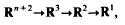
starting with an (n + 1)-simplex, vertices of the successive iterates correspond to, respectively, subsets, permutations and sequences of permutations of an n-set. The first iterate will always be combinatorially an n-cube, and, under certain conditions, the second will have the structure of the (n−1)-dimensional permutohedron.
Chapter II - Inequalities for sums of independent random variables in rearrangement invariant spaces
-
- Book:
- Independent Random Variables and Rearrangement Invariant Spaces
- Published online:
- 15 March 2010
- Print publication:
- 20 October 1994, pp 21-49
-
- Chapter
- Export citation
References
-
- Book:
- Independent Random Variables and Rearrangement Invariant Spaces
- Published online:
- 15 March 2010
- Print publication:
- 20 October 1994, pp 113-115
-
- Chapter
- Export citation
Index
-
- Book:
- Independent Random Variables and Rearrangement Invariant Spaces
- Published online:
- 15 March 2010
- Print publication:
- 20 October 1994, pp 116-116
-
- Chapter
- Export citation
Preface
-
- Book:
- Independent Random Variables and Rearrangement Invariant Spaces
- Published online:
- 15 March 2010
- Print publication:
- 20 October 1994, pp vii-viii
-
- Chapter
- Export citation
Contents
-
- Book:
- Independent Random Variables and Rearrangement Invariant Spaces
- Published online:
- 15 March 2010
- Print publication:
- 20 October 1994, pp v-vi
-
- Chapter
- Export citation
Frontmatter
-
- Book:
- Independent Random Variables and Rearrangement Invariant Spaces
- Published online:
- 15 March 2010
- Print publication:
- 20 October 1994, pp i-iv
-
- Chapter
- Export citation
Chapter IV - Complementability of subspaces generated by independent random variables
-
- Book:
- Independent Random Variables and Rearrangement Invariant Spaces
- Published online:
- 15 March 2010
- Print publication:
- 20 October 1994, pp 88-112
-
- Chapter
- Export citation
Chapter III - Linear combinations of independent random variables in rearrangement invariant spaces
-
- Book:
- Independent Random Variables and Rearrangement Invariant Spaces
- Published online:
- 15 March 2010
- Print publication:
- 20 October 1994, pp 50-87
-
- Chapter
- Export citation
Chapter I - Preliminaries
-
- Book:
- Independent Random Variables and Rearrangement Invariant Spaces
- Published online:
- 15 March 2010
- Print publication:
- 20 October 1994, pp 1-20
-
- Chapter
- Export citation
MTK volume 41 issue 1 Cover and Front matter
-
- Journal:
- Mathematika / Volume 41 / Issue 1 / June 1994
- Published online by Cambridge University Press:
- 26 February 2010, pp. f1-f4
- Print publication:
- June 1994
-
- Article
-
- You have access
- Export citation
Detecting exotic structures via the Pontrjagin-Thom construction
- Part of
-
- Journal:
- Mathematika / Volume 41 / Issue 1 / June 1994
- Published online by Cambridge University Press:
- 26 February 2010, pp. 145-148
- Print publication:
- June 1994
-
- Article
- Export citation
The number of zero sums modulo m in a sequence of length n
- Part of
-
- Journal:
- Mathematika / Volume 41 / Issue 1 / June 1994
- Published online by Cambridge University Press:
- 26 February 2010, pp. 149-163
- Print publication:
- June 1994
-
- Article
- Export citation
-
We prove a result related to the Erdős-Ginzburg-Ziv theorem: Let p and q be primes, α a positive integer, and m∈{pα, pαq}. Then for any sequence of integers c= {c1, c2,…, cn} there are at least
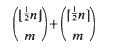
subsequences of length m, whose terms add up to 0 modulo m (Theorem 8). We also show why it is unlikely that the result is true for any m not of the form pα or pαq (Theorem 9).
Borel and analytic sets in Banach spaces
- Part of
-
- Journal:
- Mathematika / Volume 41 / Issue 1 / June 1994
- Published online by Cambridge University Press:
- 26 February 2010, pp. 133-140
- Print publication:
- June 1994
-
- Article
- Export citation
On the nonlinear growth of single three-dimensional disturbances in boundary layers
-
- Journal:
- Mathematika / Volume 41 / Issue 1 / June 1994
- Published online by Cambridge University Press:
- 26 February 2010, pp. 1-39
- Print publication:
- June 1994
-
- Article
- Export citation
Dimension prints of fractal sets
- Part of
-
- Journal:
- Mathematika / Volume 41 / Issue 1 / June 1994
- Published online by Cambridge University Press:
- 26 February 2010, pp. 68-94
- Print publication:
- June 1994
-
- Article
- Export citation
L. Aizenberg. Carleman's Formula in Complex Analysis. Kluwer. 1993, 300 pp., £90. - B. Amberg, S. Franciosi and F. de Giovanni. Products of Groups. Clarendon Press. 1992, 218 pp., £45. - Michael Artin. Algebra. Birkhäuser. 1993, 705 pp., Swiss Fr.78. - L. W. Baggett. Functional Analysis—A Primer. Marcel Dekker. 1992, 288 pp., $49.75. - Y. Bahturin. Basic Structures of Modern Algebra. Kluwer Academic. 1993, 419 pp., £122·50. - D. Bainov and P. Simeonov. Impulsive Differential Equations: Periodic Solutions and Applications. Longman. 1993, 228 pp., £38. - D. Daners and P. K. Medina. Abstract evolution equations, periodic problems and applications. Longman. 1992, 249 pp., £28. - R. Deville, G. Godefroy and V. Zizler. Smoothness and Renormings in Banach Space. Longman. 1993, 375 pp., £52. - T. Dracos and A. Tsinober. New Approaches and Concepts in Turbulence. Birkhäuser. 1993, 426 pp., £56. - I. Gohberg and N. Krupnik. One-Dimensional Linear Singular Integral Equations.. Birkhäuser. 1992, 267 pp., Swiss Fr.128. - L. S. Grinblat. On sets not belonging to algebras of subsets. Amer. Math.Soc. 1992, 111 pp., £18. - S. Guerre-Delabrière. Classical Sequences in Banach Spaces. Marcel Dekker. 1992, 232 pp., $99.75. - C. Hog-Angeloni, W. Metzler and A. J. Sieradski. Two dimensional homotopy and combinatorial group theory. Cambridge University Press. 1993, 412 pp., £25. - I. T. Kiguradze and T. A. Chanturia. Asymptotic Properties of Solutions of Nonautonomous Ordinary Differential Equations. Kluwer. 1993, 331 pp., £92·50. - L. C. Kinsey. Topology of Surfaces. Springer. 1993, 262 pp., DM 68. - S. H. Kulkarni and B. V. Limaye. Real Function Algebras. Marcel Dekker. 1992, 200 pp., $99.75. - D. B. Meli. Equivalence and Priority: Newton versus Leibniz, including Leibniz's unpublished Manuscripts on the Principia. Clarendon Press. 1993, 318 pp., with 60 Figures and 7 plates, £55. - S. Martin. Schur Algebras and Representation Theory. Cambridge Tracts in Mathematics No. 112. Cambridge University Press. 1993, 232 pp., £30. - A. L. Onishchik. Topology of Transitive Transformation Groups. J. A. Barth. 1994, 300 pp., DM 160. - P. G. Saffman. Vortex Dynamics. Cambridge University Press. 1993, 311 pp., £35. - S. K. Sehgal. Units in Integral Group Rings. Longman. 1993, 356 pp., £57. - H. M. Srivastava and R. G. Buschman. Theory and Applications of Convolution Integral Equations. Kluwer. 1992, 240 pp., £56. - I. Tamura. Topology of Foliations: An Introduction. Amer. Math. Soc. 1992, 190 pp., £61. - H. Triebel. Theory of Function Spaces II. Birkhäuser. 1992, 370 pp., Swiss Fr. 158.
-
- Journal:
- Mathematika / Volume 41 / Issue 1 / June 1994
- Published online by Cambridge University Press:
- 26 February 2010, pp. 215-220
- Print publication:
- June 1994
-
- Article
- Export citation
A regular endomorphism of a graph and its inverses
- Part of
-
- Journal:
- Mathematika / Volume 41 / Issue 1 / June 1994
- Published online by Cambridge University Press:
- 26 February 2010, pp. 189-198
- Print publication:
- June 1994
-
- Article
- Export citation
