Refine search
Actions for selected content:
26077 results in Abstract analysis
Renormalisation of finitely ramified fractals
-
- Journal:
- Proceedings of the Royal Society of Edinburgh. Section A: Mathematics / Volume 125 / Issue 5 / 1995
- Published online by Cambridge University Press:
- 14 November 2011, pp. 1085-1104
- Print publication:
- 1995
-
- Article
- Export citation
Trace functions on the algebras of certain E-unitary inverse semigroups
-
- Journal:
- Proceedings of the Royal Society of Edinburgh. Section A: Mathematics / Volume 125 / Issue 5 / 1995
- Published online by Cambridge University Press:
- 14 November 2011, pp. 1077-1084
- Print publication:
- 1995
-
- Article
- Export citation
On the eigenvalue asymptotics for a nonselfadjoint elliptic problem involving an indefinite weight
-
- Journal:
- Proceedings of the Royal Society of Edinburgh. Section A: Mathematics / Volume 125 / Issue 4 / 1995
- Published online by Cambridge University Press:
- 14 November 2011, pp. 859-875
- Print publication:
- 1995
-
- Article
- Export citation
Variation of constants for hybrid systems of functional differential equations
-
- Journal:
- Proceedings of the Royal Society of Edinburgh. Section A: Mathematics / Volume 125 / Issue 1 / 1995
- Published online by Cambridge University Press:
- 14 November 2011, pp. 1-12
- Print publication:
- 1995
-
- Article
- Export citation
Correspondences of completely regular semigroups and
 -isomorphisms of semigroups
-
- Journal:
- Proceedings of the Royal Society of Edinburgh. Section A: Mathematics / Volume 125 / Issue 3 / 1995
- Published online by Cambridge University Press:
- 14 November 2011, pp. 625-637
- Print publication:
- 1995
-
- Article
- Export citation
-
A correspondence of a semigroup S is any subsemigroup of S × S, and the set of all correspondences of S, with the operations of composition and involution and the relation of set-theoretic inclusion, forms the bundle of correspondences of S, denoted by
 (S). For semigroups S and T, any isomorphism of (S) onto (T) is called a -isomorphism of S upon T. Similar notion can be introduced for other types of algebras and in the general frame of category theory. The principal goal of this paper is to study -isomorphisms of completely regular semigroups (that is, unions of groups) and of one other interesting class of semigroups.
 -isomorphisms of semigroups
 (S). For semigroups S and T, any isomorphism of
 Instability of quasiperiodic solutions of the Ginzburg–Landau equation
-
- Journal:
- Proceedings of the Royal Society of Edinburgh. Section A: Mathematics / Volume 125 / Issue 3 / 1995
- Published online by Cambridge University Press:
- 14 November 2011, pp. 501-517
- Print publication:
- 1995
-
- Article
- Export citation
On semigroups defined by Coxeter-type presentations
-
- Journal:
- Proceedings of the Royal Society of Edinburgh. Section A: Mathematics / Volume 125 / Issue 5 / 1995
- Published online by Cambridge University Press:
- 14 November 2011, pp. 1063-1075
- Print publication:
- 1995
-
- Article
- Export citation
Weak solutions to a hydrodynamic model for semiconductors: the Cauchy problem
-
- Journal:
- Proceedings of the Royal Society of Edinburgh. Section A: Mathematics / Volume 125 / Issue 1 / 1995
- Published online by Cambridge University Press:
- 14 November 2011, pp. 115-131
- Print publication:
- 1995
-
- Article
- Export citation
Counting stationary solutions of the Cahn–Hilliard equation by transversality arguments
-
- Journal:
- Proceedings of the Royal Society of Edinburgh. Section A: Mathematics / Volume 125 / Issue 2 / 1995
- Published online by Cambridge University Press:
- 14 November 2011, pp. 351-370
- Print publication:
- 1995
-
- Article
- Export citation
Application of two parameter eigencurves to Sturm–Liouville problems with eigenparameter-dependent boundary conditions
-
- Journal:
- Proceedings of the Royal Society of Edinburgh. Section A: Mathematics / Volume 125 / Issue 6 / 1995
- Published online by Cambridge University Press:
- 14 November 2011, pp. 1205-1218
- Print publication:
- 1995
-
- Article
- Export citation
-
Oscillation, comparison and asymptotic theory for the Sturm-Liouville problem

with 1/p, q, r ε L1 ([0, 1]), p, r > 0, are studied subject to eigenvalue-dependent boundary conditions

This continues previous work on cases with (− 1)j δj ≦ 0 where δj = ajdj − bjcj. We now consider the remaining sign conditions for δj, exploiting the interplay between the graph of cot θ− (λ, 1), for a modified Prüfer angle θ−, and the eigencurves of a related two-parameter problem.
Equidistribution of values of rational functions (mod p)
-
- Journal:
- Proceedings of the Royal Society of Edinburgh. Section A: Mathematics / Volume 125 / Issue 5 / 1995
- Published online by Cambridge University Press:
- 14 November 2011, pp. 911-929
- Print publication:
- 1995
-
- Article
- Export citation
-
Let R1(x),…, Rd(x) be rational functions in Iℚ(x), such that 1, R1(x),…, Rd(x) are linearly independent over Iℚ. For almost all primes p, their mod p reductions,
 are well-defined rational functions over Fp and are linearly independent over Fp We show that asymptotically the points
are uniformly distributed in [0, l)d.
 are well-defined rational functions over F
Contracting sets and dissipation
-
- Journal:
- Proceedings of the Royal Society of Edinburgh. Section A: Mathematics / Volume 125 / Issue 6 / 1995
- Published online by Cambridge University Press:
- 14 November 2011, pp. 1305-1329
- Print publication:
- 1995
-
- Article
- Export citation
Realisation of ordinary differential equations by retarded functional differential equations in neighbourhoods of equilibrium points*
-
- Journal:
- Proceedings of the Royal Society of Edinburgh. Section A: Mathematics / Volume 125 / Issue 4 / 1995
- Published online by Cambridge University Press:
- 14 November 2011, pp. 759-776
- Print publication:
- 1995
-
- Article
- Export citation
A polyconvexity condition in dimension two
-
- Journal:
- Proceedings of the Royal Society of Edinburgh. Section A: Mathematics / Volume 125 / Issue 5 / 1995
- Published online by Cambridge University Press:
- 14 November 2011, pp. 901-910
- Print publication:
- 1995
-
- Article
- Export citation
PRM volume 125 issue 1 Cover and Front matter
-
- Journal:
- Proceedings of the Royal Society of Edinburgh. Section A: Mathematics / Volume 125 / Issue 1 / 1995
- Published online by Cambridge University Press:
- 14 November 2011, pp. f1-f2
- Print publication:
- 1995
-
- Article
-
- You have access
- Export citation
PRM volume 125 issue 4 Cover and Front matter
-
- Journal:
- Proceedings of the Royal Society of Edinburgh. Section A: Mathematics / Volume 125 / Issue 4 / 1995
- Published online by Cambridge University Press:
- 14 November 2011, pp. f1-f2
- Print publication:
- 1995
-
- Article
-
- You have access
- Export citation
The spectra of well-posed operators
-
- Journal:
- Proceedings of the Royal Society of Edinburgh. Section A: Mathematics / Volume 125 / Issue 6 / 1995
- Published online by Cambridge University Press:
- 14 November 2011, pp. 1331-1348
- Print publication:
- 1995
-
- Article
- Export citation
-
In this paper, the general ordinary quasidifferential expression M of nth order, with complex coefficients, and its formal adjoint M− are considered. It is shown in the case of two singular endpomts and when all solutions of the equation and the adjoint equation are in
 (the limit-circle case) that all well-posed extensions of the minimal operator T0(M) have resolvents which are Hilbert Schmidt integral operators and consequently have a wholly discrete spectrum. This implies that all the regularly solvable operators have all of the standard essential spectra to be empty. These results extend those for the formally symmetric expression M studied in [1] and [14], and also extend those proved in [8] for one singular endpoint.
 (the limit-circle case) that all well-posed extensions of the minimal operator T
The Riemann problem for a system of conservation laws of mixed type with a cubic nonlinearity
-
- Journal:
- Proceedings of the Royal Society of Edinburgh. Section A: Mathematics / Volume 125 / Issue 4 / 1995
- Published online by Cambridge University Press:
- 14 November 2011, pp. 675-699
- Print publication:
- 1995
-
- Article
- Export citation
-
Using the viscosity-capillarity admissibility criterion for shock waves, we solve the Riemann problem for the system of conservation laws
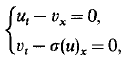
where σ(u) = u3 − u. This system is hyperbolic at (u, v) unless
 . We find that the Riemann problem has a unique solution for all data in the hyperbolic regions, except for a range of data in the same phase (i.e. on the same side of the nonhyperbolic strip). In the nonunique cases, there are exactly two admissible solutions. The analysis is based upon a formula describing all saddle-to-saddle heteroclinic orbits for a family of cubic vector fields in the plane.
 . We find that the Riemann problem has a unique solution for all data in the hyperbolic regions, except for a range of data in the same phase (i.e. on the same side of the nonhyperbolic strip). In the nonunique cases, there are exactly two admissible solutions. The analysis is based upon a formula describing all saddle-to-saddle heteroclinic orbits for a family of cubic vector fields in the plane.
Uniform asymptotic expansions for oblate spheroidal functions II: negative separation parameter λ
-
- Journal:
- Proceedings of the Royal Society of Edinburgh. Section A: Mathematics / Volume 125 / Issue 4 / 1995
- Published online by Cambridge University Press:
- 14 November 2011, pp. 719-737
- Print publication:
- 1995
-
- Article
- Export citation
Approximation of attractors for nongradient systems
-
- Journal:
- Proceedings of the Royal Society of Edinburgh. Section A: Mathematics / Volume 125 / Issue 4 / 1995
- Published online by Cambridge University Press:
- 14 November 2011, pp. 739-758
- Print publication:
- 1995
-
- Article
- Export citation
-
The problem of approximation of attractors for semidynamical systems (SDSs) in a metric space is studied. Let some (exact) SDS possessing an attractor M be inaccurately defined, i.e. let another (approximate) SDS, which is close in some sense to the exact one, be given. The problem is to construct a set
 , which is close to M in the Hausdorff metric.
The suggested procedure for constructing
is finite, which makes it possible to use it in computations. The results obtained are suitable for numerical approximation of attractors for a rather large class of semidynamical systems, including ones generated by the Lorenz equations and the Navier–Stokes equations.
 , which is close to M in the Hausdorff metric.