Refine search
Actions for selected content:
26077 results in Abstract analysis
A symplectic fixed-point theorem for T2k × CPn × CPm
-
- Journal:
- Proceedings of the Royal Society of Edinburgh. Section A: Mathematics / Volume 125 / Issue 3 / 1995
- Published online by Cambridge University Press:
- 14 November 2011, pp. 465-492
- Print publication:
- 1995
-
- Article
- Export citation
Boundary value problems on noncompact intervals
-
- Journal:
- Proceedings of the Royal Society of Edinburgh. Section A: Mathematics / Volume 125 / Issue 4 / 1995
- Published online by Cambridge University Press:
- 14 November 2011, pp. 777-799
- Print publication:
- 1995
-
- Article
- Export citation
Nilpotents and congruences on semigroups of transformations with fixed rank
-
- Journal:
- Proceedings of the Royal Society of Edinburgh. Section A: Mathematics / Volume 125 / Issue 2 / 1995
- Published online by Cambridge University Press:
- 14 November 2011, pp. 399-412
- Print publication:
- 1995
-
- Article
- Export citation
Change of stability for Schrödinger semigroups*
-
- Journal:
- Proceedings of the Royal Society of Edinburgh. Section A: Mathematics / Volume 125 / Issue 4 / 1995
- Published online by Cambridge University Press:
- 14 November 2011, pp. 827-846
- Print publication:
- 1995
-
- Article
- Export citation
Asymptotic behaviour and attractors for a semilinear damped wave equation with supercritical exponent
-
- Journal:
- Proceedings of the Royal Society of Edinburgh. Section A: Mathematics / Volume 125 / Issue 5 / 1995
- Published online by Cambridge University Press:
- 14 November 2011, pp. 1051-1062
- Print publication:
- 1995
-
- Article
- Export citation
-
We prove the existence of a global attractor for the problem
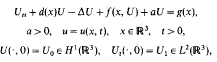
where f is ‘coercive at infinity’ and satisfies the growth condition

while g ϵL2(R3).
On the existence of solitary waves in rotating fluids
-
- Journal:
- Proceedings of the Royal Society of Edinburgh. Section A: Mathematics / Volume 125 / Issue 5 / 1995
- Published online by Cambridge University Press:
- 14 November 2011, pp. 1105-1129
- Print publication:
- 1995
-
- Article
- Export citation
Complexity in spatio-temporal dynamics
-
- Journal:
- Proceedings of the Royal Society of Edinburgh. Section A: Mathematics / Volume 125 / Issue 5 / 1995
- Published online by Cambridge University Press:
- 14 November 2011, pp. 959-974
- Print publication:
- 1995
-
- Article
- Export citation
High-energy and multi-peaked solutions for a nonlinear Neumann problem with critical exponents*
-
- Journal:
- Proceedings of the Royal Society of Edinburgh. Section A: Mathematics / Volume 125 / Issue 5 / 1995
- Published online by Cambridge University Press:
- 14 November 2011, pp. 1003-1029
- Print publication:
- 1995
-
- Article
- Export citation
PRM volume 125 issue 6 Cover and Back matter
-
- Journal:
- Proceedings of the Royal Society of Edinburgh. Section A: Mathematics / Volume 125 / Issue 6 / 1995
- Published online by Cambridge University Press:
- 14 November 2011, pp. b1-b2
- Print publication:
- 1995
-
- Article
-
- You have access
- Export citation
PRM volume 125 issue 4 Cover and Back matter
-
- Journal:
- Proceedings of the Royal Society of Edinburgh. Section A: Mathematics / Volume 125 / Issue 4 / 1995
- Published online by Cambridge University Press:
- 14 November 2011, pp. b1-b2
- Print publication:
- 1995
-
- Article
-
- You have access
- Export citation
Equations for biological evolution*
-
- Journal:
- Proceedings of the Royal Society of Edinburgh. Section A: Mathematics / Volume 125 / Issue 5 / 1995
- Published online by Cambridge University Press:
- 14 November 2011, pp. 939-958
- Print publication:
- 1995
-
- Article
- Export citation
On the unitarity of the wave operators for AC-Stark Hamiltonians
-
- Journal:
- Proceedings of the Royal Society of Edinburgh. Section A: Mathematics / Volume 125 / Issue 3 / 1995
- Published online by Cambridge University Press:
- 14 November 2011, pp. 617-624
- Print publication:
- 1995
-
- Article
- Export citation
Periodic orbits of difference equations
-
- Journal:
- Proceedings of the Royal Society of Edinburgh. Section A: Mathematics / Volume 125 / Issue 4 / 1995
- Published online by Cambridge University Press:
- 14 November 2011, pp. 657-674
- Print publication:
- 1995
-
- Article
- Export citation
On commutative idempotent rings
-
- Journal:
- Proceedings of the Royal Society of Edinburgh. Section A: Mathematics / Volume 125 / Issue 2 / 1995
- Published online by Cambridge University Press:
- 14 November 2011, pp. 341-349
- Print publication:
- 1995
-
- Article
- Export citation
Singularities of general one-dimensional motions of the plane and space
-
- Journal:
- Proceedings of the Royal Society of Edinburgh. Section A: Mathematics / Volume 125 / Issue 3 / 1995
- Published online by Cambridge University Press:
- 14 November 2011, pp. 639-656
- Print publication:
- 1995
-
- Article
- Export citation
PRM volume 125 issue 5 Cover and Front matter
-
- Journal:
- Proceedings of the Royal Society of Edinburgh. Section A: Mathematics / Volume 125 / Issue 5 / 1995
- Published online by Cambridge University Press:
- 14 November 2011, pp. f1-f2
- Print publication:
- 1995
-
- Article
-
- You have access
- Export citation
Inequalities for a function involving its integral and derivative
-
- Journal:
- Proceedings of the Royal Society of Edinburgh. Section A: Mathematics / Volume 125 / Issue 1 / 1995
- Published online by Cambridge University Press:
- 14 November 2011, pp. 133-151
- Print publication:
- 1995
-
- Article
- Export citation
-
We give a concise approach to generalising the inequalities of Wirtinger, Hardy, Weyl and Opial by using the well-known inequality: if X and Y are non-negative, then

for p > 1 (0 < p < 1), respectively.
Gradient estimates and heat kernel estimates
-
- Journal:
- Proceedings of the Royal Society of Edinburgh. Section A: Mathematics / Volume 125 / Issue 5 / 1995
- Published online by Cambridge University Press:
- 14 November 2011, pp. 975-990
- Print publication:
- 1995
-
- Article
- Export citation
On the representation of functions by the Hankel and some related transformations
-
- Journal:
- Proceedings of the Royal Society of Edinburgh. Section A: Mathematics / Volume 125 / Issue 3 / 1995
- Published online by Cambridge University Press:
- 14 November 2011, pp. 449-463
- Print publication:
- 1995
-
- Article
- Export citation
-
A representation theory for the Hankel transformation Hv, defined for suitable f and for v > −1, by
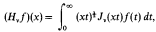
on the spaces ℒμ, p defined by the norm

is developed. Using this, representation theories are developed for some related transformations.
Perpendicular bisectors, duality and local symmetry of plane curves
-
- Journal:
- Proceedings of the Royal Society of Edinburgh. Section A: Mathematics / Volume 125 / Issue 1 / 1995
- Published online by Cambridge University Press:
- 14 November 2011, pp. 181-194
- Print publication:
- 1995
-
- Article
- Export citation
