Refine search
Actions for selected content:
26077 results in Abstract analysis
Positive solutions of certain elliptic systems with density-dependent diffusions
-
- Journal:
- Proceedings of the Royal Society of Edinburgh. Section A: Mathematics / Volume 125 / Issue 5 / 1995
- Published online by Cambridge University Press:
- 14 November 2011, pp. 1031-1050
- Print publication:
- 1995
-
- Article
- Export citation
-
Results are obtained on the existence of positive solutions to the following elliptic system:
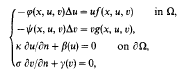
in a bounded region Ω in Rn with a smooth boundary, where the diffusion terms φ ψ are non-negative functions and the system could be degenerate, β γ are strictly increasing functions, k,σ ≧ 0 are constants. We assume also that the growth rates f, g satisfy certain monotonicities. Applications to biological interactions with density-dependent diffusions are given.
On the planar rank-one convexity condition
-
- Journal:
- Proceedings of the Royal Society of Edinburgh. Section A: Mathematics / Volume 125 / Issue 2 / 1995
- Published online by Cambridge University Press:
- 14 November 2011, pp. 247-264
- Print publication:
- 1995
-
- Article
- Export citation
Approximate controllability of the semilinear heat equation
-
- Journal:
- Proceedings of the Royal Society of Edinburgh. Section A: Mathematics / Volume 125 / Issue 1 / 1995
- Published online by Cambridge University Press:
- 14 November 2011, pp. 31-61
- Print publication:
- 1995
-
- Article
- Export citation
Weighted Poincaré inequalities and Minkowski content
-
- Journal:
- Proceedings of the Royal Society of Edinburgh. Section A: Mathematics / Volume 125 / Issue 4 / 1995
- Published online by Cambridge University Press:
- 14 November 2011, pp. 817-825
- Print publication:
- 1995
-
- Article
- Export citation
On the existence of a timelike trajectory for a Lorentzian metric
-
- Journal:
- Proceedings of the Royal Society of Edinburgh. Section A: Mathematics / Volume 125 / Issue 4 / 1995
- Published online by Cambridge University Press:
- 14 November 2011, pp. 807-815
- Print publication:
- 1995
-
- Article
- Export citation
PRM volume 125 issue 6 Cover and Front matter
-
- Journal:
- Proceedings of the Royal Society of Edinburgh. Section A: Mathematics / Volume 125 / Issue 6 / 1995
- Published online by Cambridge University Press:
- 14 November 2011, pp. f1-f2
- Print publication:
- 1995
-
- Article
-
- You have access
- Export citation
Poincaré–Birkhoff results for Lagrangian systems with subquadratic potential
-
- Journal:
- Proceedings of the Royal Society of Edinburgh. Section A: Mathematics / Volume 125 / Issue 6 / 1995
- Published online by Cambridge University Press:
- 14 November 2011, pp. 1169-1177
- Print publication:
- 1995
-
- Article
- Export citation
Invariant subspaces and new explicit solutions to evolution equations with quadratic nonlinearities
-
- Journal:
- Proceedings of the Royal Society of Edinburgh. Section A: Mathematics / Volume 125 / Issue 2 / 1995
- Published online by Cambridge University Press:
- 14 November 2011, pp. 225-246
- Print publication:
- 1995
-
- Article
- Export citation
-
We present new explicit solutions to some classes of quasilinear evolution equations arising in different applications, including equations of the Boussinesq type:
and quasilinear heat equations:
The method is based on construction of finite-dimensional linear functional subspaces which are invariant with respect to spatial operators having quadratic nonlinearities. The corresponding nonlinear evolution equations on invariant subspaces are shown to be equivalent to finite-dimensional dynamical systems. Examples of two-, three- and five- dimensional invariant subspaces are given. Some generalisations to N-dimensional quadratic operators are also considered.
Approximation of relaxed Dirichlet problems by boundary value problems in perforated domains
-
- Journal:
- Proceedings of the Royal Society of Edinburgh. Section A: Mathematics / Volume 125 / Issue 1 / 1995
- Published online by Cambridge University Press:
- 14 November 2011, pp. 99-114
- Print publication:
- 1995
-
- Article
- Export citation
PRM volume 125 issue 3 Cover and Back matter
-
- Journal:
- Proceedings of the Royal Society of Edinburgh. Section A: Mathematics / Volume 125 / Issue 3 / 1995
- Published online by Cambridge University Press:
- 14 November 2011, pp. b1-b2
- Print publication:
- 1995
-
- Article
-
- You have access
- Export citation
Weighted inequalities for the Stieltjes transform and the maximal spherical partial sum operator on radial functions*
-
- Journal:
- Proceedings of the Royal Society of Edinburgh. Section A: Mathematics / Volume 125 / Issue 1 / 1995
- Published online by Cambridge University Press:
- 14 November 2011, pp. 195-204
- Print publication:
- 1995
-
- Article
- Export citation
Singular limit of quasilinear Neumann problems
-
- Journal:
- Proceedings of the Royal Society of Edinburgh. Section A: Mathematics / Volume 125 / Issue 1 / 1995
- Published online by Cambridge University Press:
- 14 November 2011, pp. 205-223
- Print publication:
- 1995
-
- Article
- Export citation
PRM volume 125 issue 1 Cover and Back matter
-
- Journal:
- Proceedings of the Royal Society of Edinburgh. Section A: Mathematics / Volume 125 / Issue 1 / 1995
- Published online by Cambridge University Press:
- 14 November 2011, pp. b1-b2
- Print publication:
- 1995
-
- Article
-
- You have access
- Export citation
Sturmian comparison theorem for half-linear second-order differential equations
-
- Journal:
- Proceedings of the Royal Society of Edinburgh. Section A: Mathematics / Volume 125 / Issue 6 / 1995
- Published online by Cambridge University Press:
- 14 November 2011, pp. 1193-1204
- Print publication:
- 1995
-
- Article
- Export citation
-
Let φ:ℝ→ℝ be defined by φ(s) = |s|p−2s, with p > 1 a fixed number. We extend Sturm Comparison Theorem of the linear differential equation
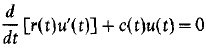
to the nonlinear differential equation

by using the Wirtinger inequality. A Lyapunov inequality and some oscillation criteria of (E) are also given.
Positive root vectors
-
- Journal:
- Proceedings of the Royal Society of Edinburgh. Section A: Mathematics / Volume 125 / Issue 4 / 1995
- Published online by Cambridge University Press:
- 14 November 2011, pp. 701-717
- Print publication:
- 1995
-
- Article
- Export citation
Bounds on the effective conductivity of two-dimensional composites made of n ≧ 3 isotropic phases in prescribed volume fraction: the weighted translation method
-
- Journal:
- Proceedings of the Royal Society of Edinburgh. Section A: Mathematics / Volume 125 / Issue 6 / 1995
- Published online by Cambridge University Press:
- 14 November 2011, pp. 1219-1239
- Print publication:
- 1995
-
- Article
- Export citation
Characterisation of correctness of cardinal interpolation with shifted three-directional box splines
-
- Journal:
- Proceedings of the Royal Society of Edinburgh. Section A: Mathematics / Volume 125 / Issue 5 / 1995
- Published online by Cambridge University Press:
- 14 November 2011, pp. 931-937
- Print publication:
- 1995
-
- Article
- Export citation
-
Cardinal interpolation by integer translates of shifted three-directional box splines is studied. It is shown that, for arbitrary orders, k, l, m ∈ N of the directional vectors, this problem is correct if and only if the shift vector is taken from the hexagonal shift region
 (modulo translation with respect to the lattice Z2). This confirms a conjecture of S. D. Riemenschneider [9], and settles the problem studied in [5] for the special case k = l = m in full generality. The method of proof is from homotopy theory.
 (modulo translation with respect to the lattice Z
Oriented and nonoriented curvature varifolds
-
- Journal:
- Proceedings of the Royal Society of Edinburgh. Section A: Mathematics / Volume 125 / Issue 1 / 1995
- Published online by Cambridge University Press:
- 14 November 2011, pp. 63-83
- Print publication:
- 1995
-
- Article
- Export citation
On the uniform stability for a ‘food-limited’ population model with time delay*
-
- Journal:
- Proceedings of the Royal Society of Edinburgh. Section A: Mathematics / Volume 125 / Issue 5 / 1995
- Published online by Cambridge University Press:
- 14 November 2011, pp. 991-1002
- Print publication:
- 1995
-
- Article
- Export citation
On the stability of the saddle solution of Allen–Cahn's equation
-
- Journal:
- Proceedings of the Royal Society of Edinburgh. Section A: Mathematics / Volume 125 / Issue 6 / 1995
- Published online by Cambridge University Press:
- 14 November 2011, pp. 1241-1275
- Print publication:
- 1995
-
- Article
- Export citation
-
Let f be an odd, C2 function on [− 1, 1], which vanishes at ± 1, and such that f′(O) < 0, f′ (±1) > 0 and u ↦ f(u)/u is increasing. Dang, Fife and Peletier [5] showed that there is a unique solution u with values in [−1, 1] of

which has the same sign as xy. The linearised operator around u is B defined by

It is proved here that the spectrum of B contains at least one negative eigenvalue, that all eigenfunctions corresponding to negative eigenvalues have the symmetries of the square, and that for Allen–Cahn's nonlinearity (f(u) = 2u3 − 2u), there is exactly one negative eigenvalue.
