Refine search
Actions for selected content:
26077 results in Abstract analysis
Odd-order differential expressions with positive supporting coefficients
-
- Journal:
- Proceedings of the Royal Society of Edinburgh. Section A: Mathematics / Volume 105 / Issue 1 / 1987
- Published online by Cambridge University Press:
- 14 November 2011, pp. 167-192
- Print publication:
- 1987
-
- Article
- Export citation
Conjugacy classes in finite groups
-
- Journal:
- Proceedings of the Royal Society of Edinburgh. Section A: Mathematics / Volume 105 / Issue 1 / 1987
- Published online by Cambridge University Press:
- 14 November 2011, pp. 259-264
- Print publication:
- 1987
-
- Article
- Export citation
-
In this paper, the number of conjugacy classes in a finite group G is analysed in terms of the number of ordered pairs that generate it. Using this relation, we give a new elementary proof of one of A. Mann's results for finite groups, namely: |G| ≡ r(G) (mod. d|G|. δ|G|), where
 , prime and pi ≠ Pj for every i≠j, r(G) denotes the number of conjugacy classes of elements of G, d|G| = g.c.d. (p1 − 1, … pt − 1) and δ|G| = g.c.d.
  . The above congruence is obtained without using character theory. We also obtain new local congruences that slightly improve Mann's congruence.
 , prime and p
 . The above congruence is obtained without using character theory. We also obtain new local congruences that slightly improve Mann's congruence.
Regularisation of Abel's integral equation
-
- Journal:
- Proceedings of the Royal Society of Edinburgh. Section A: Mathematics / Volume 107 / Issue 1-2 / 1987
- Published online by Cambridge University Press:
- 14 November 2011, pp. 165-168
- Print publication:
- 1987
-
- Article
- Export citation
-
Consider the Abel integral operator

where 0 < α < 1. Suppose u is in H1(0, 1) of H1-norm ≦E, and f is an element of L2(0, 1) such that ∥Au – f∥L−2 < ε. We give a regularised approximate solution uβ(f) of the equation

which satisfies

and can be computed simply by performing some integrations. The preceding error estimate can be sharpened by strengthening regularity conditions on u

Schützenberger groups of polynomials in the semigroup of entire functions
-
- Journal:
- Proceedings of the Royal Society of Edinburgh. Section A: Mathematics / Volume 105 / Issue 1 / 1987
- Published online by Cambridge University Press:
- 14 November 2011, pp. 43-60
- Print publication:
- 1987
-
- Article
- Export citation
-
Let
 denote the semigroup, under composition, of all entire functions of a complex variable and for
  , let Γ(f) denote the Schützenberger group of the ℋ-class of which contains f. The main results of this paper completely describe Γ(P) where P is a polynomial function. Γ(P) is trivial if P is a constant function. If Deg (P) (the degree of P) is one, then Γ(P) is isomorphic to the group of all matrices of the form
  where a and b are complex numbers with a ≠ 0. If Deg (P) > 1, then Γ(P) is isomorphic to ℂM, the multiplicative group of nonzero complex numbers if and only if P(z) = α(z +β)n + γ where α ≠ 0. If P is not of this form and Deg (P) > 1, then Γ (P)is a finite cyclic group and its order can be determined by defining
 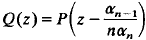 (where αn−1 and α n are the coefficients in P of zn−1 and zn respectively) and then inspecting the coefficients of Q.
 denote the semigroup, under composition, of all entire functions of a complex variable and for
  , let Γ(f) denote the Schützenberger group of the ℋ-class of
  where a and b are complex numbers with a ≠ 0. If Deg (P) > 1, then Γ(P) is isomorphic to ℂ
 (where α
On a counterexample of a rank 1 convex function which is not polyconvex in the case N = 2
-
- Journal:
- Proceedings of the Royal Society of Edinburgh. Section A: Mathematics / Volume 106 / Issue 3-4 / 1987
- Published online by Cambridge University Press:
- 14 November 2011, pp. 237-240
- Print publication:
- 1987
-
- Article
- Export citation
A Laplace transform relevant to holomorphic semigroups
-
- Journal:
- Proceedings of the Royal Society of Edinburgh. Section A: Mathematics / Volume 105 / Issue 1 / 1987
- Published online by Cambridge University Press:
- 14 November 2011, pp. 243-258
- Print publication:
- 1987
-
- Article
- Export citation
On the codegree of negative multiples of the Hopf bundle
-
- Journal:
- Proceedings of the Royal Society of Edinburgh. Section A: Mathematics / Volume 107 / Issue 1-2 / 1987
- Published online by Cambridge University Press:
- 14 November 2011, pp. 87-107
- Print publication:
- 1987
-
- Article
- Export citation
Tight stable surfaces, I
-
- Journal:
- Proceedings of the Royal Society of Edinburgh. Section A: Mathematics / Volume 107 / Issue 3-4 / 1987
- Published online by Cambridge University Press:
- 14 November 2011, pp. 213-232
- Print publication:
- 1987
-
- Article
- Export citation
Order of singularity applied to linear operators
-
- Journal:
- Proceedings of the Royal Society of Edinburgh. Section A: Mathematics / Volume 106 / Issue 1-2 / 1987
- Published online by Cambridge University Press:
- 14 November 2011, pp. 103-111
- Print publication:
- 1987
-
- Article
- Export citation
Spectral properties of two parameter eigenvalue problems II
-
- Journal:
- Proceedings of the Royal Society of Edinburgh. Section A: Mathematics / Volume 106 / Issue 1-2 / 1987
- Published online by Cambridge University Press:
- 14 November 2011, pp. 39-51
- Print publication:
- 1987
-
- Article
- Export citation
E-unitary regular semigroups
-
- Journal:
- Proceedings of the Royal Society of Edinburgh. Section A: Mathematics / Volume 106 / Issue 1-2 / 1987
- Published online by Cambridge University Press:
- 14 November 2011, pp. 89-102
- Print publication:
- 1987
-
- Article
- Export citation
A fourth order limit-3 expression with nonempty essential spectrum
-
- Journal:
- Proceedings of the Royal Society of Edinburgh. Section A: Mathematics / Volume 106 / Issue 3-4 / 1987
- Published online by Cambridge University Press:
- 14 November 2011, pp. 233-235
- Print publication:
- 1987
-
- Article
- Export citation
Corrigendum: Enumeration of smooth labelled graphs
-
- Journal:
- Proceedings of the Royal Society of Edinburgh. Section A: Mathematics / Volume 107 / Issue 1-2 / 1987
- Published online by Cambridge University Press:
- 14 November 2011, p. 197
- Print publication:
- 1987
-
- Article
- Export citation
Low energy resolvent estimates and continuity of time-delay operators
-
- Journal:
- Proceedings of the Royal Society of Edinburgh. Section A: Mathematics / Volume 105 / Issue 1 / 1987
- Published online by Cambridge University Press:
- 14 November 2011, pp. 229-242
- Print publication:
- 1987
-
- Article
- Export citation
Radial entire solutions to even order semilinear elliptic equations in the plane
-
- Journal:
- Proceedings of the Royal Society of Edinburgh. Section A: Mathematics / Volume 105 / Issue 1 / 1987
- Published online by Cambridge University Press:
- 14 November 2011, pp. 275-287
- Print publication:
- 1987
-
- Article
- Export citation
-
Semilinear elliptic equations of the form

are considered, where Δm is the m-th iterate of the two-dimensional Laplacian Δ, p(t) is continuous in [0, ∞), and f(u is continuous and positive either in (0, ∞) or in ℝ.
Our main objective is to present conditions on p and f which imply the existence of radial entire solutions to (*), that is, those functions of class C2m(ℝ2) which depend only on |x| and satisfy (*) pointwise in ℝ2.
First, necessary and sufficient conditions are established for equation (*), with p(t) > 0 in [0, ∞), to possess infinitely many positive radial entire solutions which are asymptotic to positive constant multiples of |x|2m−2 log |x as |x| → ∞. Secondly, it is shown that, in the case p(t < 0, in [ 0, ∞) and f(u) > 0 is nondecreasing in ℝ, equation (*) always has eventually negative radial entire solutions, all of which decrease at least as fast as negative constant multiples of |x|2m−2 log |x| as |x| → ∞. Our results seem to be new even when specialised to the prototypes

where γ is a constant.
Results old and new on the hyper-Bessel equation
-
- Journal:
- Proceedings of the Royal Society of Edinburgh. Section A: Mathematics / Volume 106 / Issue 3-4 / 1987
- Published online by Cambridge University Press:
- 14 November 2011, pp. 259-265
- Print publication:
- 1987
-
- Article
- Export citation
Bistable subvarieties of MS-algebras
-
- Journal:
- Proceedings of the Royal Society of Edinburgh. Section A: Mathematics / Volume 105 / Issue 1 / 1987
- Published online by Cambridge University Press:
- 14 November 2011, pp. 127-128
- Print publication:
- 1987
-
- Article
- Export citation
Index to Volume 106
-
- Journal:
- Proceedings of the Royal Society of Edinburgh. Section A: Mathematics / Volume 106 / Issue 3-4 / 1987
- Published online by Cambridge University Press:
- 14 November 2011, pp. i-ii
- Print publication:
- 1987
-
- Article
- Export citation
Centraliser near-rings determined by fixed point free automorphism groups
-
- Journal:
- Proceedings of the Royal Society of Edinburgh. Section A: Mathematics / Volume 107 / Issue 3-4 / 1987
- Published online by Cambridge University Press:
- 14 November 2011, pp. 327-337
- Print publication:
- 1987
-
- Article
- Export citation
Global theorems for symmetry sets of smooth curves and polygons in the plane
-
- Journal:
- Proceedings of the Royal Society of Edinburgh. Section A: Mathematics / Volume 106 / Issue 3-4 / 1987
- Published online by Cambridge University Press:
- 14 November 2011, pp. 221-231
- Print publication:
- 1987
-
- Article
- Export citation
