Refine search
Actions for selected content:
26077 results in Abstract analysis
PRM volume 107 issue 1-2 Cover and Back matter
-
- Journal:
- Proceedings of the Royal Society of Edinburgh. Section A: Mathematics / Volume 107 / Issue 1-2 / 1987
- Published online by Cambridge University Press:
- 14 November 2011, pp. b1-b2
- Print publication:
- 1987
-
- Article
-
- You have access
- Export citation
Norm form equations IV: Rational functions
-
- Journal:
- Mathematika / Volume 33 / Issue 2 / December 1986
- Published online by Cambridge University Press:
- 26 February 2010, pp. 204-211
- Print publication:
- December 1986
-
- Article
- Export citation
-
This paper is devoted to the establishment of explicit bounds on the rational function solutions of a general class of equations in several variables. The first general result on Diophantine equations over function fields was discovered in 1930 [1], as an analogy on the work of Thue on number fields: it was shown that the degrees of polynomial solutions X, Y in k[z] of f(X, Y) = c are bound for each c: here f denotes an irreducible binary form over k[z] of degree at least three, and k is an algebraically closed field of characteristic zero. The Manin-Grauert theorem [7] extended this conclusion to the rational function solutions X, Y in k(z) of any equation in two variables over k(z), provided that the curve corresponding to the equation has genus two or more: this is the analogue for function fields of the Mordell conjecture for number fields, proved by Faltings in 1983. Parsin [6] made the Manin-Grauert theorem effective by furnishing explicit bounds on the degrees of X and Y: this approach followed Grauert and Shafarevitch in relying heavily on algebraic geometry. In 1976 a different attack was made by Schmidt [8] using the theory of algebraic differential equations, first developed by Kolchin and Osgood. This method produced very good bounds for equations such as the Thue equation discussed above: for example, Schmidt provides the bound

for any rational function solution X, Y in k(z) of f(X, Y) = 1, where f denotes a binary form over k(z) of degree in X and Y at least five, and which factorises into distinct linear factors. Here deg zf is the degree of f in z. In 1983 [2] the power of Diophantine approximation provided another approach to attack Dlophantine equations.over function fields. By first establishing an inequality on solutions of the unit equation in two variables, it was shown in [3, p. 122] that the bound (1) could be improved to 36 degz f, and the condition on the degree in X and Y could be relaxed to include quartic forms. In fact the principal purpose of this new approach using Diophantine approximation had been to provide algorithms for the effective construction of all the polynomial solutions of various equations: it was a surprise to find that not only were these algorithms extremely efficient, but also that the technique extended to include rational function solutions. A full account of this approach and its consequences is given in a recent tome [3].
Large gaps between zeros of the zeta-function
-
- Journal:
- Mathematika / Volume 33 / Issue 2 / December 1986
- Published online by Cambridge University Press:
- 26 February 2010, pp. 212-238
- Print publication:
- December 1986
-
- Article
- Export citation
-
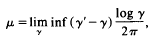
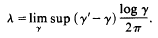
Let 0 < γ ≤ γ” denote the ordinates of consecutive nontrivial zeros of ζ(s) and set
Index to volume 33
-
- Journal:
- Mathematika / Volume 33 / Issue 2 / December 1986
- Published online by Cambridge University Press:
- 26 February 2010, p. 299
- Print publication:
- December 1986
-
- Article
- Export citation
Least primitive roots modulo the square of a prime ideal
-
- Journal:
- Mathematika / Volume 33 / Issue 2 / December 1986
- Published online by Cambridge University Press:
- 26 February 2010, pp. 244-251
- Print publication:
- December 1986
-
- Article
- Export citation
-
Let K be an algebraic number field of degree n = r1 + 2r2 (in the usual notation) over the rationals. ZK will denote the ring of integers in K. Consider the set of all totally positive primitive roots modulo the square of a prime ideal p of first degree in K. We recall (see e.g., [6], p. 249) that there exists such a primitive root mod p2, if, and only if, p is of first degree. Let vp be a least element of this set, least in the sense that its norm Nvp is minimal. We ask for the order of magnitude of Nvp in comparison to Np2. The author”s work [5] on cubefree ideal modulus character sums yields the estimate

for any a > 0, where the implied «-constant depends on a and K.

Ranks of differentiable functions
-
- Journal:
- Mathematika / Volume 33 / Issue 2 / December 1986
- Published online by Cambridge University Press:
- 26 February 2010, pp. 252-278
- Print publication:
- December 1986
-
- Article
- Export citation
Book Reviews - H. Abelson and A. diSessa. Turtle Geometry. MIT Press. 1986, 477 pp., £10·95. - M. Altman. A Unified Theory of Nonlinear Operator and Evolution Equations with Applications. Marcel Dekker. 1986, 292 pp., $83.50. - R. C. Baker. Diophantine Inequalities. London Math. Soc. Monographs, New Series, No. 1. Oxford University Press. 1986, 275 pp., £32. - T. S. Blyth and E. F. Robertson. Essential Student Algebra. 1 Sets and Mappings, 2 Matrices and Vector Spaces, 3 Abstract Algebra, 4 Linear Algebra, 5 Groups. Chapman and Hall. 1986, 120 pp each, £3·95 each. - J. H. Carruth, J. A. Hildebrant and R. J. Koch. The Theory of Topological Semigroups, Vol. 2. Marcel Dekker. 1986, 195pp., $59·29. - D. Eisenbud and W. Neumann. Three Dimensional Link Theory and Invariants of Plane Curve Singularities. Annals of Math. Studies no. 110. Princeton University Press. 1985, 172pp., £28·30, paperback £10·30. - C. F. Gardiner. Algebraic Structures. Ellis Horwood. 1986, 280pp., paperback £14·50. - P. R. Halmos. I Want to be a Mathematician. Springer. 1985, 421pp., DM 134. - R. Hill. A First Course in Coding Theory. Oxford University Press. 1986, 251pp, £25, paperback £12·50. - R. Maude. Mathematical Analysis. Edward Arnold. 1986, 224pp., £11·75. - S. G. Mikhlin. Constants in Some Inequalities of Analysis. J. Wiley & Sons.1986, 108pp., £13·75. - K. W. Morton and M. J. Baines, Editors. Numerical Methods for Fluid Dynamics II. Oxford University Press. 1986, 679pp., £60. - G. Saccheri. Euclides Vindicatus, 2nd English Edition. Chelsea. 1986, 255pp., $16·95. - V. M. Tikhomirov. Fundamental Principles of the Theory of Extremal Problems. J. Wiley & Sons.1986, 136pp., £13.95. - B. L. van der Waerden. A History of Algebra. Springer. 1985, 271pp., DM98. - P. L. Walker. The Theory of Fourier Series and Integrals. Wiley-Interscience. 1986, 192pp., £14·95.
-
- Journal:
- Mathematika / Volume 33 / Issue 2 / December 1986
- Published online by Cambridge University Press:
- 26 February 2010, pp. 296-298
- Print publication:
- December 1986
-
- Article
- Export citation
A note on the Kronecker limit formula for real quadratic fields
-
- Journal:
- Mathematika / Volume 33 / Issue 2 / December 1986
- Published online by Cambridge University Press:
- 26 February 2010, pp. 239-243
- Print publication:
- December 1986
-
- Article
- Export citation
An indecomposable polytope all of whose facets are decomposable
-
- Journal:
- Mathematika / Volume 33 / Issue 2 / December 1986
- Published online by Cambridge University Press:
- 26 February 2010, pp. 192-196
- Print publication:
- December 1986
-
- Article
- Export citation
-
A (convex) d-polytope is the convex hull of a finite set of points in Euclidean d–space Ed. The (Minkowski) sum of two polytopes P1 and P2 is defined by
 .
.
Isoperimetric problems for tilings, corrigendum
-
- Journal:
- Mathematika / Volume 33 / Issue 2 / December 1986
- Published online by Cambridge University Press:
- 26 February 2010, pp. 189-191
- Print publication:
- December 1986
-
- Article
- Export citation
-
In [1] I made the following conjecture. If we tile a convex polygon of at most six sides with N convex tiles of areas a1, …,aN, then the total perimeter of the tiles is never less than the total perimeter of N regular hexagons of areas a1, …, aN. In order to show that the condition of the convexity of the tiles cannot be omitted I constructed a tiling with an equal number of “pentagons” and “heptagons” of perimeters and areas
 and
and  , and ā5 and ā7, respectively. In a letter to me R. Schneider kindly pointed out that, in contrast to the value given in [1], the value of the quotient
  was equal to 3.7263… This being greater than √8√3 = 3–7224… the tiling given in [1] does not yield the desired counter-example. In what follows we shall construct a tiling for which the respective quotient will turn out to be less than √8√3.
 and
and  , and ā
 was equal to 3.7263… This being greater than √8√3 = 3–7224… the tiling given in [1] does not yield the desired counter-example. In what follows we shall construct a tiling for which the respective quotient will turn out to be less than √8√3.
An upper estimate for the lattice point enumerator
-
- Journal:
- Mathematika / Volume 33 / Issue 2 / December 1986
- Published online by Cambridge University Press:
- 26 February 2010, pp. 197-203
- Print publication:
- December 1986
-
- Article
- Export citation
Angle-sum relations for polyhedral sets
-
- Journal:
- Mathematika / Volume 33 / Issue 2 / December 1986
- Published online by Cambridge University Press:
- 26 February 2010, pp. 173-188
- Print publication:
- December 1986
-
- Article
- Export citation
d-sequences, local cohomology modules and generalized analytic independence
- Part of
-
- Journal:
- Mathematika / Volume 33 / Issue 2 / December 1986
- Published online by Cambridge University Press:
- 26 February 2010, pp. 279-284
- Print publication:
- December 1986
-
- Article
- Export citation
-
Throughout this paper A is a commutative noetherian ring (with identity) and M is an A-module. We use
 to denote, for i ≥ 0, the i-th right derived functor of the local cohomology functor L with respect to an ideal a of A [8; 2.1].
 to denote, for i ≥ 0, the i-th right derived functor of the local cohomology functor L with respect to an ideal a of A [8; 2.1].
On generalized Dedekind domains
- Part of
-
- Journal:
- Mathematika / Volume 33 / Issue 2 / December 1986
- Published online by Cambridge University Press:
- 26 February 2010, pp. 285-295
- Print publication:
- December 1986
-
- Article
- Export citation
MTK volume 33 issue 2 Cover and Front matter
-
- Journal:
- Mathematika / Volume 33 / Issue 2 / December 1986
- Published online by Cambridge University Press:
- 26 February 2010, pp. f1-f3
- Print publication:
- December 1986
-
- Article
-
- You have access
- Export citation
6 - Fredholm formulae and the Riesz theory
-
- Book:
- Fredholm Theory in Banach Spaces
- Published online:
- 16 October 2009
- Print publication:
- 17 July 1986, pp 135-165
-
- Chapter
- Export citation
Bibliography
-
- Book:
- Fredholm Theory in Banach Spaces
- Published online:
- 16 October 2009
- Print publication:
- 17 July 1986, pp 250-284
-
- Chapter
- Export citation
7 - Fredholm formulae for special classes of operators
-
- Book:
- Fredholm Theory in Banach Spaces
- Published online:
- 16 October 2009
- Print publication:
- 17 July 1986, pp 166-213
-
- Chapter
- Export citation
2 - Asymptotically quasi-compact operators and the Riesz theory
-
- Book:
- Fredholm Theory in Banach Spaces
- Published online:
- 16 October 2009
- Print publication:
- 17 July 1986, pp 17-41
-
- Chapter
- Export citation
Subject index
-
- Book:
- Fredholm Theory in Banach Spaces
- Published online:
- 16 October 2009
- Print publication:
- 17 July 1986, pp 288-293
-
- Chapter
- Export citation
