Refine search
Actions for selected content:
26078 results in Abstract analysis
Normal subgroups of skew linear groups
-
- Journal:
- Mathematika / Volume 33 / Issue 1 / June 1986
- Published online by Cambridge University Press:
- 26 February 2010, pp. 102-110
- Print publication:
- June 1986
-
- Article
- Export citation
Mean values of character sums
-
- Journal:
- Mathematika / Volume 33 / Issue 1 / June 1986
- Published online by Cambridge University Press:
- 26 February 2010, pp. 1-5
- Print publication:
- June 1986
-
- Article
- Export citation
-
In 1979 Montgomery and Vaughan [3] showed that for each k > 0
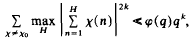
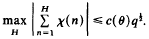
the sum being over the non-principal characters χ modulo q. As a corollary they deduced that, if 0 < θ < 1 then there is a constant c(θ) such that at least θφ(q) of the non-principal characters χ modulo q satisfy
On Waring's problem for smaller exponents. II
-
- Journal:
- Mathematika / Volume 33 / Issue 1 / June 1986
- Published online by Cambridge University Press:
- 26 February 2010, pp. 6-22
- Print publication:
- June 1986
-
- Article
- Export citation
-
Let k denote a fixed natural number with k > 2, let ℛs(n) denote the number of representations of n as the sum of sk-th powers of natural numbers, and let

with

denote the corresponding singular series.
Positive values of indefinite quadratic forms
-
- Journal:
- Mathematika / Volume 33 / Issue 1 / June 1986
- Published online by Cambridge University Press:
- 26 February 2010, pp. 164-169
- Print publication:
- June 1986
-
- Article
- Export citation
-
Let

be a real quadratic form in n variables with integral coefficients (i.e., 2fij ε ℤ, fiiε ℤ.) and determinant D ≠ O. A well-known theorem of Cassels [1] states that if the equation f = 0 is properly soluble in integers x1 … , xn then there is a solution satisfying

where F = max |fij and we use the «-notation with an implicit factor depending only on n. More recently it has been shown that f has n linearly independent zeros x1 …, xn satisfying

(see [2, 3 and 6])
The number of polytopes, configurations and real matroids
- Part of
-
- Journal:
- Mathematika / Volume 33 / Issue 1 / June 1986
- Published online by Cambridge University Press:
- 26 February 2010, pp. 62-71
- Print publication:
- June 1986
-
- Article
- Export citation
-
We show that the number of combinatorially distinct labelled d-polytopes on n vertices is at most
 , as n/d → ∞. A similar bound for the number of simplicial polytopes has previously been proved by Goodman and Pollack. This bound improves considerably the previous known bounds. We also obtain sharp upper and lower bounds for the numbers of real oriented and unoriented matroids with n elements of rank d. Our main tool is a theorem of Milnor and Thorn from real algebraic geometry.
 , as n/d → ∞. A similar bound for the number of simplicial polytopes has previously been proved by Goodman and Pollack. This bound improves considerably the previous known bounds. We also obtain sharp upper and lower bounds for the numbers of real oriented and unoriented matroids with n elements of rank d. Our main tool is a theorem of Milnor and Thorn from real algebraic geometry.
The Akivis algebra of a homogeneous loop
- Part of
-
- Journal:
- Mathematika / Volume 33 / Issue 1 / June 1986
- Published online by Cambridge University Press:
- 26 February 2010, pp. 87-95
- Print publication:
- June 1986
-
- Article
- Export citation
Note on irregularities of distribution
-
- Journal:
- Mathematika / Volume 33 / Issue 1 / June 1986
- Published online by Cambridge University Press:
- 26 February 2010, pp. 148-163
- Print publication:
- June 1986
-
- Article
- Export citation
-
Let UK = [0, 1)K be the K-dimensional unit cube, where K ≥ 2. Suppose that we have a distribution ℘ of N points in UK. For × = ( x1, … , xK) ε UK, let A(x) denote the box

and write

Note that since N is the cardinality of ℘ and x1 … xK is the K-dimensional volume of A(x), the term Nx1 … xK represents the “expected number” of, points of ℘ in A(x).
Some examples of Borel-inseparable pairs of coanalylic sets
- Part of
-
- Journal:
- Mathematika / Volume 33 / Issue 1 / June 1986
- Published online by Cambridge University Press:
- 26 February 2010, pp. 72-79
- Print publication:
- June 1986
-
- Article
- Export citation
-
The purpose of this paper is to give some natural examples of Borel-inseparable pairs of coanalytic sets in Polish spaces.
A Polish space is a topological space homeomorphic to a separable complete metric space. In this paper, all spaces are uncountable Polish spaces. A pointset is analytic (or
 ) if it is the continuous image of a Borel set (in any space), or equivalently, the projection of a Borel set, and is coanalytic (or
  ) if it is the complement of an analytic set. The class of analytic sets is closed under countable unions and intersections, images and preimages by Borel measurable functions, and projections; it is not closed under complements, hence there is an analytic set which is not Borel.
 ) if it is the continuous image of a Borel set (in any space), or equivalently, the projection of a Borel set, and is coanalytic (or
  ) if it is the complement of an analytic set. The class of analytic sets is closed under countable unions and intersections, images and preimages by Borel measurable functions, and projections; it is not closed under complements, hence there is an analytic set which is not Borel.
PRM volume 104 issue 1-2 Cover and Front matter
-
- Journal:
- Proceedings of the Royal Society of Edinburgh. Section A: Mathematics / Volume 104 / Issue 1-2 / 1986
- Published online by Cambridge University Press:
- 14 November 2011, pp. f1-f2
- Print publication:
- 1986
-
- Article
-
- You have access
- Export citation
Semidirect products of semigroups†
-
- Journal:
- Proceedings of the Royal Society of Edinburgh. Section A: Mathematics / Volume 102 / Issue 1-2 / 1986
- Published online by Cambridge University Press:
- 14 November 2011, pp. 91-102
- Print publication:
- 1986
-
- Article
- Export citation
Fractional powers of a closed pair of operators
-
- Journal:
- Proceedings of the Royal Society of Edinburgh. Section A: Mathematics / Volume 102 / Issue 1-2 / 1986
- Published online by Cambridge University Press:
- 14 November 2011, pp. 149-158
- Print publication:
- 1986
-
- Article
- Export citation
Exact estimates of the conductivity of a binary mixture of isotropic materials*
-
- Journal:
- Proceedings of the Royal Society of Edinburgh. Section A: Mathematics / Volume 104 / Issue 1-2 / 1986
- Published online by Cambridge University Press:
- 14 November 2011, pp. 21-38
- Print publication:
- 1986
-
- Article
- Export citation
Multiplicity results for nonlinear elliptic equations involving critical Sobolev exponent*
-
- Journal:
- Proceedings of the Royal Society of Edinburgh. Section A: Mathematics / Volume 103 / Issue 3-4 / 1986
- Published online by Cambridge University Press:
- 14 November 2011, pp. 275-285
- Print publication:
- 1986
-
- Article
- Export citation
-
In this paper we study the following boundary value problem

where Ω is a bounded domain in Rn, n≧3, x ∈Rn, p* = 2n/(n – 2) is the critical exponent for the Sobolev embedding
 is a real parameter and f(x, t) increases, at infinity, more slowly than
  .
.By using variational techniques, we prove the existence of multiple solutions to the equations (0.1), in the case when λ belongs to a suitable left neighbourhood of an arbitrary eigenvalue of −Δ, and the existence of at least one solution for any λ sufficiently large.
 is a real parameter and f(x, t) increases, at infinity, more slowly than
  .
.On Sobolev type integral inequalities
-
- Journal:
- Proceedings of the Royal Society of Edinburgh. Section A: Mathematics / Volume 103 / Issue 1-2 / 1986
- Published online by Cambridge University Press:
- 14 November 2011, pp. 1-14
- Print publication:
- 1986
-
- Article
- Export citation
Some homomorphisms of general and special linear groups
-
- Journal:
- Proceedings of the Royal Society of Edinburgh. Section A: Mathematics / Volume 103 / Issue 3-4 / 1986
- Published online by Cambridge University Press:
- 14 November 2011, pp. 287-291
- Print publication:
- 1986
-
- Article
- Export citation
On the asymptotic properties of solutions to a differential equation in a case of bifurcation without eigenvalues
-
- Journal:
- Proceedings of the Royal Society of Edinburgh. Section A: Mathematics / Volume 104 / Issue 1-2 / 1986
- Published online by Cambridge University Press:
- 14 November 2011, pp. 137-159
- Print publication:
- 1986
-
- Article
- Export citation
Complex and real singularities of eigenfunction expansions
-
- Journal:
- Proceedings of the Royal Society of Edinburgh. Section A: Mathematics / Volume 103 / Issue 3-4 / 1986
- Published online by Cambridge University Press:
- 14 November 2011, pp. 179-199
- Print publication:
- 1986
-
- Article
- Export citation
-
Let θ(t, λ) and (t,λ) be the solutions to the differential equation y“+(λ − q(t))y =0, − ∞ <t < ∞ such that θ(0, λ)) = l, θ'(0, λ)) = 0, ø(0, λ) = 0 and ø'(0, λ) = −1. It is known that for a function f(t)∈ L2(−∞,∞), we have
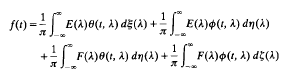
where
 for some measures dξ, dη; and dζ independent of f.
In the first part of this paper we devise a technique to locate the singular points of f(t) (t is complex) under the assumptions that E(λ), F(λ) are of order O(e-cvλ), as λ →∞and q(t) is a sufficiently nice function. In this case all the singularities of fare off the real axis. In the second part of the paper we relax the restriction on E(λ) and f(λ) so that they are of order O(λk) as λ →∞ for some constant k, and we show that in this case f(t) is a generalised function whose analytic representation
 is holomorphic in the upper and lower half planes. We then devise a technique to continue analytically across the real axis and locate its singularities thereon.
 for some measures dξ, dη; and dζ independent of f.
 is holomorphic in the upper and lower half planes. We then devise a technique to continue
 On periodic solutions of nonlinear second order vector differential equations
-
- Journal:
- Proceedings of the Royal Society of Edinburgh. Section A: Mathematics / Volume 104 / Issue 1-2 / 1986
- Published online by Cambridge University Press:
- 14 November 2011, pp. 107-125
- Print publication:
- 1986
-
- Article
- Export citation
-
This paper considers existence of periodic solutions for vector Liénard differential equations

In our main result we write

where Q(t, x) is a symmetric matrix and h(t, x) is sublinear. The key assumption relates the asymptotic behaviour as x →+ ∞ of the eigenvalues of Q(t, x) to the spectrum of the linear operator −d2/dt2 Several choices for Q(t, x) are considered which lead to known theorems and extend others. In the case of the Duffing equation

the assumptions are weakened.
Our approach is based on Leray-Schauder's degree theory and a priori estimates.

Metrizability of precompact subsets in (LF)-spaces
-
- Journal:
- Proceedings of the Royal Society of Edinburgh. Section A: Mathematics / Volume 103 / Issue 3-4 / 1986
- Published online by Cambridge University Press:
- 14 November 2011, pp. 293-299
- Print publication:
- 1986
-
- Article
- Export citation
On two-dimensional slow viscous flows past obstacles in a half-plane*
-
- Journal:
- Proceedings of the Royal Society of Edinburgh. Section A: Mathematics / Volume 104 / Issue 3-4 / 1986
- Published online by Cambridge University Press:
- 14 November 2011, pp. 205-215
- Print publication:
- 1986
-
- Article
- Export citation
