Refine search
Actions for selected content:
26078 results in Abstract analysis
A repeated transformation in the asymptotic solution of linear differential systems
-
- Journal:
- Proceedings of the Royal Society of Edinburgh. Section A: Mathematics / Volume 102 / Issue 1-2 / 1986
- Published online by Cambridge University Press:
- 14 November 2011, pp. 173-188
- Print publication:
- 1986
-
- Article
- Export citation
On the minimal eigenvalue of a positive definite operator determinant
-
- Journal:
- Proceedings of the Royal Society of Edinburgh. Section A: Mathematics / Volume 103 / Issue 3-4 / 1986
- Published online by Cambridge University Press:
- 14 November 2011, pp. 201-208
- Print publication:
- 1986
-
- Article
- Export citation
Linearisation at infinity and Lipschitz estimates for certain problems in the calculus of variations
-
- Journal:
- Proceedings of the Royal Society of Edinburgh. Section A: Mathematics / Volume 102 / Issue 3-4 / 1986
- Published online by Cambridge University Press:
- 14 November 2011, pp. 291-303
- Print publication:
- 1986
-
- Article
- Export citation
Index to Volume 102
-
- Journal:
- Proceedings of the Royal Society of Edinburgh. Section A: Mathematics / Volume 102 / Issue 3-4 / 1986
- Published online by Cambridge University Press:
- 14 November 2011, pp. i-ii
- Print publication:
- 1986
-
- Article
- Export citation
Deficiency zero presentations for certain perfect groups
-
- Journal:
- Proceedings of the Royal Society of Edinburgh. Section A: Mathematics / Volume 103 / Issue 1-2 / 1986
- Published online by Cambridge University Press:
- 14 November 2011, pp. 63-71
- Print publication:
- 1986
-
- Article
- Export citation
The G-invariant implicit function theorem in infinite dimensions II
-
- Journal:
- Proceedings of the Royal Society of Edinburgh. Section A: Mathematics / Volume 102 / Issue 3-4 / 1986
- Published online by Cambridge University Press:
- 14 November 2011, pp. 211-220
- Print publication:
- 1986
-
- Article
- Export citation
On a characterisation of Dirac measures
-
- Journal:
- Proceedings of the Royal Society of Edinburgh. Section A: Mathematics / Volume 103 / Issue 3-4 / 1986
- Published online by Cambridge University Press:
- 14 November 2011, pp. 253-264
- Print publication:
- 1986
-
- Article
- Export citation
-
Assume f ∈ C(RM, SN−1) (M ≧ 1, N ≧ 1) is periodic with period one in each variable and satisfies:

Then, every probability measure on [0, 1)M such that

is a Dirac measure at some point of [0, 1)M.
A note on a resonance problem
-
- Journal:
- Proceedings of the Royal Society of Edinburgh. Section A: Mathematics / Volume 102 / Issue 1-2 / 1986
- Published online by Cambridge University Press:
- 14 November 2011, pp. 1-7
- Print publication:
- 1986
-
- Article
- Export citation
-
In this paper, we prove the existence of at least one solution to the problem
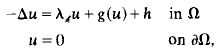
where ∆k is an eigenvalue of the linear part, h is orthogonal to the eigenspace corresponding to ∆R and g is a nonlinear perturbation which can be, for instance, a continuous periodic real function with mean value zero. We employ the techniques used by the second author in a previous paper in which the same result was obtained in the case in which ∆R is assumed to be simple. The final result is obtained by using variational methods and in particular a suitable version of the saddle point theorem of P. Rabinowitz.
Properties of some ordinary differential equations related to free boundary problems
-
- Journal:
- Proceedings of the Royal Society of Edinburgh. Section A: Mathematics / Volume 104 / Issue 3-4 / 1986
- Published online by Cambridge University Press:
- 14 November 2011, pp. 217-234
- Print publication:
- 1986
-
- Article
- Export citation
The asymptotic form of the Titchmarsh–Weyl m-function associated with a second order differential equation with locally integrable coefficient
-
- Journal:
- Proceedings of the Royal Society of Edinburgh. Section A: Mathematics / Volume 102 / Issue 3-4 / 1986
- Published online by Cambridge University Press:
- 14 November 2011, pp. 243-251
- Print publication:
- 1986
-
- Article
- Export citation
-
We derive an asymptotic expansion for the Titchmarsh–Weyl m-function associated with the second order linear differential equation

in the case where the only restriction on the real-valued function q is

Radicals and one-sided ideals
-
- Journal:
- Proceedings of the Royal Society of Edinburgh. Section A: Mathematics / Volume 103 / Issue 3-4 / 1986
- Published online by Cambridge University Press:
- 14 November 2011, pp. 241-251
- Print publication:
- 1986
-
- Article
- Export citation
PRM volume 104 issue 3-4 Cover and Front matter
-
- Journal:
- Proceedings of the Royal Society of Edinburgh. Section A: Mathematics / Volume 104 / Issue 3-4 / 1986
- Published online by Cambridge University Press:
- 14 November 2011, pp. f1-f2
- Print publication:
- 1986
-
- Article
-
- You have access
- Export citation
PRM volume 102 issue 3-4 Cover and Front matter
-
- Journal:
- Proceedings of the Royal Society of Edinburgh. Section A: Mathematics / Volume 102 / Issue 3-4 / 1986
- Published online by Cambridge University Press:
- 14 November 2011, pp. f1-f2
- Print publication:
- 1986
-
- Article
-
- You have access
- Export citation
Extension and amalgamation in rings
-
- Journal:
- Proceedings of the Royal Society of Edinburgh. Section A: Mathematics / Volume 102 / Issue 1-2 / 1986
- Published online by Cambridge University Press:
- 14 November 2011, pp. 103-115
- Print publication:
- 1986
-
- Article
- Export citation
PRM volume 104 issue 1-2 Cover and Back matter
-
- Journal:
- Proceedings of the Royal Society of Edinburgh. Section A: Mathematics / Volume 104 / Issue 1-2 / 1986
- Published online by Cambridge University Press:
- 14 November 2011, pp. b1-b2
- Print publication:
- 1986
-
- Article
-
- You have access
- Export citation
On the behaviour of eigenfunction expansions in the complex domain
-
- Journal:
- Proceedings of the Royal Society of Edinburgh. Section A: Mathematics / Volume 104 / Issue 1-2 / 1986
- Published online by Cambridge University Press:
- 14 November 2011, pp. 73-91
- Print publication:
- 1986
-
- Article
- Export citation
PRM volume 104 issue 3-4 Cover and Back matter
-
- Journal:
- Proceedings of the Royal Society of Edinburgh. Section A: Mathematics / Volume 104 / Issue 3-4 / 1986
- Published online by Cambridge University Press:
- 14 November 2011, pp. b1-b4
- Print publication:
- 1986
-
- Article
-
- You have access
- Export citation
PRM volume 103 issue 1-2 Cover and Back matter
-
- Journal:
- Proceedings of the Royal Society of Edinburgh. Section A: Mathematics / Volume 103 / Issue 1-2 / 1986
- Published online by Cambridge University Press:
- 14 November 2011, pp. b1-b2
- Print publication:
- 1986
-
- Article
-
- You have access
- Export citation
On Hamilton–Jacobi equations in bounded domains
-
- Journal:
- Proceedings of the Royal Society of Edinburgh. Section A: Mathematics / Volume 102 / Issue 3-4 / 1986
- Published online by Cambridge University Press:
- 14 November 2011, pp. 221-242
- Print publication:
- 1986
-
- Article
- Export citation
Weighted norm inequalities for the Hankel- and
 -transformations
-
- Journal:
- Proceedings of the Royal Society of Edinburgh. Section A: Mathematics / Volume 103 / Issue 3-4 / 1986
- Published online by Cambridge University Press:
- 14 November 2011, pp. 325-333
- Print publication:
- 1986
-
- Article
- Export citation
-
We give conditions on pairs of non-negative weight functions u and v which are sufficient that, for 1<p, q <∞,

where T is the Hankel-or the K-transformation.
The proofs are based on a weighted Marcinkiewicz interpolation theorem for linear operators. In the case that T is the Hankel transformation and 1<p≦q <∞, the result is similar to a weighted estimate of Heywood and Rooney [9], but with different weight conditions.
 -transformations
