Refine search
Actions for selected content:
26078 results in Abstract analysis
Subject index
-
- Book:
- Fredholm Theory in Banach Spaces
- Published online:
- 16 October 2009
- Print publication:
- 17 July 1986, pp 288-293
-
- Chapter
- Export citation
1 - Introduction
-
- Book:
- Fredholm Theory in Banach Spaces
- Published online:
- 16 October 2009
- Print publication:
- 17 July 1986, pp 1-16
-
- Chapter
- Export citation
Contents
-
- Book:
- Fredholm Theory in Banach Spaces
- Published online:
- 16 October 2009
- Print publication:
- 17 July 1986, pp vii-viii
-
- Chapter
- Export citation
4 - Fredholm theory for operators of finite rank
-
- Book:
- Fredholm Theory in Banach Spaces
- Published online:
- 16 October 2009
- Print publication:
- 17 July 1986, pp 78-117
-
- Chapter
- Export citation
Frontmatter
-
- Book:
- Fredholm Theory in Banach Spaces
- Published online:
- 16 October 2009
- Print publication:
- 17 July 1986, pp i-vi
-
- Chapter
- Export citation
Index of notations
-
- Book:
- Fredholm Theory in Banach Spaces
- Published online:
- 16 October 2009
- Print publication:
- 17 July 1986, pp 285-287
-
- Chapter
- Export citation
Preface
-
- Book:
- Fredholm Theory in Banach Spaces
- Published online:
- 16 October 2009
- Print publication:
- 17 July 1986, pp ix-x
-
- Chapter
- Export citation
3 - Tensor products of normed spaces
-
- Book:
- Fredholm Theory in Banach Spaces
- Published online:
- 16 October 2009
- Print publication:
- 17 July 1986, pp 42-77
-
- Chapter
- Export citation
5 - Operators with a Fredholm determinant
-
- Book:
- Fredholm Theory in Banach Spaces
- Published online:
- 16 October 2009
- Print publication:
- 17 July 1986, pp 118-134
-
- Chapter
- Export citation
8 - Notes and Comments
-
- Book:
- Fredholm Theory in Banach Spaces
- Published online:
- 16 October 2009
- Print publication:
- 17 July 1986, pp 214-249
-
- Chapter
- Export citation
Sphere packing in R3
-
- Journal:
- Mathematika / Volume 33 / Issue 1 / June 1986
- Published online by Cambridge University Press:
- 26 February 2010, pp. 137-147
- Print publication:
- June 1986
-
- Article
- Export citation
On the large sieve inequality in an algebraic number field
-
- Journal:
- Mathematika / Volume 33 / Issue 1 / June 1986
- Published online by Cambridge University Press:
- 26 February 2010, pp. 31-54
- Print publication:
- June 1986
-
- Article
- Export citation
-
Large sieve inequalities have been developed and applied to a host of arithmetical problems since their inception by Linnik in 1941. Such inequalities provide mean square estimates for a trigonometric polynomial over a set of well-spaced points. In particular, let x ∈ ℝ and let

Book Reviews - E. Bach. Analytic Methods in the Analysis and Design of Number Theoretic Algorithms. The MIT Press. 1985, 62 pp., £14·95. - C. A. Baker and L. M. Batten, Editors. Finite Geometries. Marcel Dekker. 1985, 387 pp., $83·50. - J. Berstel and D. Perrin. Theory of Codes. Academic Press. 1985, 447 pp., £60·00. - B. Bollobás. Random Graphs. Academic Press. 1985, 447 pp., £52·00. - M. R. Cullen. Linear Models in Biology. Ellis Horwood. 1985, 213 pp., £10·50. - J. I. Diaz. Nonlinear Partial Differential Equations and Free Boundaries, Volume I, Elliptic Equations. Pitman Adv. Publ. Program. 1985, 331pp., £18·50. - C.-E. Fröberg. Numerical Mathematics: Theory and Computer Applications. Benjamin Cummings Publ. 1985, 448pp., £15·95. - R. Geroch. Mathematical Physics. University of Chicago Press. 1986, 357pp., £25·00 (c), £12·75 (p). - R.-E. Hoffmann and K. H. Hofmann, Editors. Continuous Lattices and their Applications. Marcel Dekker. 1985, 379pp., $83·50. - A. S. Lodge et al., Editors. Viscoelasticity and Rheology. Proc. Symp. Wisconsin, 1984. Academic Press. 1985, 455pp., £31·50. - L. Narici and E. Beckenstein. Topological Vector Spaces. Marcel Dekker. 1985, 419pp., $83·50. - W. B. Powell and C. Tsinakis, Editors. Ordered Algebraic Structures. Marcel Dekker. 1985, 208pp., $59·50. - G. M. Rassias and T. M. Rassias. Editors. Differential Geometry, Calculus of Variations, and their Applications. Marcel Dekker. 1985, 536pp., $90·00. - M. Rosenblum and J. Rovnyak. Hardy Classes and Operator Theory. Oxford University Press. 1985, 175pp., £37·50. - R. J. Wilson. Introduction to Graph Theory, Third Edition. Longman. 1985, 174pp., £5·95. (Hints and Solutions Manual. £2·95).
-
- Journal:
- Mathematika / Volume 33 / Issue 1 / June 1986
- Published online by Cambridge University Press:
- 26 February 2010, pp. 170-172
- Print publication:
- June 1986
-
- Article
- Export citation
MTK volume 33 issue 1 Cover and Front matter
-
- Journal:
- Mathematika / Volume 33 / Issue 1 / June 1986
- Published online by Cambridge University Press:
- 26 February 2010, pp. f1-f4
- Print publication:
- June 1986
-
- Article
-
- You have access
- Export citation
The delay differential equation
- Part of
-
- Journal:
- Mathematika / Volume 33 / Issue 1 / June 1986
- Published online by Cambridge University Press:
- 26 February 2010, pp. 80-86
- Print publication:
- June 1986
-
- Article
- Export citation
-
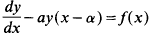
The usual method of dealing with delay differential equations such as

is the method of steps [1, 2]. In this, y(x) is assumed to be known for − α < x < 0, thereby defining
 over 0 < x < α. As a result of integration, the value of y is now known over 0 < x < α, and the integration proceeds thereon by a succession of steps.
 over 0 < x < α. As a result of integration, the value of y is now known over 0 < x < α, and the integration proceeds thereon by a succession of steps.
The prime number theorem via the large sieve
-
- Journal:
- Mathematika / Volume 33 / Issue 1 / June 1986
- Published online by Cambridge University Press:
- 26 February 2010, pp. 23-30
- Print publication:
- June 1986
-
- Article
- Export citation
-
In the last three decades there appeared a number of elementary proofs of the prime number theorem (PNT) in the literature (see [3] for a survey). Most of these proofs are based, at least in part, on ideas from the original proof by Erdős [5] and Selberg [12]. In particular, one of the main ingredients of the Erdős-Selberg proof, Selberg's formula

(where p and q run through primes) appears, in some form, in almost all these proofs.
Non-σ-finite sets for packing measure
- Part of
-
- Journal:
- Mathematika / Volume 33 / Issue 1 / June 1986
- Published online by Cambridge University Press:
- 26 February 2010, pp. 129-136
- Print publication:
- June 1986
-
- Article
- Export citation
-
In a recent paper Taylor and Tricot [10] introduced packing measures in ℝd. We modify their definition slightly to extend it to a general metric space. Our main concern is to show that in any complete separable metric space every analytic set of non-σ-finite h-packing measure contains
 disjoint compact subsets each of non-σ-finite measure. The corresponding problem for Hausdorff measures is discussed, but not completely resolved, in Rogers' book [7]. We also show that packing measure cannot be attained by taking the Hausdorff measure with respect to a different increasing function using another metric which generates the same topology. This means that the class of pacing measures is distinct from the class of Hausdorff measures.
 disjoint compact subsets each of non-σ-finite measure. The corresponding problem for Hausdorff measures is discussed, but not completely resolved, in Rogers' book [7]. We also show that packing measure cannot be attained by taking the Hausdorff measure with respect to a different increasing function using another metric which generates the same topology. This means that the class of pacing measures is distinct from the class of Hausdorff measures.
Approximate subdifferentials and applications II
- Part of
-
- Journal:
- Mathematika / Volume 33 / Issue 1 / June 1986
- Published online by Cambridge University Press:
- 26 February 2010, pp. 111-128
- Print publication:
- June 1986
-
- Article
- Export citation
A polyhedral model for Cartan's Hypersurface in S4
-
- Journal:
- Mathematika / Volume 33 / Issue 1 / June 1986
- Published online by Cambridge University Press:
- 26 February 2010, pp. 55-61
- Print publication:
- June 1986
-
- Article
- Export citation
On the Koszul homology modules for the powers of a multiplicity system
- Part of
-
- Journal:
- Mathematika / Volume 33 / Issue 1 / June 1986
- Published online by Cambridge University Press:
- 26 February 2010, pp. 96-101
- Print publication:
- June 1986
-
- Article
- Export citation
-
It is well-known that if R is a commutative ring with identity, M is a Noetherian R-module and I is an ideal of R such that M/IM has finite length, then the function n → lR (M /InM) is a polynomial function for n large (cf. [3], p. II-25), where lR denotes length as an R-module. In this note we are concerned with the function
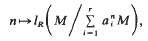
where a1, … , ar is a multiplicity system for
 has finite length.
 has finite length.