Refine search
Actions for selected content:
26077 results in Abstract analysis
Global existence and convergence to a singular steady state for a semilinear heat equation
-
- Journal:
- Proceedings of the Royal Society of Edinburgh. Section A: Mathematics / Volume 105 / Issue 1 / 1987
- Published online by Cambridge University Press:
- 14 November 2011, pp. 289-305
- Print publication:
- 1987
-
- Article
- Export citation
A note on the exact solutions for non-conservative three-wave resonance
-
- Journal:
- Proceedings of the Royal Society of Edinburgh. Section A: Mathematics / Volume 106 / Issue 3-4 / 1987
- Published online by Cambridge University Press:
- 14 November 2011, pp. 205-207
- Print publication:
- 1987
-
- Article
- Export citation
Index to Volume 105
-
- Journal:
- Proceedings of the Royal Society of Edinburgh. Section A: Mathematics / Volume 105 / Issue 1 / 1987
- Published online by Cambridge University Press:
- 14 November 2011, pp. v-vi
- Print publication:
- 1987
-
- Article
- Export citation
Existence of bounded solutions of some nonlinear parabolic equations
-
- Journal:
- Proceedings of the Royal Society of Edinburgh. Section A: Mathematics / Volume 107 / Issue 3-4 / 1987
- Published online by Cambridge University Press:
- 14 November 2011, pp. 313-326
- Print publication:
- 1987
-
- Article
- Export citation
-
This paper proves the existence of (at least) one solution of the following equation:

Here,
 is an elliptic operator of Leray-Lions type acting from
 into Lp′(0, T; W−1.p′ (Ω)), (1/p + 1/p′ = 1) and |F(u, ∇u)| ≧b(|u|)(l + |≧u|P). There are no smoothness assumptions on the bounded open set Ω; the operator
  and the nonlinearity F(u, ∇u) are denned in terms of Carathéodory functions. These points are the most characteristic features of this paper.
Assuming the existence of upper and lower solutions allows us to obtain L∞(Q)-estimates. An
 estimate is then proved. The final step is to prove the strong convergence in of the approximations. This proof relies on the method introduced by L. Boccardo, F. Murat and J. P. Puel for elliptic and parabolic problems of this type.
 is an elliptic operator of Leray-Lions type acting from
 into L
 and the nonlinearity F(u, ∇u) are denned in terms of Carathéodory functions. These points are the most characteristic features of this paper.
 estimate is then proved. The final step is to prove the strong convergence in
 PRM volume 107 issue 1-2 Cover and Front matter
-
- Journal:
- Proceedings of the Royal Society of Edinburgh. Section A: Mathematics / Volume 107 / Issue 1-2 / 1987
- Published online by Cambridge University Press:
- 14 November 2011, pp. f1-f2
- Print publication:
- 1987
-
- Article
-
- You have access
- Export citation
A class of contracted inverse semigroup rings
-
- Journal:
- Proceedings of the Royal Society of Edinburgh. Section A: Mathematics / Volume 107 / Issue 1-2 / 1987
- Published online by Cambridge University Press:
- 14 November 2011, pp. 175-196
- Print publication:
- 1987
-
- Article
- Export citation
Bifurcation of A-proper mappings without transversality considerations
-
- Journal:
- Proceedings of the Royal Society of Edinburgh. Section A: Mathematics / Volume 107 / Issue 1-2 / 1987
- Published online by Cambridge University Press:
- 14 November 2011, pp. 65-74
- Print publication:
- 1987
-
- Article
- Export citation
Geršgorin theory and the definiteness of determinantal operators
-
- Journal:
- Proceedings of the Royal Society of Edinburgh. Section A: Mathematics / Volume 106 / Issue 1-2 / 1987
- Published online by Cambridge University Press:
- 14 November 2011, pp. 1-10
- Print publication:
- 1987
-
- Article
- Export citation
-
Let Aij, l≦j≦k, be bounded Hermitean operators on Hilbert spaces Hi, 1≦i≦k, and let
 be the induced operators on
  . An important operator for multiparameter theory is δ: H →H denned by δ = det
  the determinant being expanded formally. Various definiteness properties of δ are critical for multiparameter spectral theory.
We use the operators Aij to construct a numerical matrix δ(δ) upon which we use Geršgorin theory to investigate the non-singularity and definiteness of δ. Diagonal dominance properties of the array [Aij] are also discussed.
 be the induced operators on
  . An important operator for multiparameter theory is δ: H →H denned by δ = det
  the determinant being expanded formally. Various definiteness properties of δ are critical for multiparameter spectral theory.
Analogues of the bicyclic semigroup in simple semigroups without idempotents
-
- Journal:
- Proceedings of the Royal Society of Edinburgh. Section A: Mathematics / Volume 106 / Issue 1-2 / 1987
- Published online by Cambridge University Press:
- 14 November 2011, pp. 11-24
- Print publication:
- 1987
-
- Article
- Export citation
-
By an important theorem of Andersen, any semigroup, containing idempotents, which is simple but not completely simple contains a copy of the bicyclic semigroup B = 〈a, b | ab = 1〉. In this paper the semigroups A = 〈a, b | a2b = a〉 and C = 〈a, b | a2b = a, ab2 = b〉 are shown to play a similar role in various classes of simple semigroups without idempotents, particularly in those for which Green's relation
 is nontrivial. For example it is shown that every right simple semigroup without idempotents is a union of copies of A; every finitely generated simple semigroup without idempotents contains either A or C. In a generalisation of a different sort it is shown that the bicyclic semigroup divides every simple semigroup without idempotents.
Similar results are obtained for 0-simple semigroups without nonzero idempotents.
 is nontrivial. For example it is shown that every right simple semigroup without idempotents is a union of copies of A; every finitely generated simple semigroup without idempotents contains either A or C. In a generalisation of a different sort it is shown that the bicyclic semigroup divides every simple semigroup without idempotents.
Boundary regularity and normal derivatives of logarithmic potentials
-
- Journal:
- Proceedings of the Royal Society of Edinburgh. Section A: Mathematics / Volume 106 / Issue 3-4 / 1987
- Published online by Cambridge University Press:
- 14 November 2011, pp. 241-258
- Print publication:
- 1987
-
- Article
- Export citation
Studies in multiplicative solutions to linear differential equations
-
- Journal:
- Proceedings of the Royal Society of Edinburgh. Section A: Mathematics / Volume 106 / Issue 3-4 / 1987
- Published online by Cambridge University Press:
- 14 November 2011, pp. 277-305
- Print publication:
- 1987
-
- Article
- Export citation
Periodic solutions to second order Hamiltonian systems in an unbounded potential well*
-
- Journal:
- Proceedings of the Royal Society of Edinburgh. Section A: Mathematics / Volume 105 / Issue 1 / 1987
- Published online by Cambridge University Press:
- 14 November 2011, pp. 1-15
- Print publication:
- 1987
-
- Article
- Export citation
-
In this paper we give some results on the existence of periodic solutions to the second order Hamiltonian system:
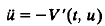
where
 and Ω is an open set of ℝn with non-empty bounded complement ℝn\Ω; we suppose V(t, x) is periodic in t, V(t, x)→ + ∞ as x → ∂Ω and V is super (or sub)-quadratic as |x| → + ∞.
 and Ω is an open set of ℝ
PRM volume 105 issue 1 Cover and Back matter
-
- Journal:
- Proceedings of the Royal Society of Edinburgh. Section A: Mathematics / Volume 105 / Issue 1 / 1987
- Published online by Cambridge University Press:
- 14 November 2011, pp. b1-b2
- Print publication:
- 1987
-
- Article
-
- You have access
- Export citation
Erratum: Comparison principles for strongly coupled reaction-diffusion equations
-
- Journal:
- Proceedings of the Royal Society of Edinburgh. Section A: Mathematics / Volume 107 / Issue 1-2 / 1987
- Published online by Cambridge University Press:
- 14 November 2011, p. 199
- Print publication:
- 1987
-
- Article
- Export citation
On the number of conjugacy classes of π-elements in a finite group*
-
- Journal:
- Proceedings of the Royal Society of Edinburgh. Section A: Mathematics / Volume 107 / Issue 1-2 / 1987
- Published online by Cambridge University Press:
- 14 November 2011, pp. 121-132
- Print publication:
- 1987
-
- Article
- Export citation
On a new class of Hardy type inequalities
-
- Journal:
- Proceedings of the Royal Society of Edinburgh. Section A: Mathematics / Volume 105 / Issue 1 / 1987
- Published online by Cambridge University Press:
- 14 November 2011, pp. 265-274
- Print publication:
- 1987
-
- Article
- Export citation
A deletion-contraction algorithm for the characteristic polynomial of a multigraph
-
- Journal:
- Proceedings of the Royal Society of Edinburgh. Section A: Mathematics / Volume 105 / Issue 1 / 1987
- Published online by Cambridge University Press:
- 14 November 2011, pp. 153-160
- Print publication:
- 1987
-
- Article
- Export citation
Index to Volume 107
-
- Journal:
- Proceedings of the Royal Society of Edinburgh. Section A: Mathematics / Volume 107 / Issue 3-4 / 1987
- Published online by Cambridge University Press:
- 14 November 2011, pp. v-vi
- Print publication:
- 1987
-
- Article
- Export citation
A remark on the equation of a vibrating plate
-
- Journal:
- Proceedings of the Royal Society of Edinburgh. Section A: Mathematics / Volume 106 / Issue 3-4 / 1987
- Published online by Cambridge University Press:
- 14 November 2011, pp. 307-314
- Print publication:
- 1987
-
- Article
- Export citation
PRM volume 107 issue 3-4 Cover and Back matter
-
- Journal:
- Proceedings of the Royal Society of Edinburgh. Section A: Mathematics / Volume 107 / Issue 3-4 / 1987
- Published online by Cambridge University Press:
- 14 November 2011, pp. b1-b4
- Print publication:
- 1987
-
- Article
-
- You have access
- Export citation
