Refine search
Actions for selected content:
26077 results in Abstract analysis
The structure of the singularities of holomorphic matrices
-
- Journal:
- Proceedings of the Royal Society of Edinburgh. Section A: Mathematics / Volume 107 / Issue 1-2 / 1987
- Published online by Cambridge University Press:
- 14 November 2011, pp. 1-14
- Print publication:
- 1987
-
- Article
- Export citation
A variational approach for a class of singular perturbation problems and applications
-
- Journal:
- Proceedings of the Royal Society of Edinburgh. Section A: Mathematics / Volume 107 / Issue 1-2 / 1987
- Published online by Cambridge University Press:
- 14 November 2011, pp. 27-42
- Print publication:
- 1987
-
- Article
- Export citation
-
We study the limit as ε → 0 of global minimisers of functionals of the type

where Ω is an annul us or a ball in ℝn.
On the fixed point index in locally convex spaces
-
- Journal:
- Proceedings of the Royal Society of Edinburgh. Section A: Mathematics / Volume 106 / Issue 1-2 / 1987
- Published online by Cambridge University Press:
- 14 November 2011, pp. 161-168
- Print publication:
- 1987
-
- Article
- Export citation
On the zeros of solutions to nonlinear hyperbolic equations
-
- Journal:
- Proceedings of the Royal Society of Edinburgh. Section A: Mathematics / Volume 106 / Issue 1-2 / 1987
- Published online by Cambridge University Press:
- 14 November 2011, pp. 121-129
- Print publication:
- 1987
-
- Article
- Export citation
-
We consider the hyperbolic equation uxy + c(x, y, u) =f(x, y) and the wave equation

We show that, under suitable conditions, there are bounded domains in which every solution to certain problems has a zero. Characteristic initial value problems and initial boundary value problems are considered.
On the time-asymptotic behaviour of solutions in thermoelasticity*
-
- Journal:
- Proceedings of the Royal Society of Edinburgh. Section A: Mathematics / Volume 107 / Issue 3-4 / 1987
- Published online by Cambridge University Press:
- 14 November 2011, pp. 289-298
- Print publication:
- 1987
-
- Article
- Export citation
Unstable planes for rank 2 reflexive sheaves
-
- Journal:
- Proceedings of the Royal Society of Edinburgh. Section A: Mathematics / Volume 105 / Issue 1 / 1987
- Published online by Cambridge University Press:
- 14 November 2011, pp. 161-166
- Print publication:
- 1987
-
- Article
- Export citation
Short time behaviour of a singular solution to the heat equation with absorption
-
- Journal:
- Proceedings of the Royal Society of Edinburgh. Section A: Mathematics / Volume 107 / Issue 3-4 / 1987
- Published online by Cambridge University Press:
- 14 November 2011, pp. 271-288
- Print publication:
- 1987
-
- Article
- Export citation
-
The paper considers the small time evolution of the interface which appears in the boundary value problem
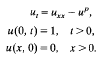
A diffusion dominated small time outer expansion is not uniformly valid when x = O(t½ log t) and has to be supplemented by an inner expansion valid in a region where diffusion and absorption are of equal importance. For p < 1 a zero order inner solution is constructed, which is consistent with a moving interface where u is zero, and the small time development of this is given.
These results are first derived in a heuristic way using the method of matched expansions. However, an important aim of the paper is to give rigorous proofs, being one of the very few cases in nonlinear diffusion where this has been done.
Comparison principles for strongly coupled reaction-diffusion equations
-
- Journal:
- Proceedings of the Royal Society of Edinburgh. Section A: Mathematics / Volume 106 / Issue 3-4 / 1987
- Published online by Cambridge University Press:
- 14 November 2011, pp. 209-219
- Print publication:
- 1987
-
- Article
- Export citation
An elliptic boundary-value problem with a discontinuous nonlinearity, II
-
- Journal:
- Proceedings of the Royal Society of Edinburgh. Section A: Mathematics / Volume 105 / Issue 1 / 1987
- Published online by Cambridge University Press:
- 14 November 2011, pp. 23-36
- Print publication:
- 1987
-
- Article
- Export citation
-
Let Ω be a bounded domain in ℝ2. The study, begun in Keady [13], of the boundary-value problem, for (λ/k, ψ),
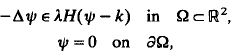
is continued. Here Δ denotes the Laplacian, H is the Heaviside step function and one of λ or k is a given positive constant. The solutions considered always have ψ > 0 in Ω and λ/k > 0, and have cores

In the special case Ω = B(0, R), a disc, the explicit exact solutions of the branch τe have connected cores A and the diameter of A tends to zero when the area of A tends to zero. This result is established here for other convex domains Ω and solutions with connected cores A.
An adaptation of the maximum principles and of the domain folding arguments of Gidas, Ni and Nirenberg [9] is an important step in establishing the above result.
Sturmian theory for nonself-adjoint differential equations of second order
-
- Journal:
- Proceedings of the Royal Society of Edinburgh. Section A: Mathematics / Volume 105 / Issue 1 / 1987
- Published online by Cambridge University Press:
- 14 November 2011, pp. 337-343
- Print publication:
- 1987
-
- Article
- Export citation
An example of H1-unboundedness of solutions to strongly elliptic systems of partial differential equations in a laminated geometry
-
- Journal:
- Proceedings of the Royal Society of Edinburgh. Section A: Mathematics / Volume 105 / Issue 1 / 1987
- Published online by Cambridge University Press:
- 14 November 2011, pp. 77-82
- Print publication:
- 1987
-
- Article
- Export citation
Homogenisation of a viscoelastic equation with non-periodic coefficients
-
- Journal:
- Proceedings of the Royal Society of Edinburgh. Section A: Mathematics / Volume 106 / Issue 1-2 / 1987
- Published online by Cambridge University Press:
- 14 November 2011, pp. 143-160
- Print publication:
- 1987
-
- Article
- Export citation
A perturbation theorem for exponential dichotomies
-
- Journal:
- Proceedings of the Royal Society of Edinburgh. Section A: Mathematics / Volume 106 / Issue 1-2 / 1987
- Published online by Cambridge University Press:
- 14 November 2011, pp. 25-37
- Print publication:
- 1987
-
- Article
- Export citation
Floquet solutions of non-linear ordinary differential equations
-
- Journal:
- Proceedings of the Royal Society of Edinburgh. Section A: Mathematics / Volume 106 / Issue 3-4 / 1987
- Published online by Cambridge University Press:
- 14 November 2011, pp. 267-275
- Print publication:
- 1987
-
- Article
- Export citation
-
In this paper we study the solutions of the boundary value problem

where t ∊ℝ, x ∊ ℝN, f is a continuous function of (t,x)and locally Lipschitz in x and ω is a fixed positive number and λ ∊ ℝ. By using degree theory we prove results on the existence of solutions of (*) and the dependence of such solutions on λ. We shall prove that (*) does not have an isolated solution, and study the topological properties of the components of solutions of (*).
A class of time periodic Hamiltonians with no bound states
-
- Journal:
- Proceedings of the Royal Society of Edinburgh. Section A: Mathematics / Volume 105 / Issue 1 / 1987
- Published online by Cambridge University Press:
- 14 November 2011, pp. 37-42
- Print publication:
- 1987
-
- Article
- Export citation
Two-parameter strong laws and maximal inequalities for U-statistics*
-
- Journal:
- Proceedings of the Royal Society of Edinburgh. Section A: Mathematics / Volume 107 / Issue 1-2 / 1987
- Published online by Cambridge University Press:
- 14 November 2011, pp. 133-151
- Print publication:
- 1987
-
- Article
- Export citation
Some remarks concerning quasiconvexity and strong convergence
-
- Journal:
- Proceedings of the Royal Society of Edinburgh. Section A: Mathematics / Volume 106 / Issue 1-2 / 1987
- Published online by Cambridge University Press:
- 14 November 2011, pp. 53-61
- Print publication:
- 1987
-
- Article
- Export citation
Dynamic phase transitions: Existence of “cavitation” waves
-
- Journal:
- Proceedings of the Royal Society of Edinburgh. Section A: Mathematics / Volume 107 / Issue 1-2 / 1987
- Published online by Cambridge University Press:
- 14 November 2011, pp. 153-163
- Print publication:
- 1987
-
- Article
- Export citation
Semilinear evolution equations and fractional powers of a closed pair of operators
-
- Journal:
- Proceedings of the Royal Society of Edinburgh. Section A: Mathematics / Volume 105 / Issue 1 / 1987
- Published online by Cambridge University Press:
- 14 November 2011, pp. 101-115
- Print publication:
- 1987
-
- Article
- Export citation
PRM volume 106 issue 1-2 Cover and Front matter
-
- Journal:
- Proceedings of the Royal Society of Edinburgh. Section A: Mathematics / Volume 106 / Issue 1-2 / 1987
- Published online by Cambridge University Press:
- 14 November 2011, pp. f1-f2
- Print publication:
- 1987
-
- Article
-
- You have access
- Export citation
