Refine search
Actions for selected content:
26078 results in Abstract analysis
On the question of whether f″+ e−zf′ + B(z)f = 0 can admit a solution f ≢ 0 of finite order
-
- Journal:
- Proceedings of the Royal Society of Edinburgh. Section A: Mathematics / Volume 102 / Issue 1-2 / 1986
- Published online by Cambridge University Press:
- 14 November 2011, pp. 9-17
- Print publication:
- 1986
-
- Article
- Export citation
A general monotone scheme for elliptic systems with applications to ecological models
-
- Journal:
- Proceedings of the Royal Society of Edinburgh. Section A: Mathematics / Volume 102 / Issue 3-4 / 1986
- Published online by Cambridge University Press:
- 14 November 2011, pp. 315-325
- Print publication:
- 1986
-
- Article
- Export citation
-
We consider weakly-coupled elliptic systems of the type

with each fi being either an increasing or a decreasing function of each uj. Assuming the existence of coupled super- and subsolutions, we prove the existence of solutions, and provide a constructive iteration scheme to approximate the solutions. We then apply our results to study the steady-states of two-species interaction in the Volterra–Lotka model with diffusion.
Mixed boundary value problems of the type of Sommerfeld's half-plane problem*
-
- Journal:
- Proceedings of the Royal Society of Edinburgh. Section A: Mathematics / Volume 104 / Issue 3-4 / 1986
- Published online by Cambridge University Press:
- 14 November 2011, pp. 261-277
- Print publication:
- 1986
-
- Article
- Export citation
Boundary integral equations for magnetic screens in ℝ3*
-
- Journal:
- Proceedings of the Royal Society of Edinburgh. Section A: Mathematics / Volume 102 / Issue 3-4 / 1986
- Published online by Cambridge University Press:
- 14 November 2011, pp. 189-210
- Print publication:
- 1986
-
- Article
- Export citation
The set of positive solutions of semilinear equations in large balls
-
- Journal:
- Proceedings of the Royal Society of Edinburgh. Section A: Mathematics / Volume 104 / Issue 1-2 / 1986
- Published online by Cambridge University Press:
- 14 November 2011, pp. 53-72
- Print publication:
- 1986
-
- Article
- Export citation
PRM volume 102 issue 1-2 Cover and Front matter
-
- Journal:
- Proceedings of the Royal Society of Edinburgh. Section A: Mathematics / Volume 102 / Issue 1-2 / 1986
- Published online by Cambridge University Press:
- 14 November 2011, pp. f1-f2
- Print publication:
- 1986
-
- Article
-
- You have access
- Export citation
Homoclinic and heteroclinic orbits of reversible vectorfields under perturbation
-
- Journal:
- Proceedings of the Royal Society of Edinburgh. Section A: Mathematics / Volume 102 / Issue 3-4 / 1986
- Published online by Cambridge University Press:
- 14 November 2011, pp. 345-363
- Print publication:
- 1986
-
- Article
- Export citation
Existence conditions for higher order eigensets of multiparameter operators
-
- Journal:
- Proceedings of the Royal Society of Edinburgh. Section A: Mathematics / Volume 103 / Issue 1-2 / 1986
- Published online by Cambridge University Press:
- 14 November 2011, pp. 137-146
- Print publication:
- 1986
-
- Article
- Export citation
-
We consider classes of self-adjoint operators
 for which the nonpositive part of the spectrum consists of eigenvalues ρ0(λ)≦ ρ1(») ≦ … repeated according to multiplicity. The sets of λ where ρi(λ) is negative and zero are labelled Ni and Zi respectively, and Pi = ℝk\(Ni ∪ Zi). We study conditions on the Vj sufficient to ensure nonemptiness of at least one of Ni, Zi and Pi for all T or for all positive definite T, as well as conditions which are necessary in the sense that failure permits emptiness for at least one T.
As an example of our results, we show in the Sturm–Liouville case
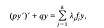
with L∞ coefficients and separated end conditions, that nonemptiness of Zi for all T (i.e. for all p > 0, all q and all boundary data) is equivalent to the i-independent condition that the ftj do not vanish simultaneously on a set of positive measure.
 for which the nonpositive part of the spectrum consists of eigenvalues ρ
PRM volume 103 issue 3-4 Cover and Back matter
-
- Journal:
- Proceedings of the Royal Society of Edinburgh. Section A: Mathematics / Volume 103 / Issue 3-4 / 1986
- Published online by Cambridge University Press:
- 14 November 2011, pp. b1-b4
- Print publication:
- 1986
-
- Article
-
- You have access
- Export citation
Erratum: Multiparameter definiteness conditions II [Proc. Roy. Soc. Edinburgh Sect. A 93 (1982), 47-61]
-
- Journal:
- Proceedings of the Royal Society of Edinburgh. Section A: Mathematics / Volume 103 / Issue 3-4 / 1986
- Published online by Cambridge University Press:
- 14 November 2011, p. 359
- Print publication:
- 1986
-
- Article
- Export citation
Growth properties of solutions to a linear differential equation
-
- Journal:
- Proceedings of the Royal Society of Edinburgh. Section A: Mathematics / Volume 104 / Issue 1-2 / 1986
- Published online by Cambridge University Press:
- 14 November 2011, pp. 127-135
- Print publication:
- 1986
-
- Article
- Export citation
The Ljapunov equation and an application to stabilisation of one-dimensional diffusion equations*
-
- Journal:
- Proceedings of the Royal Society of Edinburgh. Section A: Mathematics / Volume 104 / Issue 1-2 / 1986
- Published online by Cambridge University Press:
- 14 November 2011, pp. 39-52
- Print publication:
- 1986
-
- Article
- Export citation
Some applications of Hausdorff dimension inequalities for ordinary differential equations
-
- Journal:
- Proceedings of the Royal Society of Edinburgh. Section A: Mathematics / Volume 104 / Issue 3-4 / 1986
- Published online by Cambridge University Press:
- 14 November 2011, pp. 235-259
- Print publication:
- 1986
-
- Article
- Export citation
Index to Volume 104
-
- Journal:
- Proceedings of the Royal Society of Edinburgh. Section A: Mathematics / Volume 104 / Issue 3-4 / 1986
- Published online by Cambridge University Press:
- 14 November 2011, pp. i-ii
- Print publication:
- 1986
-
- Article
- Export citation
On prespectrality of generalised derivations*
-
- Journal:
- Proceedings of the Royal Society of Edinburgh. Section A: Mathematics / Volume 104 / Issue 1-2 / 1986
- Published online by Cambridge University Press:
- 14 November 2011, pp. 93-106
- Print publication:
- 1986
-
- Article
- Export citation
-
In this paper it is proved that, for scalar-type operators a and b on an infinite dimensional separable complex Hilbert space H, the generalised derivation Δa,b, defined for bounded linear operators x onℋ by the equation Δa,bx = ax − xb, is a (scalar-type) prespectral operator of the class
 (the trace class operators on ℋ) if and only if at least one of the spectra σ(a)or σ(b)is finite. It is shown also that the same condition is necessary and sufficient for Δa,b restricted to any one of the von Neumann-Schatten classes(p≠2) to be a spectral operator (of scalar type). Our results may be compared with those of J. Anderson and C. Foiaş, who established in [1] that, for scalar-type a, b, Δa,b is a (scalar-type) spectral operator if and only if both spectra, σ(a) and σ(b), are finite. However, we use different and more direct methods to show the existence or nonexistence of the spectral resolution of identity for Δa,b.
 (the trace class operators on ℋ) if and only if at least one of the spectra σ(a)or σ(b)is finite. It is shown also that the same condition is necessary and sufficient for Δ
Global blow-up of a nonlinear heat equation
-
- Journal:
- Proceedings of the Royal Society of Edinburgh. Section A: Mathematics / Volume 104 / Issue 1-2 / 1986
- Published online by Cambridge University Press:
- 14 November 2011, pp. 161-167
- Print publication:
- 1986
-
- Article
- Export citation
On the boundary operator in electromagnetic scattering
-
- Journal:
- Proceedings of the Royal Society of Edinburgh. Section A: Mathematics / Volume 103 / Issue 1-2 / 1986
- Published online by Cambridge University Press:
- 14 November 2011, pp. 91-98
- Print publication:
- 1986
-
- Article
- Export citation
Minimum action solutions of non-linear elliptic equations in unbounded domains containing a plane
-
- Journal:
- Proceedings of the Royal Society of Edinburgh. Section A: Mathematics / Volume 102 / Issue 3-4 / 1986
- Published online by Cambridge University Press:
- 14 November 2011, pp. 327-343
- Print publication:
- 1986
-
- Article
- Export citation
Corrigendum: Convergence theorems for intermediate problems
-
- Journal:
- Proceedings of the Royal Society of Edinburgh. Section A: Mathematics / Volume 104 / Issue 3-4 / 1986
- Published online by Cambridge University Press:
- 14 November 2011, pp. 349-350
- Print publication:
- 1986
-
- Article
- Export citation
Approximation to inverses of normal operators
-
- Journal:
- Proceedings of the Royal Society of Edinburgh. Section A: Mathematics / Volume 103 / Issue 3-4 / 1986
- Published online by Cambridge University Press:
- 14 November 2011, pp. 335-345
- Print publication:
- 1986
-
- Article
- Export citation
