Refine search
Actions for selected content:
26078 results in Abstract analysis
PREFACE
-
- Book:
- A Local Spectral Theory for Closed Operators
- Published online:
- 05 April 2013
- Print publication:
- 01 August 1985, pp vii-viii
-
- Chapter
- Export citation
BIBLIOGRAPHY
-
- Book:
- A Local Spectral Theory for Closed Operators
- Published online:
- 05 April 2013
- Print publication:
- 01 August 1985, pp 162-176
-
- Chapter
- Export citation
Frontmatter
-
- Book:
- A Local Spectral Theory for Closed Operators
- Published online:
- 05 April 2013
- Print publication:
- 01 August 1985, pp i-iv
-
- Chapter
- Export citation
Contents
-
- Book:
- A Local Spectral Theory for Closed Operators
- Published online:
- 05 April 2013
- Print publication:
- 01 August 1985, pp v-vi
-
- Chapter
- Export citation
Glossary of Notations and Symbols
-
- Book:
- A Local Spectral Theory for Closed Operators
- Published online:
- 05 April 2013
- Print publication:
- 01 August 1985, pp ix-x
-
- Chapter
- Export citation
Chapter III - SPECTRAL DUALITY
-
- Book:
- A Local Spectral Theory for Closed Operators
- Published online:
- 05 April 2013
- Print publication:
- 01 August 1985, pp 61-80
-
- Chapter
- Export citation
Index
-
- Book:
- A Local Spectral Theory for Closed Operators
- Published online:
- 05 April 2013
- Print publication:
- 01 August 1985, pp 177-178
-
- Chapter
- Export citation
Chapter IV - SPECTRAL RESOLVENTS
-
- Book:
- A Local Spectral Theory for Closed Operators
- Published online:
- 05 April 2013
- Print publication:
- 01 August 1985, pp 81-107
-
- Chapter
- Export citation
Chapter II - THE SPECTRAL DECOMPOSITION PROPERTY
-
- Book:
- A Local Spectral Theory for Closed Operators
- Published online:
- 05 April 2013
- Print publication:
- 01 August 1985, pp 33-60
-
- Chapter
- Export citation
Appendix B - Some open problems
-
- Book:
- A Local Spectral Theory for Closed Operators
- Published online:
- 05 April 2013
- Print publication:
- 01 August 1985, pp 161-161
-
- Chapter
- Export citation
Appendix A - The (**)-version of the predual theorem
-
- Book:
- A Local Spectral Theory for Closed Operators
- Published online:
- 05 April 2013
- Print publication:
- 01 August 1985, pp 148-160
-
- Chapter
- Export citation
Chapter V - SPECIAL TOPICS IN SPECTRAL DECOMPOSITION
-
- Book:
- A Local Spectral Theory for Closed Operators
- Published online:
- 05 April 2013
- Print publication:
- 01 August 1985, pp 108-147
-
- Chapter
- Export citation
On Hayman's alternative
- Part of
-
- Journal:
- Mathematika / Volume 32 / Issue 1 / June 1985
- Published online by Cambridge University Press:
- 26 February 2010, pp. 139-146
- Print publication:
- June 1985
-
- Article
- Export citation
-
Suppose that f(z) is non-constant and meromorphic in the plane and that, for some k≥= 1, a0(z),…, ak(z) are meromorphic in the plane with

for j' = 0,…, k. Here, using standard notation from [3], S(r,f) denotes any quantity satisfying S(r,f) = o(T(r,f)) as r→ ∞, possibly outside a set of finite linear measure. Then, setting

we have ([3, p. 57])
Theorem A. Suppose that f(z) is non-constant and meromorphic in the plane, and thatψ (z) given by (1.2) and (1.1) and is non-constant. Then

where N0(r, l/ψ') counts only zeros of ψ' which are not zeros of ψ − 1, and the
 counting functions count points without regard to multiplicity.
 counting functions count points without regard to multiplicity.
On transformations of the biharmonic equation
- Part of
-
- Journal:
- Mathematika / Volume 32 / Issue 1 / June 1985
- Published online by Cambridge University Press:
- 26 February 2010, pp. 118-130
- Print publication:
- June 1985
-
- Article
- Export citation
-
Consider a point transformation of the biharmonic equation
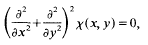
namely a coordinate transformation

together with a change of dependent variable given by

for some multiplier F(ξ, η).
MTK volume 32 issue 1 Cover and Front matter
-
- Journal:
- Mathematika / Volume 32 / Issue 1 / June 1985
- Published online by Cambridge University Press:
- 26 February 2010, pp. f1-f4
- Print publication:
- June 1985
-
- Article
-
- You have access
- Export citation
Singularities of bessel-zeta functions and Hawkins' polynomials
-
- Journal:
- Mathematika / Volume 32 / Issue 1 / June 1985
- Published online by Cambridge University Press:
- 26 February 2010, pp. 96-103
- Print publication:
- June 1985
-
- Article
- Export citation
-
The asymptotic behaviour of a sequence of polynomials cm = cm(v) satisfying
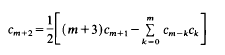
is established. These polynomials occur in Hawkins' formula for the residues of a Bessel-zeta function at its possible poles in the left half plane. The results imply that cm(v)/cm(0) converges uniformly to cos πV on compact sets. This in turn implies that, for v not a half odd integer, all but finitely many of the possible poles are actual poles.
Solution of a problem of Knuth on complete uniform distribution of sequences
-
- Journal:
- Mathematika / Volume 32 / Issue 1 / June 1985
- Published online by Cambridge University Press:
- 26 February 2010, pp. 26-32
- Print publication:
- June 1985
-
- Article
- Export citation
-
It is proved that the sequence
 is completely uniformly distributed modulo 1 for almost all real numbers x with |x|> 1, if (an) is an arbitrary sequence of distinct positive integers.
 is completely uniformly distributed modulo 1 for almost all real numbers x with |x|> 1, if (a
Thinness and boundary behaviour of potentials for the heat equation
- Part of
-
- Journal:
- Mathematika / Volume 32 / Issue 1 / June 1985
- Published online by Cambridge University Press:
- 26 February 2010, pp. 90-95
- Print publication:
- June 1985
-
- Article
- Export citation
-
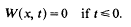
For (x, t) ∈ Rn+1, we put
On an extremal property of the Rudin-Shapiro sequence
-
- Journal:
- Mathematika / Volume 32 / Issue 1 / June 1985
- Published online by Cambridge University Press:
- 26 February 2010, pp. 33-38
- Print publication:
- June 1985
-
- Article
- Export citation
-
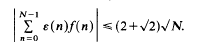
Extending the well-known property of the Rudin- Shapiro sequence ε = (ε(n)) with values in {−1, +1} satisfying

we show that for all unimodular 2-multiplicative sequences f = (f(n))
Zeros of generalized Airy functions
-
- Journal:
- Mathematika / Volume 32 / Issue 1 / June 1985
- Published online by Cambridge University Press:
- 26 February 2010, pp. 104-117
- Print publication:
- June 1985
-
- Article
- Export citation
-
Some interlacing properties of the zeros of the generalized Airy functions A1(z, p) are given for non-positive integral values of p. The result that A1 (z,p) has no real zero for
 is extended to show that all the zeros of A1(z,p) are real and simple if . It is also shown that all the zeros of the functions Bk(z,p, 1) for k = 1, 2, 3 are simple for non-positive integral p.
 is extended to show that all the zeros of A