Refine search
Actions for selected content:
26078 results in Abstract analysis
Free actions on (Sn)k
-
- Journal:
- Mathematika / Volume 32 / Issue 1 / June 1985
- Published online by Cambridge University Press:
- 26 February 2010, pp. 49-54
- Print publication:
- June 1985
-
- Article
- Export citation
Extending classical criteria for differentiation theorems
- Part of
-
- Journal:
- Mathematika / Volume 32 / Issue 1 / June 1985
- Published online by Cambridge University Press:
- 26 February 2010, pp. 68-74
- Print publication:
- June 1985
-
- Article
- Export citation
Isoperimetric problems for tilings
-
- Journal:
- Mathematika / Volume 32 / Issue 1 / June 1985
- Published online by Cambridge University Press:
- 26 February 2010, pp. 10-15
- Print publication:
- June 1985
-
- Article
- Export citation
The asymptotic solution of linear differential systems
- Part of
-
- Journal:
- Mathematika / Volume 32 / Issue 1 / June 1985
- Published online by Cambridge University Press:
- 26 February 2010, pp. 131-138
- Print publication:
- June 1985
-
- Article
- Export citation
-
In the paper which forms the basis for the modern asymptotic theory of linear differential systems, Levinson [22] considered the system

on an interval [a, ∞), where
(1) A is a constant nÜn matrix with n distinct eigenvalues and either
(2a) R(x) is L(a, ∞)
or
(2b) R(x)→0 as x→∞ and R'(x) is L(a, ∞).
Cohomology of Bieberbach groups
- Part of
-
- Journal:
- Mathematika / Volume 32 / Issue 1 / June 1985
- Published online by Cambridge University Press:
- 26 February 2010, pp. 55-59
- Print publication:
- June 1985
-
- Article
- Export citation
-
Recently, Szczepariski [11] has constructed examples of aspherical manifolds with the ℚ-homology of a sphere. More precisely, if k is a commutative ring of characteristic zero containing
 , the following theorem holds.
 , the following theorem holds.
A note on the integral points of a modular curve of level 7
-
- Journal:
- Mathematika / Volume 32 / Issue 1 / June 1985
- Published online by Cambridge University Press:
- 26 February 2010, pp. 45-48
- Print publication:
- June 1985
-
- Article
- Export citation
-
Let
 . denote the modular curve associated with the normalizer of a non-split Cartan group of level N., where N. is an arbitrary integer. The curve is denned over Q and the corresponding scheme over ℤ[1/N] is smooth [1]. If N. is a prime, the genus formula for . is given in [5,6]. The curve . has genus 0 if N < 11 and
  has genus 1. Ligozat [5] has shown that the group of Q-rational points on has rank 1. If the genus g(N). is greater than 1, very little is known about the Q-rational points of . Since under simple conditions imaginary quadratic fields with class number 1 give an integral point on these curves, Serre and others have asked whether all integral points are obtained in this way [8].
 . denote the modular curve associated with the normalizer of a non-split Cartan group of level N., where N. is an arbitrary integer. The curve
  has genus 1. Ligozat [5] has shown that the group of Q-rational points on
 Functions and measures on products spaces
- Part of
-
- Journal:
- Mathematika / Volume 32 / Issue 1 / June 1985
- Published online by Cambridge University Press:
- 26 February 2010, pp. 60-67
- Print publication:
- June 1985
-
- Article
- Export citation
The distribution of exponential sums
-
- Journal:
- Mathematika / Volume 32 / Issue 1 / June 1985
- Published online by Cambridge University Press:
- 26 February 2010, pp. 16-25
- Print publication:
- June 1985
-
- Article
- Export citation
-
We shall consider incomplete exponential sums of the shape
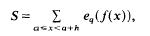
where q, a and h are integers satisfying 1 ≤ a < a + h ≤ q, f(x) is a function denned at least for the integers in the range of summation, and eq(t) is an abbreviation for e2πit/q.
An upper bound for the index of χ-irregularity
-
- Journal:
- Mathematika / Volume 32 / Issue 1 / June 1985
- Published online by Cambridge University Press:
- 26 February 2010, pp. 39-44
- Print publication:
- June 1985
-
- Article
- Export citation
Convex bodies equidecomposable by locally discrete groups of isometries
- Part of
-
- Journal:
- Mathematika / Volume 32 / Issue 1 / June 1985
- Published online by Cambridge University Press:
- 26 February 2010, pp. 1-9
- Print publication:
- June 1985
-
- Article
- Export citation
Perturbation theory for a displacement front passing discontinuities in capillary pressure and permeability in a porous medium
- Part of
-
- Journal:
- Mathematika / Volume 32 / Issue 1 / June 1985
- Published online by Cambridge University Press:
- 26 February 2010, pp. 75-89
- Print publication:
- June 1985
-
- Article
- Export citation
Separation of K–analytic sets
- Part of
-
- Journal:
- Mathematika / Volume 32 / Issue 1 / June 1985
- Published online by Cambridge University Press:
- 26 February 2010, pp. 147-190
- Print publication:
- June 1985
-
- Article
- Export citation
-
In [5] we have developed part of a theory of K- analytic sets that forms a common generalization of the theory of Lindelöf K- analytic sets developed by Choquet, Sion and Frolik and the theory of metric
 analytic sets developed by Stone and Hansell. As we explain in [5], this theory parallels the recently developed theory of Frolík and Holický, but has certain advantages. In this paper we take the theory rather further, and, in particular, we prove a number of variants of Lusin's first separation theorem and give some of their applications. We make free use of the definitions, notation and conventions introduced in [5].
 analytic sets developed by Stone and Hansell. As we explain in [5], this theory parallels the recently developed theory of Frolík and Holický, but has certain advantages. In this paper we take the theory rather further, and, in particular, we prove a number of variants of Lusin's first separation theorem and give some of their applications. We make free use of the definitions, notation and conventions introduced in [5].
List of Symbols
-
- Book:
- The Banach-Tarski Paradox
- Published online:
- 05 August 2012
- Print publication:
- 23 May 1985, pp 248-249
-
- Chapter
- Export citation
Addendum to Second Printing
-
- Book:
- The Banach-Tarski Paradox
- Published online:
- 05 August 2012
- Print publication:
- 23 May 1985, pp 234-235
-
- Chapter
- Export citation
Chapter 6 - Free Groups of Large Rank: Getting a Continuum of Spheres from One
- from Part I - Paradoxical Decompositions, or the Nonexistence of Finitely Additive Measures
-
- Book:
- The Banach-Tarski Paradox
- Published online:
- 05 August 2012
- Print publication:
- 23 May 1985, pp 73-95
-
- Chapter
- Export citation
Appendix B - Jordan Measure
-
- Book:
- The Banach-Tarski Paradox
- Published online:
- 05 August 2012
- Print publication:
- 23 May 1985, pp 227-228
-
- Chapter
- Export citation
Frontmatter
-
- Book:
- The Banach-Tarski Paradox
- Published online:
- 05 August 2012
- Print publication:
- 23 May 1985, pp i-vi
-
- Chapter
- Export citation
Chapter 12 - Growth Conditions in Groups and Supramenability
- from Part II - Finitely Additive Measures, or the Nonexistence of Paradoxical Decompositions
-
- Book:
- The Banach-Tarski Paradox
- Published online:
- 05 August 2012
- Print publication:
- 23 May 1985, pp 188-206
-
- Chapter
- Export citation
Part II - Finitely Additive Measures, or the Nonexistence of Paradoxical Decompositions
-
- Book:
- The Banach-Tarski Paradox
- Published online:
- 05 August 2012
- Print publication:
- 23 May 1985, pp 123-124
-
- Chapter
- Export citation
Chapter 5 - Higher Dimensions and Non-Euclidean Spaces
- from Part I - Paradoxical Decompositions, or the Nonexistence of Finitely Additive Measures
-
- Book:
- The Banach-Tarski Paradox
- Published online:
- 05 August 2012
- Print publication:
- 23 May 1985, pp 52-72
-
- Chapter
- Export citation
