Refine search
Actions for selected content:
26078 results in Abstract analysis
On an inequality of Hardy-Littlewood type: I
-
- Journal:
- Proceedings of the Royal Society of Edinburgh. Section A: Mathematics / Volume 101 / Issue 1-2 / 1985
- Published online by Cambridge University Press:
- 14 November 2011, pp. 131-140
- Print publication:
- 1985
-
- Article
- Export citation
-
This paper gives a complete analysis of the integral inequality

where the integral on the left may be only conditionally convergent. It is shown that the best possible number K is 4 and all cases of equality are identified in terms of Hankel-Bessel functions of order ⅓.
A transmission problem for the plate equation
-
- Journal:
- Proceedings of the Royal Society of Edinburgh. Section A: Mathematics / Volume 99 / Issue 3-4 / 1985
- Published online by Cambridge University Press:
- 14 November 2011, pp. 285-312
- Print publication:
- 1985
-
- Article
- Export citation
Some multipoint extensions of the Rayleigh–Ritz inequality
-
- Journal:
- Proceedings of the Royal Society of Edinburgh. Section A: Mathematics / Volume 100 / Issue 1-2 / 1985
- Published online by Cambridge University Press:
- 14 November 2011, pp. 157-174
- Print publication:
- 1985
-
- Article
- Export citation
On a nonlinear eigenvalue problem occurring in population genetics
-
- Journal:
- Proceedings of the Royal Society of Edinburgh. Section A: Mathematics / Volume 100 / Issue 1-2 / 1985
- Published online by Cambridge University Press:
- 14 November 2011, pp. 85-101
- Print publication:
- 1985
-
- Article
- Export citation
-
We discuss the nonlinear eigenvalue problem
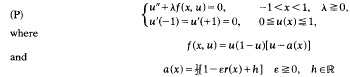
with r(–×) = –r(×) and r'≧0.
For ε = h =0, the solution to Problem P is wellknown, and every solution, except u = 0 and u =1, is unstable with respect to the corresponding parabolic problem.
PRM volume 101 issue 3 Cover and Back matter
-
- Journal:
- Proceedings of the Royal Society of Edinburgh. Section A: Mathematics / Volume 101 / Issue 3-4 / 1985
- Published online by Cambridge University Press:
- 14 November 2011, pp. b1-b4
- Print publication:
- 1985
-
- Article
-
- You have access
- Export citation
PRM volume 99 issue 3-4 Cover and Front matter
-
- Journal:
- Proceedings of the Royal Society of Edinburgh. Section A: Mathematics / Volume 99 / Issue 3-4 / 1985
- Published online by Cambridge University Press:
- 14 November 2011, pp. f1-f2
- Print publication:
- 1985
-
- Article
-
- You have access
- Export citation
Sheaf representations of strongly harmonic rings
-
- Journal:
- Proceedings of the Royal Society of Edinburgh. Section A: Mathematics / Volume 99 / Issue 3-4 / 1985
- Published online by Cambridge University Press:
- 14 November 2011, pp. 249-268
- Print publication:
- 1985
-
- Article
- Export citation
On the periodic solution of the Van der Pol oscillator with large damping
-
- Journal:
- Proceedings of the Royal Society of Edinburgh. Section A: Mathematics / Volume 100 / Issue 1-2 / 1985
- Published online by Cambridge University Press:
- 14 November 2011, pp. 103-106
- Print publication:
- 1985
-
- Article
- Export citation
PRM volume 100 issue 3-4 Cover and Back matter
-
- Journal:
- Proceedings of the Royal Society of Edinburgh. Section A: Mathematics / Volume 100 / Issue 3-4 / 1985
- Published online by Cambridge University Press:
- 14 November 2011, pp. b1-b4
- Print publication:
- 1985
-
- Article
-
- You have access
- Export citation
A classification of the solutions of a differential equation according to their behaviour at infinity, II
-
- Journal:
- Proceedings of the Royal Society of Edinburgh. Section A: Mathematics / Volume 100 / Issue 1-2 / 1985
- Published online by Cambridge University Press:
- 14 November 2011, pp. 53-66
- Print publication:
- 1985
-
- Article
- Export citation
Spectral functions of a symmetric linear relation with a directing mapping, II
-
- Journal:
- Proceedings of the Royal Society of Edinburgh. Section A: Mathematics / Volume 101 / Issue 1-2 / 1985
- Published online by Cambridge University Press:
- 14 November 2011, pp. 111-124
- Print publication:
- 1985
-
- Article
- Export citation
Counting common representatives and symmetric chain decompositions
-
- Journal:
- Proceedings of the Royal Society of Edinburgh. Section A: Mathematics / Volume 100 / Issue 1-2 / 1985
- Published online by Cambridge University Press:
- 14 November 2011, pp. 151-155
- Print publication:
- 1985
-
- Article
- Export citation
Periodic solutions to functional differential equations
-
- Journal:
- Proceedings of the Royal Society of Edinburgh. Section A: Mathematics / Volume 101 / Issue 3-4 / 1985
- Published online by Cambridge University Press:
- 14 November 2011, pp. 253-271
- Print publication:
- 1985
-
- Article
- Export citation
-
We consider a system of functional differential equations

where G: R × B → Rn is T periodic in t and B is a certain phase space of continuous functions that map (−∞, 0[ into Rn. The concepts of B-uniform boundedness and B-uniform ultimate boundedness are introduced, and sufficient conditions are given for the existence of a T-periodic solution to (1.1). Several examples are given to illustrate the main theorem.
An Ω-estimate for the lattice rest of a convex planar domain
-
- Journal:
- Proceedings of the Royal Society of Edinburgh. Section A: Mathematics / Volume 100 / Issue 3-4 / 1985
- Published online by Cambridge University Press:
- 14 November 2011, pp. 295-299
- Print publication:
- 1985
-
- Article
- Export citation
-
Let D be a compact convex planar domain containing the origin, the boundary of which is of class C∞ and has finite non-vanishing curvature throughout. For the number A(i) of lattice points in the “blown up” domain √tD, the estimate

is established. This is a generalization of Hardy's classical result for the circle problem. The proof is based on asymptotic formulae for certain exponential integrals due to E. Hlawka.
On some nonlinear elliptic equations involving derivatives of the nonlinearity
-
- Journal:
- Proceedings of the Royal Society of Edinburgh. Section A: Mathematics / Volume 100 / Issue 3-4 / 1985
- Published online by Cambridge University Press:
- 14 November 2011, pp. 281-294
- Print publication:
- 1985
-
- Article
- Export citation
-
We give some results on existence and uniqueness for the solution of elliptic boundary value problems of type

when the βi are not necessarily smooth.
On a discrete-time version of a problem of A. J. Pritchard and J. Zabczyk
-
- Journal:
- Proceedings of the Royal Society of Edinburgh. Section A: Mathematics / Volume 101 / Issue 1-2 / 1985
- Published online by Cambridge University Press:
- 14 November 2011, pp. 159-161
- Print publication:
- 1985
-
- Article
- Export citation
Non-linear mixed boundary value problems for parabolic partial differential equations
-
- Journal:
- Proceedings of the Royal Society of Edinburgh. Section A: Mathematics / Volume 100 / Issue 3-4 / 1985
- Published online by Cambridge University Press:
- 14 November 2011, pp. 219-235
- Print publication:
- 1985
-
- Article
- Export citation
Positive perturbations of self-adjoint Schrödinger operators
-
- Journal:
- Proceedings of the Royal Society of Edinburgh. Section A: Mathematics / Volume 99 / Issue 3-4 / 1985
- Published online by Cambridge University Press:
- 14 November 2011, pp. 241-248
- Print publication:
- 1985
-
- Article
- Export citation
-
In this paper, we prove that a positive perturbation T = T0 + q (q ≧ 0 and in
 ) of an essentially self-adjoint Schrödinger operator T0 = −Δ + q0 on
  is again essentially self-adjoint if T is relatively bounded with respect to T0. An application of the method of the proof to positive approximations of elements u ≧ 0 in D(T) by a positive sequence in
  is given.
 ) of an essentially self-adjoint Schrödinger operator T
 is again essentially self-adjoint if T is relatively bounded with respect to T
 is given.
On the growth of solutions to second order differential equations in Banach spaces
-
- Journal:
- Proceedings of the Royal Society of Edinburgh. Section A: Mathematics / Volume 101 / Issue 3-4 / 1985
- Published online by Cambridge University Press:
- 14 November 2011, pp. 237-252
- Print publication:
- 1985
-
- Article
- Export citation
Effects of commensurable delays in the stability of difference equations
-
- Journal:
- Proceedings of the Royal Society of Edinburgh. Section A: Mathematics / Volume 100 / Issue 3-4 / 1985
- Published online by Cambridge University Press:
- 14 November 2011, pp. 191-199
- Print publication:
- 1985
-
- Article
- Export citation
