Refine search
Actions for selected content:
26078 results in Abstract analysis
PRM volume 99 issue 3-4 Cover and Back matter
-
- Journal:
- Proceedings of the Royal Society of Edinburgh. Section A: Mathematics / Volume 99 / Issue 3-4 / 1985
- Published online by Cambridge University Press:
- 14 November 2011, pp. b1-b4
- Print publication:
- 1985
-
- Article
-
- You have access
- Export citation
PRM volume 100 issue 1-2 Cover and Back matter
-
- Journal:
- Proceedings of the Royal Society of Edinburgh. Section A: Mathematics / Volume 100 / Issue 1-2 / 1985
- Published online by Cambridge University Press:
- 14 November 2011, pp. b1-b2
- Print publication:
- 1985
-
- Article
-
- You have access
- Export citation
Singular perturbation of a nonlinear problem with multiple solutions
-
- Journal:
- Proceedings of the Royal Society of Edinburgh. Section A: Mathematics / Volume 100 / Issue 3-4 / 1985
- Published online by Cambridge University Press:
- 14 November 2011, pp. 327-341
- Print publication:
- 1985
-
- Article
- Export citation
-
A nonlinear boundary value problem (P) having positive parameters L and a is considered. We associate with it a family of perturbed problems (
 ) affected by the presence of a barrier parameter γ related to L and a. There is a critical value L*(a) of the parameter L such that for L >L*(a), (P) has no regular solution. Then some natural extensions of (P), solutions of a free boundary value problem, arise as singular limits of ().
 ) affected by the presence of a barrier parameter γ related to L and a. There is a critical value L
Amalgamation properties in the class of MS-algebras
-
- Journal:
- Proceedings of the Royal Society of Edinburgh. Section A: Mathematics / Volume 100 / Issue 1-2 / 1985
- Published online by Cambridge University Press:
- 14 November 2011, pp. 139-149
- Print publication:
- 1985
-
- Article
- Export citation
Convergence theorems for intermediate problems
-
- Journal:
- Proceedings of the Royal Society of Edinburgh. Section A: Mathematics / Volume 100 / Issue 1-2 / 1985
- Published online by Cambridge University Press:
- 14 November 2011, pp. 107-122
- Print publication:
- 1985
-
- Article
- Export citation
An extension of the Liouville–Green asymptotic formula for oscillatory second-order differential equations
-
- Journal:
- Proceedings of the Royal Society of Edinburgh. Section A: Mathematics / Volume 100 / Issue 3-4 / 1985
- Published online by Cambridge University Press:
- 14 November 2011, pp. 181-190
- Print publication:
- 1985
-
- Article
- Export citation
The commutative ring of a finite projective plane
-
- Journal:
- Proceedings of the Royal Society of Edinburgh. Section A: Mathematics / Volume 101 / Issue 1-2 / 1985
- Published online by Cambridge University Press:
- 14 November 2011, pp. 57-59
- Print publication:
- 1985
-
- Article
- Export citation
Travelling waves in radially symmetric parabolic systems
-
- Journal:
- Proceedings of the Royal Society of Edinburgh. Section A: Mathematics / Volume 99 / Issue 3-4 / 1985
- Published online by Cambridge University Press:
- 14 November 2011, pp. 269-275
- Print publication:
- 1985
-
- Article
- Export citation
PRM volume 101 issue 1-2 Cover and Front Matter
-
- Journal:
- Proceedings of the Royal Society of Edinburgh. Section A: Mathematics / Volume 101 / Issue 1-2 / 1985
- Published online by Cambridge University Press:
- 14 November 2011, pp. f1-f2
- Print publication:
- 1985
-
- Article
- Export citation
Energy decay for the wave equation with a degenerate dissipative term
-
- Journal:
- Proceedings of the Royal Society of Edinburgh. Section A: Mathematics / Volume 100 / Issue 1-2 / 1985
- Published online by Cambridge University Press:
- 14 November 2011, pp. 19-27
- Print publication:
- 1985
-
- Article
- Export citation
-
Decay estimates for the energy are derived for the initial boundary value problem of the wave equation with a degenerate dissipative term:
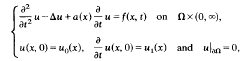
where Ω is a bounded domain in Rn, a(×) is a nonnegative function such that a1 ∊Lp(Ω) for some p > 0 and f is a function tending to 0 rapidly as t → ∞
Flows on centre manifolds for scalar functional differential equations
-
- Journal:
- Proceedings of the Royal Society of Edinburgh. Section A: Mathematics / Volume 101 / Issue 3-4 / 1985
- Published online by Cambridge University Press:
- 14 November 2011, pp. 193-201
- Print publication:
- 1985
-
- Article
- Export citation
Corrigenda: Resolution of a semilinear equation in L1
-
- Journal:
- Proceedings of the Royal Society of Edinburgh. Section A: Mathematics / Volume 99 / Issue 3-4 / 1985
- Published online by Cambridge University Press:
- 14 November 2011, p. 399
- Print publication:
- 1985
-
- Article
-
- You have access
- Export citation
-
Page 277, line 14: Read “measure” instead of “distribution”.
Page 287, line 1: Read “
 (Ω)” instead of “
 ′(Ω)”,
line 13: Read “explanation” instead of “generalization”,
line 23: Read “In fact, Corollary 1” instead of “In fact, Corollary 2”.
We thank Professor L. Véron for directing our attention to these mistakes.
 (Ω)” instead of “
 ′(Ω)”,
On the existence of eigenvalues for some nonlinear elliptic and hyperbolic problems*
-
- Journal:
- Proceedings of the Royal Society of Edinburgh. Section A: Mathematics / Volume 101 / Issue 3-4 / 1985
- Published online by Cambridge University Press:
- 14 November 2011, pp. 297-305
- Print publication:
- 1985
-
- Article
- Export citation
Inverse multi-parameter eigenvalue problems for matrices*
-
- Journal:
- Proceedings of the Royal Society of Edinburgh. Section A: Mathematics / Volume 100 / Issue 1-2 / 1985
- Published online by Cambridge University Press:
- 14 November 2011, pp. 29-38
- Print publication:
- 1985
-
- Article
- Export citation
A note on the paper “Existence conditions for eigenvalue problems generated by compact multiparameter operators” by P. Binding, P. J. Browne and L. Turyn
-
- Journal:
- Proceedings of the Royal Society of Edinburgh. Section A: Mathematics / Volume 101 / Issue 1-2 / 1985
- Published online by Cambridge University Press:
- 14 November 2011, pp. 147-148
- Print publication:
- 1985
-
- Article
- Export citation
Products of idempotent linear transformations
-
- Journal:
- Proceedings of the Royal Society of Edinburgh. Section A: Mathematics / Volume 100 / Issue 1-2 / 1985
- Published online by Cambridge University Press:
- 14 November 2011, pp. 123-138
- Print publication:
- 1985
-
- Article
- Export citation
Gradient estimates for semilinear elliptic equations
-
- Journal:
- Proceedings of the Royal Society of Edinburgh. Section A: Mathematics / Volume 100 / Issue 1-2 / 1985
- Published online by Cambridge University Press:
- 14 November 2011, pp. 11-17
- Print publication:
- 1985
-
- Article
- Export citation
Symmetry sets
-
- Journal:
- Proceedings of the Royal Society of Edinburgh. Section A: Mathematics / Volume 101 / Issue 1-2 / 1985
- Published online by Cambridge University Press:
- 14 November 2011, pp. 163-186
- Print publication:
- 1985
-
- Article
- Export citation
Travelling-wave solutions to the Korteweg-de Vries-Burgers equation
-
- Journal:
- Proceedings of the Royal Society of Edinburgh. Section A: Mathematics / Volume 101 / Issue 3-4 / 1985
- Published online by Cambridge University Press:
- 14 November 2011, pp. 207-226
- Print publication:
- 1985
-
- Article
- Export citation
-
The existence and certain qualitative properties of travelling-wave solutions to the Korteweg-de Vries-Burgers equation,

are established. The limiting behaviour of these waves, when ε tends to zero and when δ tends to zero is examined together with a singular limit wherein both ε and δ tend to zero.
The deficiency indices of powers of second order expressions with large leading coefficient
-
- Journal:
- Proceedings of the Royal Society of Edinburgh. Section A: Mathematics / Volume 101 / Issue 3-4 / 1985
- Published online by Cambridge University Press:
- 14 November 2011, pp. 227-235
- Print publication:
- 1985
-
- Article
- Export citation
