Refine search
Actions for selected content:
26079 results in Abstract analysis
RICCI SOLITONS AND CONTACT METRIC MANIFOLDS
-
- Journal:
- Glasgow Mathematical Journal / Volume 55 / Issue 1 / January 2013
- Published online by Cambridge University Press:
- 02 August 2012, pp. 123-130
-
- Article
-
- You have access
- Export citation
TWO REMARKS ON PQε-PROJECTIVITY OF RIEMANNIAN METRICS
-
- Journal:
- Glasgow Mathematical Journal / Volume 55 / Issue 1 / January 2013
- Published online by Cambridge University Press:
- 02 August 2012, pp. 131-138
-
- Article
-
- You have access
- Export citation
THE SYMMETRIC GENUS OF 2-GROUPS
-
- Journal:
- Glasgow Mathematical Journal / Volume 55 / Issue 1 / January 2013
- Published online by Cambridge University Press:
- 02 August 2012, pp. 9-21
-
- Article
-
- You have access
- Export citation
ON SELF-INTERSECTION INVARIANTS
-
- Journal:
- Glasgow Mathematical Journal / Volume 55 / Issue 2 / May 2013
- Published online by Cambridge University Press:
- 02 August 2012, pp. 259-273
-
- Article
-
- You have access
- Export citation
L1-SMOOTHING FOR THE ORNSTEIN–UHLENBECK SEMIGROUP
- Part of
-
- Journal:
- Mathematika / Volume 59 / Issue 1 / January 2013
- Published online by Cambridge University Press:
- 02 August 2012, pp. 160-168
- Print publication:
- January 2013
-
- Article
- Export citation
FINITE DOMINATION AND NOVIKOV RINGS. ITERATIVE APPROACH
-
- Journal:
- Glasgow Mathematical Journal / Volume 55 / Issue 1 / January 2013
- Published online by Cambridge University Press:
- 02 August 2012, pp. 145-160
-
- Article
-
- You have access
- Export citation
MINOR ARC MOMENTS OF WEYL SUMS
-
- Journal:
- Glasgow Mathematical Journal / Volume 55 / Issue 1 / January 2013
- Published online by Cambridge University Press:
- 02 August 2012, pp. 97-113
-
- Article
-
- You have access
- Export citation
ALGEBRAIC CONVERGENCE THEOREMS OF COMPLEX KLEINIAN GROUPS
-
- Journal:
- Glasgow Mathematical Journal / Volume 55 / Issue 1 / January 2013
- Published online by Cambridge University Press:
- 02 August 2012, pp. 1-8
-
- Article
-
- You have access
- Export citation
PURE-INJECTIVES RELATIVE TO A COTORSION PAIR: APPLICATIONS
-
- Journal:
- Glasgow Mathematical Journal / Volume 55 / Issue 1 / January 2013
- Published online by Cambridge University Press:
- 02 August 2012, pp. 59-68
-
- Article
-
- You have access
- Export citation
EXPONENTIAL POLYNOMIAL APPROXIMATION OF WEIGHTED BANACH SPACE ON ℝn
-
- Journal:
- Glasgow Mathematical Journal / Volume 55 / Issue 1 / January 2013
- Published online by Cambridge University Press:
- 02 August 2012, pp. 115-121
-
- Article
-
- You have access
- Export citation
Boundary blow-up solutions for p-Laplacian elliptic equations of logistic type
-
- Journal:
- Proceedings of the Royal Society of Edinburgh. Section A: Mathematics / Volume 142 / Issue 4 / August 2012
- Published online by Cambridge University Press:
- 10 August 2012, pp. 691-714
- Print publication:
- August 2012
-
- Article
- Export citation
ON A STRONG VERSION OF THE KEPLER CONJECTURE
- Part of
-
- Journal:
- Mathematika / Volume 59 / Issue 1 / January 2013
- Published online by Cambridge University Press:
- 01 August 2012, pp. 23-30
- Print publication:
- January 2013
-
- Article
-
- You have access
- Export citation
-
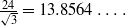
We raise and investigate the following problem which one can regard as a very close relative of the densest sphere packing problem. If the Euclidean 3-space is partitioned into convex cells each containing a unit ball, how should the shapes of the cells be designed to minimize the average surface area of the cells? In particular, we prove that the average surface area in question is always at least
Elastic waves in layered media: Two-scale homogenization approach
-
- Journal:
- European Journal of Applied Mathematics / Volume 23 / Issue 6 / December 2012
- Published online by Cambridge University Press:
- 01 August 2012, pp. 691-707
-
- Article
- Export citation
Existence of semiclassical ground-state solutions for semilinear elliptic systems
-
- Journal:
- Proceedings of the Royal Society of Edinburgh. Section A: Mathematics / Volume 142 / Issue 4 / August 2012
- Published online by Cambridge University Press:
- 10 August 2012, pp. 867-895
- Print publication:
- August 2012
-
- Article
- Export citation
-
This paper is concerned with the following semilinear elliptic equations of the form
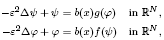
where ε is a small positive parameter, and where f and g denote superlinear and subcritical nonlinearity. Suppose that b(x) has at least one maximum. We prove that the system has a ground-state solution (ψε, φε) for all sufficiently small ε > 0. Moreover, we show that (ψε, φε) converges to the ground-state solution of the associated limit problem and concentrates to a maxima point of b(x) in certain sense, as ε → 0. Furthermore, we obtain sufficient conditions for nonexistence of ground-state solutions.
Divergence of solutions of polynomial finite-difference equations
-
- Journal:
- Proceedings of the Royal Society of Edinburgh. Section A: Mathematics / Volume 142 / Issue 4 / August 2012
- Published online by Cambridge University Press:
- 10 August 2012, pp. 787-804
- Print publication:
- August 2012
-
- Article
- Export citation
Simplicial cohomology of band semigroup algebras
-
- Journal:
- Proceedings of the Royal Society of Edinburgh. Section A: Mathematics / Volume 142 / Issue 4 / August 2012
- Published online by Cambridge University Press:
- 10 August 2012, pp. 715-744
- Print publication:
- August 2012
-
- Article
- Export citation
General uniqueness results and blow-up rates for large solutions of elliptic equations
-
- Journal:
- Proceedings of the Royal Society of Edinburgh. Section A: Mathematics / Volume 142 / Issue 4 / August 2012
- Published online by Cambridge University Press:
- 10 August 2012, pp. 825-837
- Print publication:
- August 2012
-
- Article
- Export citation
-
Making use of the Karamata regular variation theory and the López-Gómez localization method, we establish the uniqueness and asymptotic behaviour near the boundary ∂Ω for the large solutions of the singular boundary-value problem
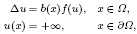
where Ω is a smooth bounded domain in ℝN. The weight function b(x) is a non-negative continuous function in the domain, which can vanish on the boundary ∂Ω at different rates according to the point x0 ∊ ∂Ω. f(u) is locally Lipschitz continuous such that f(u)/u is increasing on (0, ∞) and f(u)/up = H(u) for sufficiently large u and p > 1, here H(u) is slowly varying at infinity. Our main result provides a sharp extension of a recent result of Xie with f satisfying limu→f(u)/up = H for some positive constants H > 0 and p > 1.
Non-standard oscillation theory for multiparameter eigenvalue problems
-
- Journal:
- Proceedings of the Royal Society of Edinburgh. Section A: Mathematics / Volume 142 / Issue 4 / August 2012
- Published online by Cambridge University Press:
- 10 August 2012, pp. 673-690
- Print publication:
- August 2012
-
- Article
- Export citation
Hardy—Poincaré inequalities with boundary singularities
-
- Journal:
- Proceedings of the Royal Society of Edinburgh. Section A: Mathematics / Volume 142 / Issue 4 / August 2012
- Published online by Cambridge University Press:
- 10 August 2012, pp. 769-786
- Print publication:
- August 2012
-
- Article
- Export citation
Wave-breaking phenomena, decay properties and limit behaviour of solutions of the Degasperis—Procesi equation
-
- Journal:
- Proceedings of the Royal Society of Edinburgh. Section A: Mathematics / Volume 142 / Issue 4 / August 2012
- Published online by Cambridge University Press:
- 10 August 2012, pp. 805-824
- Print publication:
- August 2012
-
- Article
- Export citation
