Refine search
Actions for selected content:
26079 results in Abstract analysis
STABILITY OF GORENSTEIN FLAT MODULES
-
- Journal:
- Glasgow Mathematical Journal / Volume 54 / Issue 1 / January 2012
- Published online by Cambridge University Press:
- 09 December 2011, pp. 169-175
-
- Article
-
- You have access
- Export citation
-
Sather-Wagstaff et al. proved in [8] (S. Sather-Wagsta, T. Sharif and D. White, Stability of Gorenstein categories, J. Lond. Math. Soc.(2), 77(2) (2008), 481–502) that iterating the process used to define Gorenstein projective modules exactly leads to the Gorenstein projective modules. Also, they established in [9] (S. Sather-Wagsta, T. Sharif and D. White, AB-contexts and stability for Goren-stein at modules with respect to semi-dualizing modules, Algebra Represent. Theory14(3) (2011), 403–428) a stability of the subcategory of Gorenstein flat modules under a procedure to build R-modules from complete resolutions. In this paper we are concerned with another kind of stability of the class of Gorenstein flat modules via-à-vis the very Gorenstein process used to define Gorenstein flat modules. We settle in affirmative the following natural question in the setting of a left GF-closed ring R: Given an exact sequence of Gorenstein flat R-modules G = ⋅⋅⋅


STABILITY OF GORENSTEIN FLAT CATEGORIES
-
- Journal:
- Glasgow Mathematical Journal / Volume 54 / Issue 1 / January 2012
- Published online by Cambridge University Press:
- 09 December 2011, pp. 177-191
-
- Article
-
- You have access
- Export citation
JMJ volume 11 issue 1 Cover and Back matter
-
- Journal:
- Journal of the Institute of Mathematics of Jussieu / Volume 11 / Issue 1 / January 2012
- Published online by Cambridge University Press:
- 09 December 2011, pp. b1-b2
- Print publication:
- January 2012
-
- Article
-
- You have access
- Export citation
NOTE ON q-DEDEKIND-TYPE SUMS RELATED TO q-EULER POLYNOMIALS
-
- Journal:
- Glasgow Mathematical Journal / Volume 54 / Issue 1 / January 2012
- Published online by Cambridge University Press:
- 09 December 2011, pp. 121-125
-
- Article
-
- You have access
- Export citation
GMJ volume 54 issue 1 Cover and Back matter
-
- Journal:
- Glasgow Mathematical Journal / Volume 54 / Issue 1 / January 2012
- Published online by Cambridge University Press:
- 09 December 2011, pp. b1-b2
-
- Article
-
- You have access
- Export citation
ON FLATNESS COVERS OF CYCLIC ACTS OVER MONOIDS
-
- Journal:
- Glasgow Mathematical Journal / Volume 54 / Issue 1 / January 2012
- Published online by Cambridge University Press:
- 09 December 2011, pp. 163-167
-
- Article
-
- You have access
- Export citation
A MEAN VALUE RELATED TO D. H. LEHMER'S PROBLEM AND THE RAMANUJAN'S SUM*
-
- Journal:
- Glasgow Mathematical Journal / Volume 54 / Issue 1 / January 2012
- Published online by Cambridge University Press:
- 09 December 2011, pp. 155-162
-
- Article
-
- You have access
- Export citation
-
Let q > 1 be an odd integer and c be a fixed integer with (c, q) = 1. For each integer a with 1 ≤ a ≤ q − 1, it is clear that there exists one and only one b with 0 ≤ b ≤ q − 1 such that ab ≡ c (mod q). Let N(c, q) denotes the number of all solutions of the congruence equation ab ≡ c (mod q) for 1 ≤ a, b ≤ q − 1 in which a and b are of opposite parity, where b is defined by the congruence equation bb ≡ 1(modq). The main purpose of this paper is using the mean value theorem of Dirichlet L-functions to study the mean value properties of a summation involving (N(c, q) −


ON THE SPECTRA OF PISOT NUMBERS
-
- Journal:
- Glasgow Mathematical Journal / Volume 54 / Issue 1 / January 2012
- Published online by Cambridge University Press:
- 09 December 2011, pp. 127-132
-
- Article
-
- You have access
- Export citation
-
Let θ be a real number greater than 1, and let (()) be the fractional part function. Then, θ is said to be a Z-number if there is a non-zero real number λ such that ((λθn)) <

 . Also, the following characterisation of Pisot numbers among real numbers greater than 1 is shown: θ is a Pisot number ⇔ ∃ λ ≠ 0 such that
 for all
 an ∈ {0,1}, N ∈ ℕ}, where ‖λα‖ = min{((λα)), 1 − ((λα))}.

 . Also, the following characterisation of Pisot numbers among real numbers greater than 1 is shown: θ is a Pisot number ⇔ ∃ λ ≠ 0 such that
 for all
 a
aTHE COMPLEXITY OF THE EQUIVALENCE PROBLEM OVER FINITE RINGS
-
- Journal:
- Glasgow Mathematical Journal / Volume 54 / Issue 1 / January 2012
- Published online by Cambridge University Press:
- 09 December 2011, pp. 193-199
-
- Article
-
- You have access
- Export citation
EXPLICIT REPRESENTATIONS OF THE INTEGRAL CONTAINING THE ERROR TERM IN THE DIVISOR PROBLEM II
-
- Journal:
- Glasgow Mathematical Journal / Volume 54 / Issue 1 / January 2012
- Published online by Cambridge University Press:
- 09 December 2011, pp. 133-147
-
- Article
-
- You have access
- Export citation
-
In our previous paper [2], we derived an explicit representation of the integral ∫1∞t−θΔ(t)logjtdt by differentiation under the integral sign. Here, j is a fixed natural number, θ is a complex number with 1 <


JMJ volume 11 issue 1 Cover and Front matter
-
- Journal:
- Journal of the Institute of Mathematics of Jussieu / Volume 11 / Issue 1 / January 2012
- Published online by Cambridge University Press:
- 09 December 2011, pp. f1-f2
- Print publication:
- January 2012
-
- Article
-
- You have access
- Export citation
MULTIPLE POSITIVE SOLUTIONS OF RESONANT AND NON-RESONANT NON-LOCAL FOURTH-ORDER BOUNDARY VALUE PROBLEMS
-
- Journal:
- Glasgow Mathematical Journal / Volume 54 / Issue 1 / January 2012
- Published online by Cambridge University Press:
- 09 December 2011, pp. 225-240
-
- Article
-
- You have access
- Export citation
-
We study the existence of positive solutions for equations of the form
 where 0 < ω < π, subject to various non-local boundary conditions defined in terms of the Riemann–Stieltjes integrals. We prove the existence and multiplicity of positive solutions for these boundary value problems in both resonant and non-resonant cases. We discuss the resonant case by making a shift and considering an equivalent non-resonant problem.
THE DIVISIBILITY OF THE CLASS NUMBER OF THE IMAGINARY QUADRATIC FIELD

-
- Journal:
- Glasgow Mathematical Journal / Volume 54 / Issue 1 / January 2012
- Published online by Cambridge University Press:
- 09 December 2011, pp. 149-154
-
- Article
-
- You have access
- Export citation
-
Let hK denote the class number of the imaginary quadratic field
, where m and n are positive integers, k is an odd integer with k > 1 and 22m < kn. In this paper we prove that if either 3 ∣ n and 22m − kn ≡ 5(mod 8) or n = 3 and k = (22m+2 −1)/3, then 

INTEGRAL FORMULAE ON QUASI-EINSTEIN MANIFOLDS AND APPLICATIONS
-
- Journal:
- Glasgow Mathematical Journal / Volume 54 / Issue 1 / January 2012
- Published online by Cambridge University Press:
- 09 December 2011, pp. 213-223
-
- Article
-
- You have access
- Export citation
UNIQUENESS OF COMPLETE HYPERSURFACES WITH BOUNDED HIGHER ORDER MEAN CURVATURES IN SEMI-RIEMANNIAN WARPED PRODUCTS
-
- Journal:
- Glasgow Mathematical Journal / Volume 54 / Issue 1 / January 2012
- Published online by Cambridge University Press:
- 09 December 2011, pp. 201-212
-
- Article
-
- You have access
- Export citation
GMJ volume 54 issue 1 Cover and Front matter
-
- Journal:
- Glasgow Mathematical Journal / Volume 54 / Issue 1 / January 2012
- Published online by Cambridge University Press:
- 09 December 2011, pp. f1-f2
-
- Article
-
- You have access
- Export citation
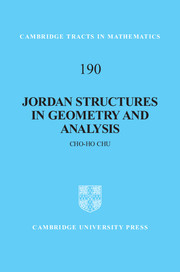
Jordan Structures in Geometry and Analysis
-
- Published online:
- 05 December 2011
- Print publication:
- 17 November 2011
The Turán Number of F3,3
-
- Journal:
- Combinatorics, Probability and Computing / Volume 21 / Issue 3 / May 2012
- Published online by Cambridge University Press:
- 29 November 2011, pp. 451-456
-
- Article
- Export citation
-
Let F3,3 be the 3-graph on 6 vertices, labelled abcxyz, and 10 edges, one of which is abc, and the other 9 of which are all triples that contain 1 vertex from abc and 2 vertices from xyz. We show that for all n ≥ 6, the maximum number of edges in an F3,3-free 3-graph on n vertices is
 . This sharpens results of Zhou [9] and of the second author and Rödl [7].
 . This sharpens results of Zhou [9] and of the second author and Rödl [7].
RATIONAL DISTANCES WITH RATIONAL ANGLES
- Part of
-
- Journal:
- Mathematika / Volume 58 / Issue 2 / July 2012
- Published online by Cambridge University Press:
- 28 November 2011, pp. 409-418
- Print publication:
- July 2012
-
- Article
- Export citation
-
In 1946 Erdős asked for the maximum number of unit distances, u(n), among n points in the plane. He showed that u(n)>n1+c/log log n and conjectured that this was the true magnitude. The best known upper bound is u(n)<cn4/3, due to Spencer, Szemerédi and Trotter. We show that the upper bound
 holds if we only consider unit distances with rational angle, by which we mean that the line through the pair of points makes a rational angle in degrees with the x-axis. Using an algebraic theorem of Mann we get a uniform bound on the number of paths between two fixed vertices in the unit distance graph, giving a contradiction if there are too many unit distances with rational angle. This bound holds if we consider rational distances instead of unit distances as long as there are no three points on a line. A superlinear lower bound is given, due to Erdős and Purdy. If we have at most nα points on a line then we get the bound O(n1+α) or
  for the number of rational distances with rational angle depending on whether α≥1/2or α<1/2respectively.
 holds if we only consider unit distances with rational angle, by which we mean that the line through the pair of points makes a rational angle in degrees with the x-axis. Using an algebraic theorem of Mann we get a uniform bound on the number of paths between two fixed vertices in the unit distance graph, giving a contradiction if there are too many unit distances with rational angle. This bound holds if we consider rational distances instead of unit distances as long as there are no three points on a line. A superlinear lower bound is given, due to Erdős and Purdy. If we have at most n
 for the number of rational distances with rational angle depending on whether α≥1/2or α<1/2respectively.
ON THE EXISTENCE OF SUPERGAUSSIAN DIRECTIONS ON CONVEX BODIES
- Part of
-
- Journal:
- Mathematika / Volume 58 / Issue 2 / July 2012
- Published online by Cambridge University Press:
- 24 November 2011, pp. 389-408
- Print publication:
- July 2012
-
- Article
- Export citation
-
We study the question of whether every centred convex body K of volume 1 in ℝn has “supergaussian directions”, which means θ∈Sn−1 such that
![\[ \biggl |\biggl \{ x\in K: | \langle x, \theta \rangle |\gr t \int _{K} |\langle x, \theta \rangle | d x \biggr \}\biggr | \gr \mathrm {e}^{-c t^{2}}, \]](//static.cambridge.org/content/id/urn%3Acambridge.org%3Aid%3Aarticle%3AS0025579311006085/resource/name/S0025579311006085_eqnU1.gif?pub-status=live) for all
for all  , where c>0 is an absolute constant. We verify that a “random” direction is indeed supergaussian for isotropic convex bodies that satisfy the hyperplane conjecture. On the other hand, we show that if, for all isotropic convex bodies, a random direction is supergaussian then the hyperplane conjecture follows.
![\[ \biggl |\biggl \{ x\in K: | \langle x, \theta \rangle |\gr t \int _{K} |\langle x, \theta \rangle | d x \biggr \}\biggr | \gr \mathrm {e}^{-c t^{2}}, \]](http://static.cambridge.org/content/id/urn%3Acambridge.org%3Aid%3Aarticle%3AS0025579311006085/resource/name/S0025579311006085_eqnU1.gif?pub-status=live)
 , where c>0 is an absolute constant. We verify that a “random” direction is indeed supergaussian for isotropic convex bodies that satisfy the hyperplane conjecture. On the other hand, we show that if, for all isotropic convex bodies, a random direction is supergaussian then the hyperplane conjecture follows.