Refine search
Actions for selected content:
26078 results in Abstract analysis
TILINGS OF HILBERT SPACES
- Part of
-
- Journal:
- Mathematika / Volume 56 / Issue 2 / July 2010
- Published online by Cambridge University Press:
- 29 April 2010, pp. 217-230
- Print publication:
- July 2010
-
- Article
- Export citation
AN EXTENSION OF A THEOREM OF HLAWKA
-
- Journal:
- Mathematika / Volume 56 / Issue 2 / July 2010
- Published online by Cambridge University Press:
- 29 April 2010, pp. 203-216
- Print publication:
- July 2010
-
- Article
- Export citation
-
This paper extends Hlawka’s theorem (from the point of view of Siegel and Weil) on SL(n,ℝ)/SL(n,ℤ) to Sp(n,ℝ)/Sp(n,ℤ). Namely, if Vn=vol(Sp(n,ℝ)/Sp(n,ℤ), where the measure is the Sp(n,ℝ)-invariant measure on Sp(n,ℝ)/Sp(n,ℤ), then Vn can be expressed in terms of the Riemann zeta function by
![\[ V_n = \frac {1}{\sqrt {2}}\prod _{k=1}^n\zeta (2k). \]](//static.cambridge.org/content/id/urn%3Acambridge.org%3Aid%3Aarticle%3AS0025579310000392/resource/name/S0025579310000392_eqnU1.gif?pub-status=live) As a consequence, let D be a domain of a sufficiently regular set in ℝ2n. Then:
As a consequence, let D be a domain of a sufficiently regular set in ℝ2n. Then: (i) if vol(D)>Vn, then some lattice in ℝ2n contains a non-zero point of D;
(ii) if vol(D)<Vn, then some lattice in ℝ2n contains only the zero point of D;
(iii) if D is star-shaped about the origin and vol(D)<ζ(2n)Vn, then some lattice in ℝ2n contains only the zero point of D.
![\[ V_n = \frac {1}{\sqrt {2}}\prod _{k=1}^n\zeta (2k). \]](http://static.cambridge.org/content/id/urn%3Acambridge.org%3Aid%3Aarticle%3AS0025579310000392/resource/name/S0025579310000392_eqnU1.gif?pub-status=live)
Une dualité entre fonctions booléennes
- Part of
-
- Journal:
- Journal of the Institute of Mathematics of Jussieu / Volume 9 / Issue 3 / July 2010
- Published online by Cambridge University Press:
- 26 April 2010, pp. 633-652
- Print publication:
- July 2010
-
- Article
- Export citation
On descent theory and main conjectures in non-commutative Iwasawa theory
- Part of
-
- Journal:
- Journal of the Institute of Mathematics of Jussieu / Volume 10 / Issue 1 / January 2011
- Published online by Cambridge University Press:
- 26 April 2010, pp. 59-118
- Print publication:
- January 2011
-
- Article
- Export citation
Vertex-Bipartition Method for Colouring Minor-Closed Classes of Graphs
-
- Journal:
- Combinatorics, Probability and Computing / Volume 19 / Issue 4 / July 2010
- Published online by Cambridge University Press:
- 21 April 2010, pp. 579-591
-
- Article
- Export citation
-
Thomas conjectured that there is an absolute constant c such that for every proper minor-closed class


What every mathematician should know about modelling crime
-
- Journal:
- European Journal of Applied Mathematics / Volume 21 / Issue 4-5 / October 2010
- Published online by Cambridge University Press:
- 21 April 2010, pp. 275-281
-
- Article
- Export citation
Adding police to a mathematical model of burglary
-
- Journal:
- European Journal of Applied Mathematics / Volume 21 / Issue 4-5 / October 2010
- Published online by Cambridge University Press:
- 21 April 2010, pp. 401-419
-
- Article
- Export citation
Fighting cheaters: How and how much to invest
-
- Journal:
- European Journal of Applied Mathematics / Volume 21 / Issue 4-5 / October 2010
- Published online by Cambridge University Press:
- 21 April 2010, pp. 459-478
-
- Article
- Export citation
ON SHRINKING TARGETS FOR ℤm ACTIONS ON TORI
- Part of
-
- Journal:
- Mathematika / Volume 56 / Issue 2 / July 2010
- Published online by Cambridge University Press:
- 16 April 2010, pp. 193-202
- Print publication:
- July 2010
-
- Article
- Export citation
On the adjoint quotient of Chevalley groups over arbitrary base schemes
- Part of
-
- Journal:
- Journal of the Institute of Mathematics of Jussieu / Volume 9 / Issue 4 / October 2010
- Published online by Cambridge University Press:
- 16 April 2010, pp. 673-704
- Print publication:
- October 2010
-
- Article
- Export citation
-
For a split semisimple Chevalley group scheme G with Lie algebra
 over an arbitrary base scheme S, we consider the quotient of by the adjoint action of G. We study in detail the structure of over S. Given a maximal torus T with Lie algebra
  and associated Weyl group W, we show that the Chevalley morphism π : /W → /G is an isomorphism except for the group Sp2n over a base with 2-torsion. In this case this morphism is only dominant and we compute it explicitly. We compute the adjoint quotient in some other classical cases, yielding examples where the formation of the quotient → /G commutes, or does not commute, with base change on S.
 over an arbitrary base scheme S, we consider the quotient of
  and associated Weyl group W, we show that the Chevalley morphism π :
 Hölder continuous potentials on manifolds with partially positive curvature
- Part of
-
- Journal:
- Journal of the Institute of Mathematics of Jussieu / Volume 9 / Issue 4 / October 2010
- Published online by Cambridge University Press:
- 16 April 2010, pp. 705-718
- Print publication:
- October 2010
-
- Article
- Export citation
A random walk in the literature on criminality: A partial and critical view on some statistical analyses and modelling approaches
-
- Journal:
- European Journal of Applied Mathematics / Volume 21 / Issue 4-5 / October 2010
- Published online by Cambridge University Press:
- 15 April 2010, pp. 283-306
-
- Article
- Export citation
A brief history of the analysis of crime concentration
-
- Journal:
- European Journal of Applied Mathematics / Volume 21 / Issue 4-5 / October 2010
- Published online by Cambridge University Press:
- 15 April 2010, pp. 349-370
-
- Article
- Export citation
Motives of Azumaya algebras
- Part of
-
- Journal:
- Journal of the Institute of Mathematics of Jussieu / Volume 9 / Issue 3 / July 2010
- Published online by Cambridge University Press:
- 14 April 2010, pp. 481-599
- Print publication:
- July 2010
-
- Article
- Export citation
A dynamic elastic-visco-plastic unilateral contact problem with normal damped response and Coulomb friction
-
- Journal:
- European Journal of Applied Mathematics / Volume 21 / Issue 3 / June 2010
- Published online by Cambridge University Press:
- 07 April 2010, pp. 229-251
-
- Article
- Export citation
Concentration of personal and household crimes in England and Wales
-
- Journal:
- European Journal of Applied Mathematics / Volume 21 / Issue 4-5 / October 2010
- Published online by Cambridge University Press:
- 06 April 2010, pp. 325-348
-
- Article
- Export citation
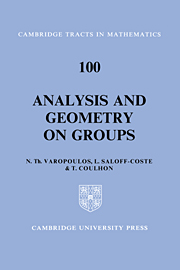
Analysis and Geometry on Groups
-
- Published online:
- 01 April 2010
- Print publication:
- 07 January 1993
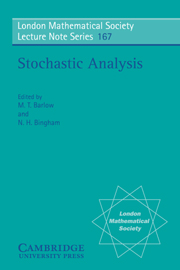
Stochastic Analysis
- Proceedings of the Durham Symposium on Stochastic Analysis, 1990
-
- Published online:
- 31 March 2010
- Print publication:
- 25 October 1991
Sesquilinear forms corresponding to a non-semibounded Sturm–Liouville operator
-
- Journal:
- Proceedings of the Royal Society of Edinburgh. Section A: Mathematics / Volume 140 / Issue 2 / April 2010
- Published online by Cambridge University Press:
- 30 March 2010, pp. 291-318
- Print publication:
- April 2010
-
- Article
- Export citation
On boundary variational–hemivariational inequalities of elliptic type
-
- Journal:
- Proceedings of the Royal Society of Edinburgh. Section A: Mathematics / Volume 140 / Issue 2 / April 2010
- Published online by Cambridge University Press:
- 30 March 2010, pp. 419-434
- Print publication:
- April 2010
-
- Article
- Export citation
