Refine search
Actions for selected content:
26077 results in Abstract analysis
Relative Tutte Polynomials for Coloured Graphs and Virtual Knot Theory
-
- Journal:
- Combinatorics, Probability and Computing / Volume 19 / Issue 3 / May 2010
- Published online by Cambridge University Press:
- 18 November 2009, pp. 343-369
-
- Article
- Export citation
Vicarious Graphs
-
- Journal:
- Combinatorics, Probability and Computing / Volume 19 / Issue 5-6 / November 2010
- Published online by Cambridge University Press:
- 13 November 2009, pp. 819-827
-
- Article
- Export citation
-
Let H be some fixed graph. We call a graph Gvicarious for H if G is maximal H-free and, for every edge e of G, there is an edge f not in G such that G − e + f is also H-free. We demonstrate various properties of vicarious graphs and several examples are given. It is conjectured that a graph of order n which is vicarious for K3 has size at most (1/4 + o(1))(


The Number of Independent Sets in a Regular Graph
-
- Journal:
- Combinatorics, Probability and Computing / Volume 19 / Issue 2 / March 2010
- Published online by Cambridge University Press:
- 13 November 2009, pp. 315-320
-
- Article
- Export citation
Graph Partitioning via Adaptive Spectral Techniques
-
- Journal:
- Combinatorics, Probability and Computing / Volume 19 / Issue 2 / March 2010
- Published online by Cambridge University Press:
- 13 November 2009, pp. 227-284
-
- Article
- Export citation
Shock waves and compactons for fifth-order non-linear dispersion equations
-
- Journal:
- European Journal of Applied Mathematics / Volume 21 / Issue 1 / February 2010
- Published online by Cambridge University Press:
- 12 November 2009, pp. 1-50
-
- Article
- Export citation
-
The following first problem is posed:
 is a correct ‘entropy solution’ of the Cauchy problem for the fifth-order degenerate non-linear dispersion equations (NDEs), same as for the classic Euler one ut + uux = 0,
 These two quasi-linear degenerate partial differential equations (PDEs) are chosen as typical representatives; so other (2m + 1)th-order NDEs of non-divergent form admit such shocks waves. As a related second problem, the opposite initial shock S+(x) = −S−(x) = sign x is shown to be a non-entropy solution creating a rarefaction wave, which becomes C∞ for any t > 0. Formation of shocks leads to non-uniqueness of any ‘entropy solutions’. Similar phenomena are studied for a fifth-order in time NDE uttttt = (uux)xxxx in normal form.
On the other hand, related NDEs, such as
 are shown to admit smooth compactons, as oscillatory travelling wave solutions with compact support. The well-known non-negative compactons, which appeared in various applications (first examples by Dey, 1998, Phys. Rev. E, vol. 57, pp. 4733–4738, and Rosenau and Levy, 1999, Phys. Lett. A, vol. 252, pp. 297–306), are non-existent in general and are not robust relative to small perturbations of parameters of the PDE.

The Theory of Cluster Sets
-
- Published online:
- 06 November 2009
- Print publication:
- 02 January 1966
Application of the Abel integral equation to an inverse problem in thermoelectricity
-
- Journal:
- European Journal of Applied Mathematics / Volume 20 / Issue 6 / December 2009
- Published online by Cambridge University Press:
- 05 November 2009, pp. 519-529
-
- Article
- Export citation
On a phase field problem driven by interface area and interface curvature
-
- Journal:
- European Journal of Applied Mathematics / Volume 20 / Issue 6 / December 2009
- Published online by Cambridge University Press:
- 05 November 2009, pp. 531-556
-
- Article
- Export citation
EJM volume 20 issue 6 Cover and Front matter
-
- Journal:
- European Journal of Applied Mathematics / Volume 20 / Issue 6 / December 2009
- Published online by Cambridge University Press:
- 05 November 2009, pp. f1-f2
-
- Article
-
- You have access
- Export citation
EJM volume 20 issue 6 Cover and Back matter
-
- Journal:
- European Journal of Applied Mathematics / Volume 20 / Issue 6 / December 2009
- Published online by Cambridge University Press:
- 05 November 2009, pp. b1-b4
-
- Article
-
- You have access
- Export citation
On the Benney equation
-
- Journal:
- Proceedings of the Royal Society of Edinburgh. Section A: Mathematics / Volume 139 / Issue 6 / December 2009
- Published online by Cambridge University Press:
- 04 November 2009, pp. 1121-1144
- Print publication:
- December 2009
-
- Article
- Export citation
Multiple positive solutions for an unbounded Dirichlet boundary problem involving sign-changing weight
-
- Journal:
- Proceedings of the Royal Society of Edinburgh. Section A: Mathematics / Volume 139 / Issue 6 / December 2009
- Published online by Cambridge University Press:
- 04 November 2009, pp. 1297-1325
- Print publication:
- December 2009
-
- Article
- Export citation
-
We study the multiplicity of positive solutions for the following semilinear elliptic equation:
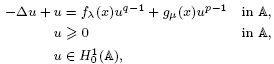
where 1 < q < 2 < p < 2* (2* = 2N/(N − 2) if N ≥ 3, 2* = ∞ if N = 2), the parameters λ, μ ≥ 0,
 is an infinite strip in ℝN and Θ is a bounded domain in ℝN−1 We assume that fλ(x) = λf+(x) + f−(x) and gμ(x) = a(x) + μb(x), where the functions f±, a and b satisfy suitable conditions.
 is an infinite strip in ℝ
Well-posedness of some initial—boundary-value problems for dynamo-generated poloidal magnetic fields
-
- Journal:
- Proceedings of the Royal Society of Edinburgh. Section A: Mathematics / Volume 139 / Issue 6 / December 2009
- Published online by Cambridge University Press:
- 04 November 2009, pp. 1209-1235
- Print publication:
- December 2009
-
- Article
- Export citation
Sharp upper bounds for the density of some invariant measures
-
- Journal:
- Proceedings of the Royal Society of Edinburgh. Section A: Mathematics / Volume 139 / Issue 6 / December 2009
- Published online by Cambridge University Press:
- 04 November 2009, pp. 1145-1161
- Print publication:
- December 2009
-
- Article
- Export citation
Two-dimensional incompressible viscous flow around a thin obstacle tending to a curve
-
- Journal:
- Proceedings of the Royal Society of Edinburgh. Section A: Mathematics / Volume 139 / Issue 6 / December 2009
- Published online by Cambridge University Press:
- 04 November 2009, pp. 1237-1254
- Print publication:
- December 2009
-
- Article
- Export citation
Evaluating norms of Pettis integrable functions
-
- Journal:
- Proceedings of the Royal Society of Edinburgh. Section A: Mathematics / Volume 139 / Issue 6 / December 2009
- Published online by Cambridge University Press:
- 04 November 2009, pp. 1255-1259
- Print publication:
- December 2009
-
- Article
- Export citation
On the Decimalization of Money
-
- Journal:
- Proceedings of the Edinburgh Mathematical Society / Volume 21 / February 1902
- Published online by Cambridge University Press:
- 04 November 2009, pp. 112-115
-
- Article
-
- You have access
- Export citation
Travelling wavefronts for a non-divergent degenerate and singular parabolic equation with changing sign sources
-
- Journal:
- Proceedings of the Royal Society of Edinburgh. Section A: Mathematics / Volume 139 / Issue 6 / December 2009
- Published online by Cambridge University Press:
- 04 November 2009, pp. 1179-1207
- Print publication:
- December 2009
-
- Article
- Export citation
Multiple positive solutions for a critical elliptic system with concave—convex nonlinearities
-
- Journal:
- Proceedings of the Royal Society of Edinburgh. Section A: Mathematics / Volume 139 / Issue 6 / December 2009
- Published online by Cambridge University Press:
- 04 November 2009, pp. 1163-1177
- Print publication:
- December 2009
-
- Article
- Export citation
Decompositions of groups of invertible elements in a ring
-
- Journal:
- Proceedings of the Royal Society of Edinburgh. Section A: Mathematics / Volume 139 / Issue 6 / December 2009
- Published online by Cambridge University Press:
- 04 November 2009, pp. 1275-1287
- Print publication:
- December 2009
-
- Article
- Export citation
