Refine search
Actions for selected content:
26077 results in Abstract analysis
GMJ volume 52 issue 1 Cover and Back matter
-
- Journal:
- Glasgow Mathematical Journal / Volume 52 / Issue 1 / January 2010
- Published online by Cambridge University Press:
- 04 December 2009, pp. b1-b2
-
- Article
-
- You have access
- Export citation
COMPLEX BERWALD MANIFOLDS WITH VANISHING HOLOMORPHIC SECTIONAL CURVATURE – CORRIGENDUM
-
- Journal:
- Glasgow Mathematical Journal / Volume 52 / Issue 1 / January 2010
- Published online by Cambridge University Press:
- 04 December 2009, p. 205
-
- Article
-
- You have access
- Export citation
NOTE ON THE DIVISIBILITY OF THE CLASS NUMBER OF CERTAIN IMAGINARY QUADRATIC FIELDS – CORRIGENDUM
-
- Journal:
- Glasgow Mathematical Journal / Volume 52 / Issue 1 / January 2010
- Published online by Cambridge University Press:
- 04 December 2009, pp. 207-208
-
- Article
-
- You have access
- Export citation
A NOTE ON POLYCYLIC RESIDUALLY FINITE-p GROUPS
-
- Journal:
- Glasgow Mathematical Journal / Volume 52 / Issue 1 / January 2010
- Published online by Cambridge University Press:
- 04 December 2009, pp. 137-143
-
- Article
-
- You have access
- Export citation
CPC volume 19 issue 1 Cover and Back matter
-
- Journal:
- Combinatorics, Probability and Computing / Volume 19 / Issue 1 / January 2010
- Published online by Cambridge University Press:
- 02 December 2009, pp. b1-b3
-
- Article
-
- You have access
- Export citation
Expressing Combinatorial Problems by Systems of Polynomial Equations and Hilbert's Nullstellensatz – Corrigendum
-
- Journal:
- Combinatorics, Probability and Computing / Volume 19 / Issue 1 / January 2010
- Published online by Cambridge University Press:
- 02 December 2009, p. 159
-
- Article
-
- You have access
- Export citation

Positive Harmonic Functions and Diffusion
-
- Published online:
- 02 December 2009
- Print publication:
- 12 January 1995
CPC volume 19 issue 1 Cover and Front matter
-
- Journal:
- Combinatorics, Probability and Computing / Volume 19 / Issue 1 / January 2010
- Published online by Cambridge University Press:
- 02 December 2009, pp. f1-f2
-
- Article
-
- You have access
- Export citation
Markov Type of Alexandrov Spaces of Non-Negative Curvature Shin-Ichi Ohta
- Part of
-
- Journal:
- Mathematika / Volume 55 / Issue 1-2 / December 2009
- Published online by Cambridge University Press:
- 21 December 2009, pp. 177-189
- Print publication:
- December 2009
-
- Article
- Export citation
The Product of Exponents in the Factorization of Consecutive Integers
- Part of
-
- Journal:
- Mathematika / Volume 55 / Issue 1-2 / December 2009
- Published online by Cambridge University Press:
- 21 December 2009, pp. 59-65
- Print publication:
- December 2009
-
- Article
- Export citation
-
For each integer n ≥ 2, let β(n) stand for the product of the exponents in the prime factorization of n. Given an arbitrary integer k ≥ 2, let nk be the smallest positive integer n such that β(n + 1) = β(n + 2) = … = β(n + k). We prove that there exist positive constants c1 and c2 such that, for all integers k ≥ 2,

Multiplicative Invariants and the Finite Co-Hopfian Property
- Part of
-
- Journal:
- Mathematika / Volume 55 / Issue 1-2 / December 2009
- Published online by Cambridge University Press:
- 21 December 2009, pp. 115-127
- Print publication:
- December 2009
-
- Article
- Export citation
Spectral Convergence for High-Contrast Elliptic Periodic Problems with a Defect Via Homogenization
- Part of
-
- Journal:
- Mathematika / Volume 55 / Issue 1-2 / December 2009
- Published online by Cambridge University Press:
- 21 December 2009, pp. 29-57
- Print publication:
- December 2009
-
- Article
- Export citation
A Step Beyond Kemperman's Structure Theorem
- Part of
-
- Journal:
- Mathematika / Volume 55 / Issue 1-2 / December 2009
- Published online by Cambridge University Press:
- 21 December 2009, pp. 67-114
- Print publication:
- December 2009
-
- Article
- Export citation
The Artin–Carmichael Primitive Root Problem on Average
- Part of
-
- Journal:
- Mathematika / Volume 55 / Issue 1-2 / December 2009
- Published online by Cambridge University Press:
- 21 December 2009, pp. 167-176
- Print publication:
- December 2009
-
- Article
- Export citation
On Extensions of Valuations with given Residue Field and Value Group
- Part of
-
- Journal:
- Mathematika / Volume 55 / Issue 1-2 / December 2009
- Published online by Cambridge University Press:
- 21 December 2009, pp. 191-197
- Print publication:
- December 2009
-
- Article
- Export citation
Approximate Kernel Clustering
- Part of
-
- Journal:
- Mathematika / Volume 55 / Issue 1-2 / December 2009
- Published online by Cambridge University Press:
- 21 December 2009, pp. 129-165
- Print publication:
- December 2009
-
- Article
- Export citation
-
In the kernel clustering problem we are given a large n × n positive-semidefinite matrix A = (aij) with
 and a small k × k positive-semidefinite matrix B = (bij). The goal is to find a partition S1, …, Sk of {1, … n} which maximizes the quantity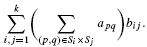
We study the computational complexity of this generic clustering problem which originates in the theory of machine learning. We design a constant factor polynomial time approximation algorithm for this problem, answering a question posed by Song et al. In some cases we manage to compute the sharp approximation threshold for this problem assuming the unique games conjecture (UGC). In particular, when B is the 3 × 3 identity matrix the UGC hardness threshold of this problem is exactly 16π/27. We present and study a geometric conjecture of independent interest which we show would imply that the UGC threshold when B is the k × k identity matrix is (8π/9)(1 – 1/k) for every k ≥ 3.
 and a small k × k positive-semidefinite matrix B = (b
Exponential Squared Integrability of the Discrepancy Function in Two Dimensions
- Part of
-
- Journal:
- Mathematika / Volume 55 / Issue 1-2 / December 2009
- Published online by Cambridge University Press:
- 21 December 2009, pp. 1-27
- Print publication:
- December 2009
-
- Article
- Export citation
-
Let AN be an N-point set in the unit square and consider the discrepancy function

where x = (x1, x2) ∈ [0,1;]2,
 and |[0, x)]| denotes the Lebesgue measure of the rectangle. We give various refinements of a well-known result of Schmidt [Irregularities of distribution. VII. Acta Arith. 21 (1972), 45–50] on the L∞ norm of DN. We show that necessarily
The case of α = ∞ is the Theorem of Schmidt. This estimate is sharp. For the digit-scrambled van der Corput sequence, we have

whenever N = 2n for some positive integer n. This estimate depends upon variants of the Chang–Wilson–Wolff inequality [S.-Y. A. Chang, J. M. Wilson and T. H.Wolff, Some weighted norm inequalities concerning the Schrödinger operators. Comment. Math. Helv.60(2) (1985), 217–246]. We also provide similar estimates for the BMO norm of DN.
 and |[
Subject index
-
- Book:
- Totally Positive Matrices
- Published online:
- 05 May 2010
- Print publication:
- 26 November 2009, pp 182-182
-
- Chapter
- Export citation
Foreword
-
- Book:
- Totally Positive Matrices
- Published online:
- 05 May 2010
- Print publication:
- 26 November 2009, pp ix-xii
-
- Chapter
- Export citation
Afterword
-
- Book:
- Totally Positive Matrices
- Published online:
- 05 May 2010
- Print publication:
- 26 November 2009, pp 169-173
-
- Chapter
- Export citation
