Refine search
Actions for selected content:
26077 results in Abstract analysis
References
-
- Book:
- Totally Positive Matrices
- Published online:
- 05 May 2010
- Print publication:
- 26 November 2009, pp 174-179
-
- Chapter
- Export citation
2 - Criteria for total positivity and strict total positivity
-
- Book:
- Totally Positive Matrices
- Published online:
- 05 May 2010
- Print publication:
- 26 November 2009, pp 36-75
-
- Chapter
- Export citation
5 - Eigenvalues and eigenvectors
-
- Book:
- Totally Positive Matrices
- Published online:
- 05 May 2010
- Print publication:
- 26 November 2009, pp 127-153
-
- Chapter
- Export citation
Frontmatter
-
- Book:
- Totally Positive Matrices
- Published online:
- 05 May 2010
- Print publication:
- 26 November 2009, pp i-vi
-
- Chapter
- Export citation
1 - Basic properties of totally positive and strictly totally positive matrices
-
- Book:
- Totally Positive Matrices
- Published online:
- 05 May 2010
- Print publication:
- 26 November 2009, pp 1-35
-
- Chapter
- Export citation
6 - Factorizations of totally positive matrices
-
- Book:
- Totally Positive Matrices
- Published online:
- 05 May 2010
- Print publication:
- 26 November 2009, pp 154-168
-
- Chapter
- Export citation
4 - Examples
-
- Book:
- Totally Positive Matrices
- Published online:
- 05 May 2010
- Print publication:
- 26 November 2009, pp 87-126
-
- Chapter
- Export citation
3 - Variation diminishing
-
- Book:
- Totally Positive Matrices
- Published online:
- 05 May 2010
- Print publication:
- 26 November 2009, pp 76-86
-
- Chapter
- Export citation
Contents
-
- Book:
- Totally Positive Matrices
- Published online:
- 05 May 2010
- Print publication:
- 26 November 2009, pp vii-viii
-
- Chapter
- Export citation
Author index
-
- Book:
- Totally Positive Matrices
- Published online:
- 05 May 2010
- Print publication:
- 26 November 2009, pp 180-181
-
- Chapter
- Export citation
COMMON FIXED POINTS OF A PAIR OF NON-EXPANSIVE MAPPINGS WITH APPLICATIONS TO CONVEX FEASIBILITY PROBLEMS
-
- Journal:
- Glasgow Mathematical Journal / Volume 52 / Issue 2 / May 2010
- Published online by Cambridge University Press:
- 25 November 2009, pp. 241-252
-
- Article
-
- You have access
- Export citation
-
Let C be a non-empty closed convex subset of a reflexive and strictly convex Banach space E which also has a weakly continuous duality map Jφ(x) with the gauge φ. Let S and T be non-expansive mappings from C into itself such that F = F(S) ∩ F(T) ≠ ∅. Let {αn} and {βn} be sequences in (0, 1). Let {xn} be a sequence defined by
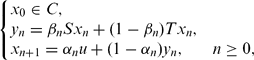 where u ∈ C is a given point. Assume that the following restrictions imposed on the control sequences are satisfied:
ZINBIEL ALGEBRAS AND COMMUTATIVE ALGEBRAS WITH DIVIDED POWERS
-
- Journal:
- Glasgow Mathematical Journal / Volume 52 / Issue 2 / May 2010
- Published online by Cambridge University Press:
- 25 November 2009, pp. 303-313
-
- Article
-
- You have access
- Export citation
φ-PRIME SUBMODULES
-
- Journal:
- Glasgow Mathematical Journal / Volume 52 / Issue 2 / May 2010
- Published online by Cambridge University Press:
- 25 November 2009, pp. 253-259
-
- Article
-
- You have access
- Export citation
-
Let R be a commutative ring with non-zero identity and M be a unitary R-module. Let


ON THE MULTIPLICITY OF SOLUTIONS FOR NON-LINEAR PERIODIC PROBLEMS WITH THE NON-LINEARITY CROSSING SEVERAL EIGENVALUES
-
- Journal:
- Glasgow Mathematical Journal / Volume 52 / Issue 2 / May 2010
- Published online by Cambridge University Press:
- 25 November 2009, pp. 271-302
-
- Article
-
- You have access
- Export citation
BLOWUP FOR A DEGENERATE AND SINGULAR PARABOLIC EQUATION WITH NON-LOCAL SOURCE AND ABSORPTION*
-
- Journal:
- Glasgow Mathematical Journal / Volume 52 / Issue 2 / May 2010
- Published online by Cambridge University Press:
- 25 November 2009, pp. 209-225
-
- Article
-
- You have access
- Export citation
-
This paper deals with the following degenerate and singular equation
 with non-local source and absorption. The existence of a unique classical non-negative solution is established and the sufficient conditions for the solution that exists globally or blows up in finite time are obtained.
SOBOLEV INEQUALITIES FOR ORLICZ SPACES OF TWO VARIABLE EXPONENTS
-
- Journal:
- Glasgow Mathematical Journal / Volume 52 / Issue 2 / May 2010
- Published online by Cambridge University Press:
- 25 November 2009, pp. 227-240
-
- Article
-
- You have access
- Export citation
-
Our aim in this paper is to deal with Sobolev's embeddings for Sobolev–Orlicz functions with ∇u ∈ Lp(·) logLq(·)(Ω) for Ω ⊂


ON DUAL BAER MODULES
-
- Journal:
- Glasgow Mathematical Journal / Volume 52 / Issue 2 / May 2010
- Published online by Cambridge University Press:
- 25 November 2009, pp. 261-269
-
- Article
-
- You have access
- Export citation
-
In this paper we introduce


Completely Bounded Maps and Operator Algebras
-
- Published online:
- 24 November 2009
- Print publication:
- 06 February 2003
Approximate transmission conditions through a rough thin layer: The case of periodic roughness
-
- Journal:
- European Journal of Applied Mathematics / Volume 21 / Issue 1 / February 2010
- Published online by Cambridge University Press:
- 23 November 2009, pp. 51-75
-
- Article
- Export citation
Clifford Algebras and Dirac Operators in Harmonic Analysis
-
- Published online:
- 23 November 2009
- Print publication:
- 26 July 1991
