Refine search
Actions for selected content:
26076 results in Abstract analysis
Meromorphic functions with shared limit values of positive linear measure
- Part of
-
- Journal:
- Proceedings of the Edinburgh Mathematical Society / Volume 52 / Issue 1 / February 2009
- Published online by Cambridge University Press:
- 02 February 2009, pp. 235-240
-
- Article
-
- You have access
- Export citation
On the characteristic initial-value problem for linear partial functional-differential equations of hyperbolic type
- Part of
-
- Journal:
- Proceedings of the Edinburgh Mathematical Society / Volume 52 / Issue 1 / February 2009
- Published online by Cambridge University Press:
- 02 February 2009, pp. 241-262
-
- Article
-
- You have access
- Export citation
-
Theorems on the Fredholm alternative and well-posedness of the characteristic initial-value problem

are established, where l : C(
 ;ℝ) is a linear bounded operator, q ∈ L(;ℝ), ϕ:[a,b]→ℝ, ψ:[c,d]→ℝ are absolutely continuous functions and =[a,b]×[c,d]. Some solvability conditions of the problem considered are also given.
 ;ℝ) is a linear bounded operator, q ∈ L(
Hecke C*-algebras and semi-direct products
- Part of
-
- Journal:
- Proceedings of the Edinburgh Mathematical Society / Volume 52 / Issue 1 / February 2009
- Published online by Cambridge University Press:
- 02 February 2009, pp. 127-153
-
- Article
-
- You have access
- Export citation
-
We analyse Hecke pairs (G,H) and the associated Hecke algebra
 when G is a semi-direct product N ⋊ Q and H = M ⋊ R for subgroups M ⊂ N and R ⊂ Q with M normal in N. Our main result shows that, when (G,H) coincides with its Schlichting completion and R is normal in Q, the closure of in C*(G) is Morita–Rieffel equivalent to a crossed product I⋊βQ/R, where I is a certain ideal in the fixed-point algebra C*(N)R. Several concrete examples are given illustrating and applying our techniques, including some involving subgroups of GL(2,K) acting on K2, where K = ℚ or K = ℤ[p−1]. In particular we look at the ax + b group of a quadratic extension of K.
 when G is a semi-direct product N ⋊ Q and H = M ⋊ R for subgroups M ⊂ N and R ⊂ Q with M normal in N. Our main result shows that, when (G,H) coincides with its Schlichting completion and R is normal in Q, the closure of
 EJM volume 20 issue 1 Cover and Back matter
-
- Journal:
- European Journal of Applied Mathematics / Volume 20 / Issue 1 / February 2009
- Published online by Cambridge University Press:
- 01 February 2009, pp. b1-b2
-
- Article
-
- You have access
- Export citation
On a Liouville-type equation with sign-changing weight
-
- Journal:
- Proceedings of the Royal Society of Edinburgh. Section A: Mathematics / Volume 139 / Issue 1 / February 2009
- Published online by Cambridge University Press:
- 13 March 2009, pp. 183-192
- Print publication:
- February 2009
-
- Article
- Export citation
-
We study the existence, nonexistence and multiplicity of non-negative solutions for the family of problems

where Ω is a bounded domain in ℝ2 and λ > 0 is a parameter. The coefficient a(x) is permitted to change sign. The techniques used in the proofs are a combination of upper and lower solutions, the Trudinger–Moser inequality and variational methods. Note that when f(x, u) = 0 the equation is of Liouville type.
GMJ volume 51 issue A Cover and Back matter
-
- Journal:
- Glasgow Mathematical Journal / Volume 51 / Issue A / February 2009
- Published online by Cambridge University Press:
- 01 February 2009, pp. b1-b8
-
- Article
-
- You have access
- Export citation
Composite meromorphic functions and normal families
-
- Journal:
- Proceedings of the Royal Society of Edinburgh. Section A: Mathematics / Volume 139 / Issue 1 / February 2009
- Published online by Cambridge University Press:
- 13 March 2009, pp. 57-72
- Print publication:
- February 2009
-
- Article
- Export citation
-
We study the normality of families of meromorphic functions defined in terms of certain omitted functions. In particular, we prove the following results. Firstly, if
 is a family of meromorphic functions in a domain D ⊂ ℂ, and a(z), b(z) and c(z) are distinct meromorphic functions in D and if, for all f ∈ and all z ∈ D, f(z) ≠ a(z), f(z) ≠ b(z) and f(z) ≠ c(z), then is normal in D. Secondly, letting R(w) be a rational function of degree greater than or equal to 3 and be a family of functions meromorphic in a domain D ⊂ ℂ, if there exists a non-constant meromorphic function α(z) in D such that, for all f ∈ and z ∈ D, R(f(z)) ≠ α(z), then is normal in D.
 is a family of meromorphic functions in a domain D ⊂ ℂ, and a(z), b(z) and c(z) are distinct meromorphic functions in D and if, for all f ∈
 BÄCKLUND TRANSFORMATIONS FOR NON-COMMUTATIVE ANTI-SELF-DUAL YANG–MILLS EQUATIONS
-
- Journal:
- Glasgow Mathematical Journal / Volume 51 / Issue A / February 2009
- Published online by Cambridge University Press:
- 01 February 2009, pp. 83-93
-
- Article
-
- You have access
- Export citation
Global bifurcation of solutions to diffusive logistic equations on bounded domains subject to nonlinear boundary conditions
-
- Journal:
- Proceedings of the Royal Society of Edinburgh. Section A: Mathematics / Volume 139 / Issue 1 / February 2009
- Published online by Cambridge University Press:
- 13 March 2009, pp. 45-56
- Print publication:
- February 2009
-
- Article
- Export citation
-
We consider the diffusive logistic equation
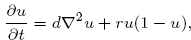
supplemented by the nonlinear boundary condition

where α is a non-negative, non-decreasing function with α([0, 1]) ⊆ [0, 1]. When regarded as an ecological model for an organism inhabiting a focal patch of its habitat, the assumptions on α are intended to capture a tendency on the part of the organism to remain in the habitat patch when it encounters the patch boundary that increases with species density. Such a mechanism has been suggested in the ecological literature as a means by which the dynamics of the organism at the scale of the patch might differ from its local dynamics within the patch. Building upon earlier examinations of the boundary-value problem by Cantrell and Cosner, we detail in this paper the global disposition of biologically relevant equilibria when both 0 and 1 (the local carrying capacity within the patch) are equilibria. Our analysis relies on global bifurcation theory and estimates for elliptic and parabolic partial differential equations.
WEAKLY NON-ASSOCIATIVE ALGEBRAS AND THE KADOMTSEV–PETVIASHVILI HIERARCHY
-
- Journal:
- Glasgow Mathematical Journal / Volume 51 / Issue A / February 2009
- Published online by Cambridge University Press:
- 01 February 2009, pp. 49-57
-
- Article
-
- You have access
- Export citation
Solutions of the Riemann–Hilbert–Poincaré problem and the Robin problem for the inhomogeneous Cauchy–Riemann equation
-
- Journal:
- Proceedings of the Royal Society of Edinburgh. Section A: Mathematics / Volume 139 / Issue 1 / February 2009
- Published online by Cambridge University Press:
- 13 March 2009, pp. 157-181
- Print publication:
- February 2009
-
- Article
- Export citation
A multiplier theorem for one-sided Hardy spaces
-
- Journal:
- Proceedings of the Royal Society of Edinburgh. Section A: Mathematics / Volume 139 / Issue 1 / February 2009
- Published online by Cambridge University Press:
- 13 March 2009, pp. 209-223
- Print publication:
- February 2009
-
- Article
- Export citation
-
In this paper we give a multiplier theorem for one-sided Hardy spaces which generalizes the results given by Strömberg and Torchinsky for two-sided weights. Also we state the
 version with a Sawyer's weight ω.
 version with a Sawyer's weight ω.
BAKER–AKHIEZER FUNCTION AS ITERATED RESIDUE AND SELBERG-TYPE INTEGRAL
-
- Journal:
- Glasgow Mathematical Journal / Volume 51 / Issue A / February 2009
- Published online by Cambridge University Press:
- 01 February 2009, pp. 59-73
-
- Article
-
- You have access
- Export citation
Interaction of homoclinic solutions and Hopf points in functional differential equations of mixed type
-
- Journal:
- Proceedings of the Royal Society of Edinburgh. Section A: Mathematics / Volume 139 / Issue 1 / February 2009
- Published online by Cambridge University Press:
- 13 March 2009, pp. 123-155
- Print publication:
- February 2009
-
- Article
- Export citation
ON DIFFERENTIAL EQUATIONS OF VON GEHLEN AND ROAN
-
- Journal:
- Glasgow Mathematical Journal / Volume 51 / Issue A / February 2009
- Published online by Cambridge University Press:
- 01 February 2009, pp. 43-48
-
- Article
-
- You have access
- Export citation
A NON-COMMUTATIVE SEMI-DISCRETE TODA EQUATION AND ITS QUASI-DETERMINANT SOLUTIONS
-
- Journal:
- Glasgow Mathematical Journal / Volume 51 / Issue A / February 2009
- Published online by Cambridge University Press:
- 01 February 2009, pp. 121-127
-
- Article
-
- You have access
- Export citation
Self-similar solutions of the p-Laplace heat equation: the case when p > 2
-
- Journal:
- Proceedings of the Royal Society of Edinburgh. Section A: Mathematics / Volume 139 / Issue 1 / February 2009
- Published online by Cambridge University Press:
- 13 March 2009, pp. 1-43
- Print publication:
- February 2009
-
- Article
- Export citation
-
We study the self-similar solutions of the equation

in ℝN, when p > 2. We make a complete study of the existence and possible uniqueness of solutions of the form

of any sign, regular or singular at x = 0. Among them we find solutions with an expanding compact support or a shrinking hole (for t > 0), or a spreading compact support or a focusing hole (for t < 0). When t < 0, we show the existence of positive solutions oscillating around the particular solution
 .
.
 .
.Ostwald ripening of droplets: The role of migration
-
- Journal:
- European Journal of Applied Mathematics / Volume 20 / Issue 1 / February 2009
- Published online by Cambridge University Press:
- 01 February 2009, pp. 1-67
-
- Article
- Export citation
Quasilinear elliptic equations with slowly growing principal part and critical Orlicz–Sobolev nonlinear term
-
- Journal:
- Proceedings of the Royal Society of Edinburgh. Section A: Mathematics / Volume 139 / Issue 1 / February 2009
- Published online by Cambridge University Press:
- 13 March 2009, pp. 73-106
- Print publication:
- February 2009
-
- Article
- Export citation
TRIGONOMETRIC DARBOUX TRANSFORMATIONS AND CALOGERO–MOSER MATRICES
-
- Journal:
- Glasgow Mathematical Journal / Volume 51 / Issue A / February 2009
- Published online by Cambridge University Press:
- 01 February 2009, pp. 95-106
-
- Article
-
- You have access
- Export citation
