Refine search
Actions for selected content:
26076 results in Abstract analysis
Interprétation de l'arithmétique dans certains groupes de permutations affines par morceaux d'un intervalle
- Part of
-
- Journal:
- Journal of the Institute of Mathematics of Jussieu / Volume 8 / Issue 4 / October 2009
- Published online by Cambridge University Press:
- 30 January 2009, pp. 623-652
- Print publication:
- October 2009
-
- Article
- Export citation
The Structure of 0-E-unitary inverse semigroups I: the monoid case
-
- Journal:
- Proceedings of the Edinburgh Mathematical Society / Volume 42 / Issue 3 / October 1999
- Published online by Cambridge University Press:
- 20 January 2009, pp. 497-520
-
- Article
-
- You have access
- Export citation
Some Finite Identities Connected with Poisson's Summation Formula
-
- Journal:
- Proceedings of the Edinburgh Mathematical Society / Volume 12 / Issue 1 / June 1960
- Published online by Cambridge University Press:
- 20 January 2009, pp. 17-25
-
- Article
-
- You have access
- Export citation
-
It is known that there is a connexion between the functional equation of the theta-function

and the reciprocity formula for Gauss sums. The latter formula is usually written as

where p and q are positive integers, mutually prime, and not both odd.
An Asymptotic Formula for a Class of Distribution Functions
-
- Journal:
- Proceedings of the Edinburgh Mathematical Society / Volume 4 / Issue 3 / August 1935
- Published online by Cambridge University Press:
- 20 January 2009, pp. 138-143
-
- Article
-
- You have access
- Export citation
E. Carpenter's proof of Taylor's theorem
-
- Journal:
- Proceedings of the Edinburgh Mathematical Society / Volume 12 / February 1893
- Published online by Cambridge University Press:
- 20 January 2009, pp. 114-117
-
- Article
-
- You have access
- Export citation
Waring's expression for a symmetric function in terms of sums of like powers
-
- Journal:
- Proceedings of the Edinburgh Mathematical Society / Volume 27 / February 1909
- Published online by Cambridge University Press:
- 20 January 2009, pp. 5-9
-
- Article
-
- You have access
- Export citation
-
1. In his Miscellanea Analytica of the year 1762, Waring stated the identities

where sp stands for the sum of the pth powers of n quantities α, β, γ,…. If the identities be written in the uncontracted form

it is readily seen that they hold not merely for certain powers of certain quantities, but for any quantities whatever; and that, indeed, for the elements of the array
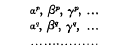
we may legitimately substitute in order the elements of the array
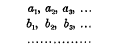
thus obtaining the identities

These latter were given by Binet in 1812, and are usually, but with little real justification, spoken of as “Binet's Identities.”
Upper bounds for the separation of real zeros of polynomials
-
- Journal:
- Proceedings of the Edinburgh Mathematical Society / Volume 39 / Issue 2 / June 1996
- Published online by Cambridge University Press:
- 20 January 2009, pp. 357-363
-
- Article
-
- You have access
- Export citation
-
Let
 be a polynomial with distinct real zeros whose separation is defined by δ(f) = min i≠j(ai-aj ). We establish upper estimates for δ(f′-kf) in terms of n, k, and δ(f). The results give sufficient conditions for the inverse operator (D – kl)−1 to preserve the reality of the zeros of a polynomial.
 be a polynomial with distinct real zeros whose separation is defined by δ(f) = min
 On the Foundations of Dynamics
-
- Journal:
- Proceedings of the Edinburgh Mathematical Society / Volume 15 / February 1896
- Published online by Cambridge University Press:
- 20 January 2009, p. 65
-
- Article
-
- You have access
- Export citation
A property of Bernstein-Schoenberg spline operators
-
- Journal:
- Proceedings of the Edinburgh Mathematical Society / Volume 28 / Issue 3 / October 1985
- Published online by Cambridge University Press:
- 20 January 2009, pp. 333-340
-
- Article
-
- You have access
- Export citation
An application of a theorem of Singer
-
- Journal:
- Proceedings of the Edinburgh Mathematical Society / Volume 19 / Issue 2 / September 1974
- Published online by Cambridge University Press:
- 20 January 2009, pp. 119-123
-
- Article
-
- You have access
- Export citation
-
The authors have recently treated (2) the problem of finding subsets E of the real line
 , of type Fσ, such that E–E contains an interval and the k-fold vector sum (k)E is of measure zero. Positive results can be obtained, for all k, on the basis of a recent theorem of J. A. Haight (3), following earlier partial results (1), (4) for k ≦ 7; and indeed in these cases the problem has a solution with E a perfect set. An analogous problem, apparently in most respects subtler than the first, is the following. Do there exist finite regular Borel measures μ on such that
  is absolutely continuous (where
  is the adjoint of μ) and the kth convolution power μk is singular? Both problems are of interest in the general context of elucidating the properties of the measure algebra or, more generally, M(G) for locally compact abelian G. The second problem may be regarded as an attempt to provide (at least one aspectof) a multiplicity theory for the first.
 , of type F
 is absolutely continuous (where
  is the adjoint of μ) and the kth convolution power μ
On the Contact-Property of the Eleven-point Conic
-
- Journal:
- Proceedings of the Edinburgh Mathematical Society / Volume 10 / February 1891
- Published online by Cambridge University Press:
- 20 January 2009, pp. 37-41
-
- Article
-
- You have access
- Export citation
A note on central idempotents in group rings
-
- Journal:
- Proceedings of the Edinburgh Mathematical Society / Volume 30 / Issue 1 / February 1987
- Published online by Cambridge University Press:
- 20 January 2009, pp. 69-72
-
- Article
-
- You have access
- Export citation
-
Let G be a group and K a field. We denote by
 (KG) the group of units of the group ring of G over K and for a group X we denote by T(X) the setof torsion elements of G i.e., the set of all elements of finite order.
 (KG) the group of units of the group ring of G over K and for a group X we denote by T(X) the setof torsion elements of G i.e., the set of all elements of finite order.
On Cohen-Macaulay and Gorenstein simplicial affine semigroups
-
- Journal:
- Proceedings of the Edinburgh Mathematical Society / Volume 41 / Issue 3 / October 1998
- Published online by Cambridge University Press:
- 20 January 2009, pp. 517-537
-
- Article
-
- You have access
- Export citation
On compound permutation matrices
-
- Journal:
- Proceedings of the Edinburgh Mathematical Society / Volume 7 / Issue 4 / October 1946
- Published online by Cambridge University Press:
- 20 January 2009, pp. 196-203
-
- Article
-
- You have access
- Export citation
Multiplicity results for semilinear elliptic boundary value problems in Besov and Triebel-Lizorkin spaces
-
- Journal:
- Proceedings of the Edinburgh Mathematical Society / Volume 34 / Issue 3 / October 1991
- Published online by Cambridge University Press:
- 20 January 2009, pp. 393-410
-
- Article
-
- You have access
- Export citation
Limits of pure states
-
- Journal:
- Proceedings of the Edinburgh Mathematical Society / Volume 32 / Issue 2 / June 1989
- Published online by Cambridge University Press:
- 20 January 2009, pp. 249-254
-
- Article
-
- You have access
- Export citation
-
In [7, Section 5], Glimm showed that if φ and ψ are inequivalent pure states of a liminal C*-algebra A such that the Gelfand-Naimark-Segal (GNS) representations πφ and πψ cannot be separated by disjoint open subsets of the spectrum  then ½ (φ+ψ) is a weak*-limit of pure states. We extend this to arbitrary C*-algebras (and more general convex combinations) by means of what we hope will be regarded as a transparent proof based on the notion of transition probabilities. As an application, we show that if J is a proper primal ideal of a separable C*-algebra A then there exists a state φ in
 (the pure state space) such that J=ker πφ (Theorem 3). The significance of this is discussed below after the introduction of further notation and terminology.
 (the pure state space) such that J=ker π
On the Evaluation of Determinants, the Formation of their Adjugates, and the Practical Solution of Simultaneous Linear Equations
-
- Journal:
- Proceedings of the Edinburgh Mathematical Society / Volume 3 / Issue 3 / February 1933
- Published online by Cambridge University Press:
- 20 January 2009, pp. 207-219
-
- Article
-
- You have access
- Export citation
-
There are various methods in existence for the practical solution of a set of simultaneous equations

Some of these methods are appropriate to special systems, as for example to the axisymmetric “normal equations” of Least Squares. In many applications, however, as in problems of statistical correlation of many variables, it may be desired not merely to solve a given set of equations but to obtain as much knowledge as possible about the system or matrix of coefficients; perhaps to evaluate its determinant and various minors, such as principal minors, possibly also to determine the elements of the adjugate matrix, or the reciprocal matrix. The examination of the sign of successive principal minors of an axisymmetric determinant, in order to find the signature of the corresponding quadratic form, is a case in point; and there are many such applications.
The asymptotic periods of integral and meromorphic functions
-
- Journal:
- Proceedings of the Edinburgh Mathematical Society / Volume 4 / Issue 4 / April 1936
- Published online by Cambridge University Press:
- 20 January 2009, pp. 254-257
-
- Article
-
- You have access
- Export citation
Twenty-Eighth Session, 1909–1910
-
- Journal:
- Proceedings of the Edinburgh Mathematical Society / Volume 28 / February 1909
- Published online by Cambridge University Press:
- 20 January 2009, p. v
-
- Article
-
- You have access
- Export citation
Whittaker's Correlation of Physics and Philosophy
-
- Journal:
- Proceedings of the Edinburgh Mathematical Society / Volume 11 / Issue 1 / June 1958
- Published online by Cambridge University Press:
- 20 January 2009, pp. 57-68
-
- Article
-
- You have access
- Export citation
