Refine search
Actions for selected content:
26076 results in Abstract analysis
Thin sets in

-
- Journal:
- Proceedings of the Edinburgh Mathematical Society / Volume 17 / Issue 4 / December 1971
- Published online by Cambridge University Press:
- 20 January 2009, pp. 311-316
-
- Article
-
- You have access
- Export citation

On the Analysis of the Kronecker Product of Irreducible Representations of the Symmetric Group
-
- Journal:
- Proceedings of the Edinburgh Mathematical Society / Volume 8 / Issue 3 / December 1949
- Published online by Cambridge University Press:
- 20 January 2009, pp. 133-137
-
- Article
-
- You have access
- Export citation
Geometrical Theory of the Hyperbolic Functions
-
- Journal:
- Proceedings of the Edinburgh Mathematical Society / Volume 17 / February 1898
- Published online by Cambridge University Press:
- 20 January 2009, pp. 2-8
-
- Article
-
- You have access
- Export citation
-
1. If PQRS be an Hyperbola, OE, OF its asymptotes, P, Q, R, S any points on it such that the sectorial area OPQ = sectorial area ORS; and if PA, QB, RC, SD be ordinates to one asymptote and parallel to the other, it is known that

Hence if A, B, C … be taken so that OA, OB, OC … are in continued proportion, the areas OPQ, OQR, ORS … are all equal, and since the number of points can be made as large as we please, the sum of the sectorial areas can be made as large as we please. ∴ The area between an asymptote, the curve, and any radius vector is infinite.
Factorization of triangular operators and ideals through the diagonal*
-
- Journal:
- Proceedings of the Edinburgh Mathematical Society / Volume 40 / Issue 2 / June 1997
- Published online by Cambridge University Press:
- 20 January 2009, pp. 227-241
-
- Article
-
- You have access
- Export citation
Note on Proofs by Projection in Trigonometry and Coordinate Geometry
-
- Journal:
- Proceedings of the Edinburgh Mathematical Society / Volume 18 / February 1900
- Published online by Cambridge University Press:
- 20 January 2009, pp. 97-98
-
- Article
-
- You have access
- Export citation
Examples of a Method of Developing Logarithms and the Trigonometrical Functions without the Calculus by means of their Addition Formulae and Indeterminate Coefficients
-
- Journal:
- Proceedings of the Edinburgh Mathematical Society / Volume 13 / February 1894
- Published online by Cambridge University Press:
- 20 January 2009, pp. 132-135
-
- Article
-
- You have access
- Export citation
-
The convergence of the series is assumed.
The method consists in assuming that the function is equal to a certain power series with undetermined coefficients, substituting these series in the addition formula. This gives an identity.
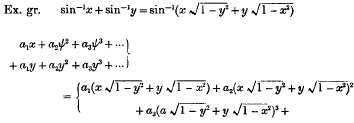
Picking out coefficient of y we get

On the general equation of the second degree representing a pair of straight lines
-
- Journal:
- Proceedings of the Edinburgh Mathematical Society / Volume 7 / February 1888
- Published online by Cambridge University Press:
- 20 January 2009, p. 8
-
- Article
-
- You have access
- Export citation
Notes on the Apollonian Problem and the allied theory
-
- Journal:
- Proceedings of the Edinburgh Mathematical Society / Volume 24 / February 1905
- Published online by Cambridge University Press:
- 20 January 2009, pp. 78-119
-
- Article
-
- You have access
- Export citation
On some generalisations of Laguerre polynomials
-
- Journal:
- Proceedings of the Edinburgh Mathematical Society / Volume 6 / Issue 3 / August 1940
- Published online by Cambridge University Press:
- 20 January 2009, pp. 135-146
-
- Article
-
- You have access
- Export citation
-
Let
 , (n = 0, 1, ….) be the Laguerre, Hn(x) the Hermite polynomial. Let
  , be the space of all functions f(x) the pth powers of which are integrable over (a, b), with the norm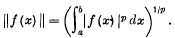
 , (n = 0, 1, ….) be the Laguerre, H
 , be the space of all functions f(x) the pth powers of which are integrable over (a, b), with the norm
C. T. H. Baker, The Numerical Treatment of Integral Equations (Clarendon Press; Oxford University Press, 1978), xiv+1034 pp., £22–50.
-
- Journal:
- Proceedings of the Edinburgh Mathematical Society / Volume 22 / Issue 1 / February 1979
- Published online by Cambridge University Press:
- 20 January 2009, p. 67
-
- Article
-
- You have access
- Export citation
Enlargements of regular semigroups
-
- Journal:
- Proceedings of the Edinburgh Mathematical Society / Volume 39 / Issue 3 / October 1996
- Published online by Cambridge University Press:
- 20 January 2009, pp. 425-460
-
- Article
-
- You have access
- Export citation
Genetic algebras associated with sex linkage
-
- Journal:
- Proceedings of the Edinburgh Mathematical Society / Volume 17 / Issue 2 / December 1970
- Published online by Cambridge University Press:
- 20 January 2009, pp. 113-120
-
- Article
-
- You have access
- Export citation
T. Frankel Gravitational Curvature: An Introduction to Einstein's Theory (Freeman, San Francisco, 1979) xviii + 172 pp. £18.50; paper, £8.95.
-
- Journal:
- Proceedings of the Edinburgh Mathematical Society / Volume 26 / Issue 1 / February 1983
- Published online by Cambridge University Press:
- 20 January 2009, pp. 117-118
-
- Article
-
- You have access
- Export citation
Office-Bearers
-
- Journal:
- Proceedings of the Edinburgh Mathematical Society / Volume 31 / February 1912
- Published online by Cambridge University Press:
- 20 January 2009, p. 1
-
- Article
-
- You have access
- Export citation
The Composition of Linear Differential Systems
-
- Journal:
- Proceedings of the Edinburgh Mathematical Society / Volume 3 / Issue 1 / March 1932
- Published online by Cambridge University Press:
- 20 January 2009, pp. 10-15
-
- Article
-
- You have access
- Export citation
-
A common method of solving a linear differential equation consists in expressing the differential operator as a product of factors. The possibility of doing so has been studied extensively by Vessiot, following the work of Picard and Drach, on the lines of the Galois theory of algebraic equations. The analogous process of resolving a, linear differential system, consisting of an equation together with boundary conditions, into two or more systems of lower order does not seem to have been investigated. Such a resolution is not always possible, even in cases where the differential equation can be factorised. Thus the system
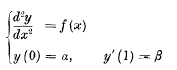
is equivalent to the systems
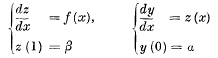
but the system
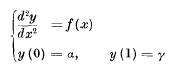
cannot be so resolved.
An unpleasant set in a non-locally-convex vector lattice
-
- Journal:
- Proceedings of the Edinburgh Mathematical Society / Volume 18 / Issue 3 / June 1973
- Published online by Cambridge University Press:
- 20 January 2009, pp. 229-233
-
- Article
-
- You have access
- Export citation
-
In a linear topological space E one often carries out various “ smoothing ” operations on a subset A, such as taking the convex hull co A and the closure A-. If E is also a (real) vector lattice, the solid hull

is also a natural “ smoothing out ” of A. If sol A = A then A is called solid, and if E has a base of solid neighbourhoods of 0 as do all the common topological vector lattices such as C(X), Lp, Köthe spaces and so on—then E is called a locally solid space.
Rings of differential operators on toric varieties
-
- Journal:
- Proceedings of the Edinburgh Mathematical Society / Volume 37 / Issue 1 / February 1994
- Published online by Cambridge University Press:
- 20 January 2009, pp. 143-160
-
- Article
-
- You have access
- Export citation
-
Let
 be a finite dimensional toric variety over an algebraically closed field of characteristic zero, k. Let
  be the sheaf of differential operators on . We show that the ring of global sections,
  is a finitely generated Noetherian k-algebra and that its generators can be explicitly found. We prove a similar result for the sheaf of differential operators with coefficients in a line bundle.
 be a finite dimensional toric variety over an algebraically closed field of characteristic zero, k. Let
  be the sheaf of differential operators on
  is a finitely generated Noetherian k-algebra and that its generators can be explicitly found. We prove a similar result for the sheaf of differential operators with coefficients in a line bundle.
On derivations of fields of algebraic functions
-
- Journal:
- Proceedings of the Edinburgh Mathematical Society / Volume 23 / Issue 3 / October 1980
- Published online by Cambridge University Press:
- 20 January 2009, pp. 239-241
-
- Article
-
- You have access
- Export citation
Note on Professor Naraniengar's Paper in the Proceedings of 1909–10
-
- Journal:
- Proceedings of the Edinburgh Mathematical Society / Volume 29 / February 1910
- Published online by Cambridge University Press:
- 20 January 2009, pp. 75-77
-
- Article
-
- You have access
- Export citation
Finitely generated groups with virtually free automorphism groups
-
- Journal:
- Proceedings of the Edinburgh Mathematical Society / Volume 38 / Issue 3 / October 1995
- Published online by Cambridge University Press:
- 20 January 2009, pp. 475-484
-
- Article
-
- You have access
- Export citation
