Refine search
Actions for selected content:
26076 results in Abstract analysis
E. S. Keeping, Introduction to Statistical Inference (D. Van Nostrand Co., Princeton, N.J., 1962), xi + 451 pp., 66s.
-
- Journal:
- Proceedings of the Edinburgh Mathematical Society / Volume 13 / Issue 3 / June 1963
- Published online by Cambridge University Press:
- 20 January 2009, p. 264
-
- Article
-
- You have access
- Export citation
Herbert Spencer and Mathematics
-
- Journal:
- Proceedings of the Edinburgh Mathematical Society / Volume 25 / February 1906
- Published online by Cambridge University Press:
- 20 January 2009, pp. 95-106
-
- Article
-
- You have access
- Export citation
On Wireless Telegraphy and High Potential Currents
-
- Journal:
- Proceedings of the Edinburgh Mathematical Society / Volume 17 / February 1898
- Published online by Cambridge University Press:
- 20 January 2009, p. 69
-
- Article
-
- You have access
- Export citation
On a non-convex hyperbolic differential inclusion
-
- Journal:
- Proceedings of the Edinburgh Mathematical Society / Volume 35 / Issue 3 / October 1992
- Published online by Cambridge University Press:
- 20 January 2009, pp. 375-382
-
- Article
-
- You have access
- Export citation
Appendix
-
- Journal:
- Proceedings of the Edinburgh Mathematical Society / Volume 21 / February 1902
- Published online by Cambridge University Press:
- 20 January 2009, pp. 182-183
-
- Article
-
- You have access
- Export citation
Angular momentum, convex Polyhedra and Algebraic Geometry
-
- Journal:
- Proceedings of the Edinburgh Mathematical Society / Volume 26 / Issue 2 / June 1983
- Published online by Cambridge University Press:
- 20 January 2009, pp. 121-133
-
- Article
-
- You have access
- Export citation
Some inequalities for a hypergeometric integral
-
- Journal:
- Proceedings of the Edinburgh Mathematical Society / Volume 18 / Issue 1 / June 1972
- Published online by Cambridge University Press:
- 20 January 2009, pp. 31-34
-
- Article
-
- You have access
- Export citation
-
In various problems in harmonic analysis (4, 5, 6), I have required an estimate for the integral for the hypergeometric function

in the case where a>c−b>0, b>0, and 0 ≦ x < 1 (the integral is then unbounded as x→l−). Although there are innumerable identities for hypergeometric functions, few inequalities for these functions seem to be known, and in estimating the integral (1) I employed ad hoc arguments that made no use of the theory of hypergeometric functions. The estimates obtained were adequate for my purposes, but were far from sharp, and the object of this note is to show that, by assembling a few known facts concerning hypergeometric functions, we can obtain sharp inequalities for the integral (1). We also give (in §4) several related inequalities that can be obtained by transforming the integral.
On some Algebraic Identities
-
- Journal:
- Proceedings of the Edinburgh Mathematical Society / Volume 22 / February 1903
- Published online by Cambridge University Press:
- 20 January 2009, p. 12
-
- Article
-
- You have access
- Export citation
Representations of normed algebras with minimal left ideals
-
- Journal:
- Proceedings of the Edinburgh Mathematical Society / Volume 19 / Issue 2 / September 1974
- Published online by Cambridge University Press:
- 20 January 2009, pp. 173-190
-
- Article
-
- You have access
- Export citation
-
The theory of *-representations of Banach *-algebras on Hilbert space is one of the most useful and most successful parts of the theory of Banach algebras. However, there are only scattered results concerning the representations of general Banach algebras on Banach spaces. It may be that a comprehensive representation theory is impossible. Nevertheless, for some special algebras interesting and worthwhile results can be proved. This is true for
 (Y), the algebra of all bounded operators on a Banach space Y, and for
  (Y), the subalgebra of (Y) consisting of operators with finite dimensional range. The representations of (Y) are studied in a recent paper by H. Porta and E. Berkson (6), and in another recent paper (8), P. Chernoff determines the structure of the representations of (Y) (and also of some more general algebras of operators). In both these papers, (Y), which is the socle of the algebras under consideration, plays an important role in the theory. This suggests the possibility that a more general representation theory can be formulated in the case of a normed algebra with a nontrivial socle. This we attempt to do in this paper.
 (Y), the algebra of all bounded operators on a Banach space Y, and for
  (Y), the subalgebra of
 On a number of concurrent spheres
-
- Journal:
- Proceedings of the Edinburgh Mathematical Society / Volume 3 / February 1884
- Published online by Cambridge University Press:
- 20 January 2009, p. 118
-
- Article
-
- You have access
- Export citation
PEM volume 38 issue 1 Cover and Front matter
-
- Journal:
- Proceedings of the Edinburgh Mathematical Society / Volume 38 / Issue 1 / February 1995
- Published online by Cambridge University Press:
- 20 January 2009, pp. f1-f2
-
- Article
-
- You have access
- Export citation
B. Stenström, Rings of Quotients (Springer-Verlag, 1975), vii + 309 pp., DM 92.00, $39.60.
-
- Journal:
- Proceedings of the Edinburgh Mathematical Society / Volume 20 / Issue 3 / March 1977
- Published online by Cambridge University Press:
- 20 January 2009, pp. 271-272
-
- Article
-
- You have access
- Export citation
V. M. Bradis, V. L. Minkovskii and A. K. Kharcheva, Lapses in Mathematical Reasoning (Pergamon Press, 1963), xiv + 201 pp., 15s
-
- Journal:
- Proceedings of the Edinburgh Mathematical Society / Volume 14 / Issue 1 / June 1964
- Published online by Cambridge University Press:
- 20 January 2009, pp. 81-82
-
- Article
-
- You have access
- Export citation
On Graphical Integration
-
- Journal:
- Proceedings of the Edinburgh Mathematical Society / Volume 30 / February 1911
- Published online by Cambridge University Press:
- 20 January 2009, pp. 49-53
-
- Article
-
- You have access
- Export citation
On the number of Independent Conditions involved in the vanishing of a Rectangular Array
-
- Journal:
- Proceedings of the Edinburgh Mathematical Society / Volume 24 / February 1905
- Published online by Cambridge University Press:
- 20 January 2009, pp. 2-6
-
- Article
-
- You have access
- Export citation
-
1. The notation for a rectangular array can be extended so as to admit of arrays in which the number of rows exceeds the number of columns.
Let
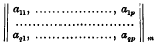
denote the aggregate of all determinants of the mth order which can be formed from the rectangular array of pq elements by deleting p – m columns and q – m rows.
On normed Lie algebras with sufficiently many subalgebras of codimension I
-
- Journal:
- Proceedings of the Edinburgh Mathematical Society / Volume 29 / Issue 2 / June 1986
- Published online by Cambridge University Press:
- 20 January 2009, pp. 199-220
-
- Article
-
- You have access
- Export citation
-
Let H be a finite or infinite dimensional Lie algebra. Barnes [2] and Towers [5] considered the case when H is a finite-dimensional Lie algebra over an arbitrary field, and all maximal subalgebras of H have codimension 1. Barnes, using the cohomology theory of Lie algebras, investigated solvable algebras, and Towers extended Barnes's results to include all Lie algebras. In [4] complex finite-dimensional Lie algebras were considered for the case when all the maximal subalgebras of H are not necessarily of codimension 1 but when

where S(H) is the set of all Lie subalgebras in H of codimension 1. Amayo [1]investigated the finite-dimensional Lie algebras with core-free subalgebras of codimension 1 and also obtained some interesting results about the structure of infinite dimensional Lie algebras with subalgebras of codimension 1.
Some Further Triple Integral Equation Solutions
-
- Journal:
- Proceedings of the Edinburgh Mathematical Society / Volume 13 / Issue 4 / December 1963
- Published online by Cambridge University Press:
- 20 January 2009, pp. 303-316
-
- Article
-
- You have access
- Export citation
K. W. Gruenberg and J. E. Roseblade (editors) Collected works of Philip Hall (Clarendon Press, Oxford1988), xii + 776 pp., 0 19 853254 7, £55.
-
- Journal:
- Proceedings of the Edinburgh Mathematical Society / Volume 33 / Issue 1 / February 1990
- Published online by Cambridge University Press:
- 20 January 2009, p. 165
-
- Article
-
- You have access
- Export citation
On strongly regular near-rings
-
- Journal:
- Proceedings of the Edinburgh Mathematical Society / Volume 27 / Issue 1 / February 1984
- Published online by Cambridge University Press:
- 20 January 2009, pp. 61-64
-
- Article
-
- You have access
- Export citation
Joint numerical ranges for unbounded normal operators
-
- Journal:
- Proceedings of the Edinburgh Mathematical Society / Volume 28 / Issue 2 / June 1985
- Published online by Cambridge University Press:
- 20 January 2009, pp. 225-232
-
- Article
-
- You have access
- Export citation
