Refine search
Actions for selected content:
26076 results in Abstract analysis
Invariants of two quaternary quadrics
-
- Journal:
- Proceedings of the Edinburgh Mathematical Society / Volume 5 / Issue 1 / October 1936
- Published online by Cambridge University Press:
- 20 January 2009, pp. 41-42
-
- Article
-
- You have access
- Export citation
-
Following the papers by H. W. Turnbull and J. Williamson, I have verified that the 122 forms, of the system of two quaternary quadrics
 and
and  are actually irreducible. The original 1917 system contained 125 forms, which Williamson reduced by three. The present verification shews that no further reduction is possible. The proof was carried out as follows. I first constructed the whole system in canonical form with
  and
and  for the two quadrics, and then listed the degrees in the coefficients and variables u, p, x of these concomitants. I next made Diophantine equations between these degrees for testing the supposed reducibility and found them to be impossible, except for Williamson's reduced forms.
 and
and  are actually irreducible. The original 1917 system contained 125 forms, which Williamson reduced by three. The present verification shews that no further reduction is possible. The proof was carried out as follows. I first constructed the whole system in canonical form with
  and
and  for the two quadrics, and then listed the degrees in the coefficients and variables u, p, x of these concomitants. I next made Diophantine equations between these degrees for testing the supposed reducibility and found them to be impossible, except for Williamson's reduced forms.
PEM volume 6 issue 2 Cover and Front matter
-
- Journal:
- Proceedings of the Edinburgh Mathematical Society / Volume 6 / Issue 2 / October 1939
- Published online by Cambridge University Press:
- 20 January 2009, pp. f1-f2
-
- Article
-
- You have access
- Export citation
The hyperosculating spaces to certain curves in [n]
-
- Journal:
- Proceedings of the Edinburgh Mathematical Society / Volume 19 / Issue 3 / March 1975
- Published online by Cambridge University Press:
- 20 January 2009, pp. 301-309
-
- Article
-
- You have access
- Export citation
Representable divisibility semigroups
-
- Journal:
- Proceedings of the Edinburgh Mathematical Society / Volume 34 / Issue 1 / February 1991
- Published online by Cambridge University Press:
- 20 January 2009, pp. 45-64
-
- Article
-
- You have access
- Export citation
-
By a divisibility semigroup we mean an algebra (S,., ∧) satisfying (Al) (S,.) is a semigroup; (A2) (S, ∧) is a semilattice; (A3)
 .
.A divisibility semigroup is called representable if it admits a subdirect decomposition into totally ordered factors.
In this paper various types of representable divisibility semigroups are investigated and characterized, admitting a representation in general or even a special decomposition, like subdirect sums of archimedean factors, for instance.
 .
.On the Eigenvector belonging to the Maximal Root of a Non-negative Matrix
-
- Journal:
- Proceedings of the Edinburgh Mathematical Society / Volume 12 / Issue 2 / December 1960
- Published online by Cambridge University Press:
- 20 January 2009, pp. 107-112
-
- Article
-
- You have access
- Export citation
-
By a theorem of Perron, a non-negative irreducible (n × n) matrix A = (aμν) has a positive fundamental root σ, the “ maximal root of A ”, such that the moduli of all other eigenvalues of A do not exceed σ. If we put

σ lies between R and r. Since σ is not changed if A is transformed by a positive diagonal matrix D(p1,…pn, σ lies also between the expressions

By a theorem of Frobenius, to σ as an eigenvalue of A belongs a positive eigenvector ξ, = (x1 …, xn), satisfying

On some steady state thermoelastic stress distributions in a slab
-
- Journal:
- Proceedings of the Edinburgh Mathematical Society / Volume 14 / Issue 4 / December 1965
- Published online by Cambridge University Press:
- 20 January 2009, pp. 303-310
-
- Article
-
- You have access
- Export citation
E. Landau, Grundlagen der Analysis (Chelsea Publishing Company, 3rd edition, 1960), 173 pp., $1.95.
-
- Journal:
- Proceedings of the Edinburgh Mathematical Society / Volume 12 / Issue 4 / December 1961
- Published online by Cambridge University Press:
- 20 January 2009, p. 217
-
- Article
-
- You have access
- Export citation
The Factors of (a, b, c, f, g, h)(x, y, z)2–λ(x2+y2+z2)
-
- Journal:
- Proceedings of the Edinburgh Mathematical Society / Volume 28 / February 1909
- Published online by Cambridge University Press:
- 20 January 2009, pp. 62-63
-
- Article
-
- You have access
- Export citation
-

f λS is the product of two factors of the form αx + βy + γz if λ is a root of a discriminating cubic
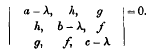
A well-known proof of the reality of the roots of the cubic is as follows :—
Write

On an Integral due to Ramanujan, and some ideas suggested by it
-
- Journal:
- Proceedings of the Edinburgh Mathematical Society / Volume 2 / Issue 1 / January 1930
- Published online by Cambridge University Press:
- 20 January 2009, pp. 26-32
-
- Article
-
- You have access
- Export citation
-
By applying Fourier's Integral Theorem to a well-known formula, due to Cauchy, expressed in the form

where R (μ + v) > 1, Ramanujan has shown that

where t is any real number.
The following Presents to the Library have been received, for which the Society tenders its grateful thanks
-
- Journal:
- Proceedings of the Edinburgh Mathematical Society / Volume 39 / February 1920
- Published online by Cambridge University Press:
- 20 January 2009, pp. vii-viii
-
- Article
-
- You have access
- Export citation
The interaction of a contact discontinuity with sound waves according to the linearised Navier-Stokes equations
-
- Journal:
- Proceedings of the Edinburgh Mathematical Society / Volume 17 / Issue 1 / June 1970
- Published online by Cambridge University Press:
- 20 January 2009, pp. 37-46
-
- Article
-
- You have access
- Export citation
To express a Determinant of the nth Order in terms of Compound Determinants of the 2nd Order, and vice-versa
-
- Journal:
- Proceedings of the Edinburgh Mathematical Society / Volume 26 / February 1907
- Published online by Cambridge University Press:
- 20 January 2009, pp. 15-17
-
- Article
-
- You have access
- Export citation
-
Let φ(a b′ c″) denote the compound determinant,

Then if A, B, etc., denote the co-factors of the elements a, b, etc. in the determinant (a b′ c″), we have

PEM volume 10 figures
-
- Journal:
- Proceedings of the Edinburgh Mathematical Society / Volume 10 / February 1891
- Published online by Cambridge University Press:
- 20 January 2009, pp. b1-b7
-
- Article
-
- You have access
- Export citation
Library of Mathematics—(i) Linear Equations by P. M. Cohn (ii) Sequences and Series by J. A. Green , (iii) Differential Calculus by P. J. Hilton, (iv) Elementary Differential Equations and Operators by G. E. H. Reuter (Routledge and Kegan Paul, 1958), 5s. each.
-
- Journal:
- Proceedings of the Edinburgh Mathematical Society / Volume 12 / Issue 1 / June 1960
- Published online by Cambridge University Press:
- 20 January 2009, pp. 59-60
-
- Article
-
- You have access
- Export citation
D. K. Arrowsmith and C. M. Place, Ordinary differential equations: a qualitative approach with applications (Chapman and Hall, 1982), 250 pp., cloth £18, paper £7.95.
-
- Journal:
- Proceedings of the Edinburgh Mathematical Society / Volume 26 / Issue 2 / June 1983
- Published online by Cambridge University Press:
- 20 January 2009, pp. 287-288
-
- Article
-
- You have access
- Export citation
On the Teaching of Elementary Geometry
-
- Journal:
- Proceedings of the Edinburgh Mathematical Society / Volume 2 / February 1883
- Published online by Cambridge University Press:
- 20 January 2009, pp. 24-25
-
- Article
-
- You have access
- Export citation
On the complex oscillation theory of f(k) + Af = F
-
- Journal:
- Proceedings of the Edinburgh Mathematical Society / Volume 36 / Issue 3 / October 1993
- Published online by Cambridge University Press:
- 20 January 2009, pp. 447-461
-
- Article
-
- You have access
- Export citation
-
In this paper, we investigate the complex oscillation theory of

where A, F≢0 are entire functions, and obtain general estimates of the exponent of convergence of the zero-sequence and of the order of growth of solutions for the above equation.
PEM volume 42 Cover and Front matter
-
- Journal:
- Proceedings of the Edinburgh Mathematical Society / Volume 42 / February 1923
- Published online by Cambridge University Press:
- 20 January 2009, pp. f1-f5
-
- Article
-
- You have access
- Export citation
The radial oscillation of solutions to ode's in the complex domain
-
- Journal:
- Proceedings of the Edinburgh Mathematical Society / Volume 39 / Issue 3 / October 1996
- Published online by Cambridge University Press:
- 20 January 2009, pp. 473-483
-
- Article
-
- You have access
- Export citation
Development of sn x, cn x, dn x, by means of their addition theorems
-
- Journal:
- Proceedings of the Edinburgh Mathematical Society / Volume 14 / February 1895
- Published online by Cambridge University Press:
- 20 January 2009, pp. 35-36
-
- Article
-
- You have access
- Export citation
-
Taking the three addition theorems and clearing away the fractions,



Let
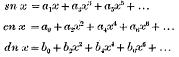
Substitute in (1) (2) (3) the expansions for sinx, siny,
 cosx, cosy,
  , dn x, dn y,
  , and then pick out the coefficients of y in (1), (2), (3). Then equate the like powers of x in the resulting series.
 cosx, cosy,
  , dn x, dn y,
  , and then pick out the coefficients of y in (1), (2), (3). Then equate the like powers of x in the resulting series.