Refine search
Actions for selected content:
26076 results in Abstract analysis
Binary and Ternary Transformations of Sequences
-
- Journal:
- Proceedings of the Edinburgh Mathematical Society / Volume 11 / Issue 3 / May 1959
- Published online by Cambridge University Press:
- 20 January 2009, pp. 175-181
-
- Article
-
- You have access
- Export citation
-
Agnew (1) has defined a binary transformation T(α), with α real, as one which takes the sequence {Si}, i = 0, 1,…, into the sequence {si(1,α)} where

PEM volume 14 issue 1 Cover and Front matter
-
- Journal:
- Proceedings of the Edinburgh Mathematical Society / Volume 14 / Issue 1 / June 1964
- Published online by Cambridge University Press:
- 20 January 2009, pp. f1-f2
-
- Article
-
- You have access
- Export citation
Euclidean Proof of Pascal's Theorem*
-
- Journal:
- Proceedings of the Edinburgh Mathematical Society / Volume 19 / February 1900
- Published online by Cambridge University Press:
- 20 January 2009, p. 2
-
- Article
-
- You have access
- Export citation
Ian S. Murphy Advanced Calculus for Engineering and Science Students (Arklay Publishers, 1984), 216 pp. £6.95.
-
- Journal:
- Proceedings of the Edinburgh Mathematical Society / Volume 28 / Issue 3 / October 1985
- Published online by Cambridge University Press:
- 20 January 2009, p. 425
-
- Article
-
- You have access
- Export citation
Irrotational Flow of a Liquid, with Axial Symmetry
-
- Journal:
- Proceedings of the Edinburgh Mathematical Society / Volume 13 / Issue 2 / December 1962
- Published online by Cambridge University Press:
- 20 January 2009, pp. 201-204
-
- Article
-
- You have access
- Export citation
Osculating primes to curves of intersection in 4-space, and to certain curves in n-space
-
- Journal:
- Proceedings of the Edinburgh Mathematical Society / Volume 18 / Issue 4 / December 1973
- Published online by Cambridge University Press:
- 20 January 2009, pp. 325-338
-
- Article
-
- You have access
- Export citation
On the semilattice of idempotents of a free inverse monoid
-
- Journal:
- Proceedings of the Edinburgh Mathematical Society / Volume 36 / Issue 2 / June 1993
- Published online by Cambridge University Press:
- 20 January 2009, pp. 349-360
-
- Article
-
- You have access
- Export citation
PEM volume 9 issue 3 Cover and Back matter
-
- Journal:
- Proceedings of the Edinburgh Mathematical Society / Volume 9 / Issue 3 / July 1956
- Published online by Cambridge University Press:
- 20 January 2009, pp. b1-b2
-
- Article
-
- You have access
- Export citation
On supports of semigroups of measures
-
- Journal:
- Proceedings of the Edinburgh Mathematical Society / Volume 19 / Issue 1 / March 1974
- Published online by Cambridge University Press:
- 20 January 2009, pp. 31-33
-
- Article
-
- You have access
- Export citation
-
Let S denote a compact semitopological semigroup (i.e. the multiplication is separately continuous) and P(S) the set of probability measures on S. Then P(S) is a compact semitopological semigroup under convolution and the weak * topology (4). Let Γ be a subsemigroup of P(S) and
 where supp μ is the support of μ ∈P(S). In the case in which S is commutative it was shown by Glicksberg in (4) that S(Γ) is an algebraic group in S if Γ is an algebraic group. For a general semigroup S, Pym (7) considered Γ = {η}, η being an idempotent, and established that S(Γ) is a topologically simple subsemigroup of S, i.e. every ideal of S(Γ) is dense in S(Γ). In this note we prove that if Γ is a simple subsemigroup of P(S) (a semigroup is simple if it contains no proper ideal) which contains an idempotent then S(Γ) is a topologically simple subsemigroup of S. We also give an example to show that our conclusion (hence also Pym's) is best possible in the sense that S(Γ) is not simple in general
 where supp μ is the support of μ ∈P(S). In the case in which S is commutative it was shown by Glicksberg in (
On The Uniformisation of Algebraic Curves of Genus 3
-
- Journal:
- Proceedings of the Edinburgh Mathematical Society / Volume 2 / Issue 2 / June 1930
- Published online by Cambridge University Press:
- 20 January 2009, pp. 102-107
-
- Article
-
- You have access
- Export citation
-
An algebraic equation

determines, in general, s as a many valued function of z. If s and z can be expressed as one valued functions of a third variable t, then t is called the uniformising variable. As Poincaré showed, s and z are automorphic functions of t.
Convergence in partially ordered groups
-
- Journal:
- Proceedings of the Edinburgh Mathematical Society / Volume 18 / Issue 3 / June 1973
- Published online by Cambridge University Press:
- 20 January 2009, pp. 239-246
-
- Article
-
- You have access
- Export citation
Easy Geometrical Proof of a Theorem of Chasles
-
- Journal:
- Proceedings of the Edinburgh Mathematical Society / Volume 34 / February 1915
- Published online by Cambridge University Press:
- 20 January 2009, p. 2
-
- Article
-
- You have access
- Export citation
Sah Chih-Han, Abstract Algebra (Academic Press, Inc., New York, 1966), xiii + 342 pp., 78s.
-
- Journal:
- Proceedings of the Edinburgh Mathematical Society / Volume 16 / Issue 2 / December 1968
- Published online by Cambridge University Press:
- 20 January 2009, pp. 181-182
-
- Article
-
- You have access
- Export citation
PEM volume 10 Cover and Front matter
-
- Journal:
- Proceedings of the Edinburgh Mathematical Society / Volume 10 / February 1891
- Published online by Cambridge University Press:
- 20 January 2009, pp. f1-f5
-
- Article
-
- You have access
- Export citation
A certain relation between coaxial circles and conics
-
- Journal:
- Proceedings of the Edinburgh Mathematical Society / Volume 27 / February 1909
- Published online by Cambridge University Press:
- 20 January 2009, pp. 2-4
-
- Article
-
- You have access
- Export citation
-
Theorem. If a point be taken on the radical axis of a coaxial system of circles, and from it tangents be drawn to any circle of the system, these tangents are cut in points on a conic, by the radical axis of the circle and a given fixed point. The two points are the foci of the conic. (Fig. 1.) Let W1W2 be the line of
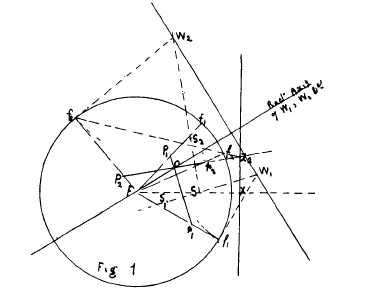
gives an ellipse as the locus of P1P2, &c, when, as in Fig, 1, S is internal to F. If S were an external point, we should have P1F-P1S = P1F - P1f1 = radius of F = constant, and the locus of P1, P2, &c., would be a hyperbola. When F is at infinity on the radical axis, P1S = P1f1, and P1f1 being at right angles to W1W2, the conic is a parabola, and the line of centres the directrix.
Paul R. Halmos, Lectures on Boolean Algebra (Van Nostrand, Princeton, 1963), 147 pp., 23s. 6d.
-
- Journal:
- Proceedings of the Edinburgh Mathematical Society / Volume 14 / Issue 4 / December 1965
- Published online by Cambridge University Press:
- 20 January 2009, p. 344
-
- Article
-
- You have access
- Export citation
Congruence permutable extensions of distributive double p-algebras*
-
- Journal:
- Proceedings of the Edinburgh Mathematical Society / Volume 36 / Issue 1 / February 1993
- Published online by Cambridge University Press:
- 20 January 2009, pp. 165-168
-
- Article
-
- You have access
- Export citation
Nuclear subalgebras of UHF C*-algebras
-
- Journal:
- Proceedings of the Edinburgh Mathematical Society / Volume 29 / Issue 1 / February 1986
- Published online by Cambridge University Press:
- 20 January 2009, pp. 97-100
-
- Article
-
- You have access
- Export citation
J. Aharoni, The Special Theory of Relativity (Clarendon Press: Oxford University Press, 1959), 285 pp., 45s.
-
- Journal:
- Proceedings of the Edinburgh Mathematical Society / Volume 12 / Issue 3 / June 1961
- Published online by Cambridge University Press:
- 20 January 2009, p. 170
-
- Article
-
- You have access
- Export citation
Bounds for the size of integral solutions to Ym = f(X)
-
- Journal:
- Proceedings of the Edinburgh Mathematical Society / Volume 42 / Issue 1 / February 1999
- Published online by Cambridge University Press:
- 20 January 2009, pp. 127-141
-
- Article
-
- You have access
- Export citation
