Refine search
Actions for selected content:
26077 results in Abstract analysis
Whittaker's Correlation of Physics and Philosophy
-
- Journal:
- Proceedings of the Edinburgh Mathematical Society / Volume 11 / Issue 1 / June 1958
- Published online by Cambridge University Press:
- 20 January 2009, pp. 57-68
-
- Article
-
- You have access
- Export citation
Unique factorisation rings
-
- Journal:
- Proceedings of the Edinburgh Mathematical Society / Volume 35 / Issue 2 / June 1992
- Published online by Cambridge University Press:
- 20 January 2009, pp. 255-269
-
- Article
-
- You have access
- Export citation
PEM volume 20 Back matter and figures
-
- Journal:
- Proceedings of the Edinburgh Mathematical Society / Volume 20 / February 1901
- Published online by Cambridge University Press:
- 20 January 2009, pp. b1-b15
-
- Article
-
- You have access
- Export citation
On some definite integrals involving Legendre functions
-
- Journal:
- Proceedings of the Edinburgh Mathematical Society / Volume 4 / Issue 1 / March 1934
- Published online by Cambridge University Press:
- 20 January 2009, pp. 41-46
-
- Article
-
- You have access
- Export citation
-
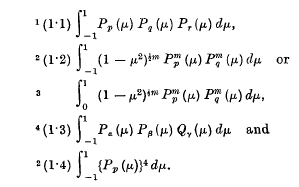
A few definite integrals involving more than two Legendre functions in the integrand have been considered by Ferrers, Adams, Dougall, Nicholson and Bailey. We take for example the following integrals.
N-ary Transformations of Sequences
-
- Journal:
- Proceedings of the Edinburgh Mathematical Society / Volume 11 / Issue 4 / November 1959
- Published online by Cambridge University Press:
- 20 January 2009, pp. 221-222
-
- Article
-
- You have access
- Export citation
-
Let T(α1, α2, …, αn−1) be the n-ary transformation which takes the sequence {si}, (i = 0, 1, …), into the sequence {s'i} where

with sm = 0 when m is a negative integer, and where α1, …, αn an are real numbers with sum unity. In a previous note (1) conditions were found on α and β for the ternary transformation T(α, β) to be equivalent to convergence. A method is given here for treating the similar problem for the general n-ary transformation.
On crossed products and Takai duality
-
- Journal:
- Proceedings of the Edinburgh Mathematical Society / Volume 31 / Issue 2 / June 1988
- Published online by Cambridge University Press:
- 20 January 2009, pp. 321-330
-
- Article
-
- You have access
- Export citation
Extension of the Notion of Wave-surface to Space of n Dimensions
-
- Journal:
- Proceedings of the Edinburgh Mathematical Society / Volume 16 / February 1897
- Published online by Cambridge University Press:
- 20 January 2009, pp. 51-56
-
- Article
-
- You have access
- Export citation
-
The following two modes of generation of the wave-surface are pretty generally known.
(a) A given ellipsoid
 (surface of elasticity) is cut by any central plane π along an ellipse of semiaxes λ1 and λ2. If π varies, the two pairs of planes π∲ parallel to π at distances k2/λ1, k2/λ2 (k = constant) from it envelope the wave-surface W1 represented by the tangential equation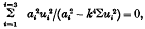
if the tangential coordinates u1 depend on Σux +1 = 0.
 (surface of elasticity) is cut by any central plane π along an ellipse of semiaxes λ
Y. B. Pesin Dimension theory in dynamical systems: contemporary views and applications, (University of Chicago Press, Chicago, 1998), xi + 304 pp., (cloth) 0 226 66221 7, £44.75 (US$56.00); (paper) 0 226 66222 5, £15.95 (US$19.95).
-
- Journal:
- Proceedings of the Edinburgh Mathematical Society / Volume 42 / Issue 2 / June 1999
- Published online by Cambridge University Press:
- 20 January 2009, pp. 430-432
-
- Article
-
- You have access
- Export citation
S. Strǎtilǎ and L. ZsidÓ, Lectures on von Neumann algebras (Abacus Press, 1979), pp. 478, £29·95.
-
- Journal:
- Proceedings of the Edinburgh Mathematical Society / Volume 26 / Issue 3 / October 1983
- Published online by Cambridge University Press:
- 20 January 2009, pp. 400-401
-
- Article
-
- You have access
- Export citation
List of Members
-
- Journal:
- Proceedings of the Edinburgh Mathematical Society / Volume 1 / February 1883
- Published online by Cambridge University Press:
- 20 January 2009, pp. 137-140
-
- Article
-
- You have access
- Export citation
Inverse multiparameter eigenvalue problems for matrices II
-
- Journal:
- Proceedings of the Edinburgh Mathematical Society / Volume 29 / Issue 3 / October 1986
- Published online by Cambridge University Press:
- 20 January 2009, pp. 343-348
-
- Article
-
- You have access
- Export citation
PEM volume 41 Cover and Front matter
-
- Journal:
- Proceedings of the Edinburgh Mathematical Society / Volume 41 / February 1922
- Published online by Cambridge University Press:
- 20 January 2009, pp. f1-f5
-
- Article
-
- You have access
- Export citation
On groups of Fibonacci type
-
- Journal:
- Proceedings of the Edinburgh Mathematical Society / Volume 20 / Issue 3 / March 1977
- Published online by Cambridge University Press:
- 20 January 2009, pp. 211-213
-
- Article
-
- You have access
- Export citation
-
Let w = w(a0, a1, an–1) be a word in the free group freely generated by a0, a1, …, an–1; let wi, denote the word w(ai, ai+1, …, ai+n–1), where the subscriptsj in aj are reduced modulo n; and let

Extensions relative to a Serre class
-
- Journal:
- Proceedings of the Edinburgh Mathematical Society / Volume 19 / Issue 4 / September 1975
- Published online by Cambridge University Press:
- 20 January 2009, pp. 375-381
-
- Article
-
- You have access
- Export citation
-
Consider a class C of projective R-modules, where R is a commutative ring with identity, which satisfies the conditions of (2), namely that C is closed under the operations of direct sum and isomorphism and C contains the zero module. Following (2) a module M is said to have C-cotype n (respectively C-type n) if it has a projective resolution … → Pn → P0 → M → 0 with Pi ∈ C for i>n (respectively Pi ∈ C for i≦n). Let S be the class of modules of C-cotype −1, equivalently of C-type infinity. It is assumed throughout that S is a Serre Class. We define an abelian category
 of modules with the property that C-cotype is homological dimension in while in the case C = 0, S is just the category of R-modules. It follows that all categorical results on homological dimension also hold for cotype.
 of modules with the property that C-cotype is homological dimension in
 PEM volume 12 issue 3 Cover and Front matter
-
- Journal:
- Proceedings of the Edinburgh Mathematical Society / Volume 12 / Issue 3 / June 1961
- Published online by Cambridge University Press:
- 20 January 2009, pp. f1-f2
-
- Article
-
- You have access
- Export citation
On certain expansions involving Bessel functions and Whittaker's M-functions
-
- Journal:
- Proceedings of the Edinburgh Mathematical Society / Volume 6 / Issue 1 / May 1939
- Published online by Cambridge University Press:
- 20 January 2009, pp. 19-23
-
- Article
-
- You have access
- Export citation
-
Adopting the notation of Barnes1 and Fox, let us write
If q > p — l, the series on the right of (1) represents an integral function, while if q = p — 1, the series converges only inside or on the circle | x |=1.
Solutions of Euclid's Problems, with a rule and one fixed aperture of the compasses, by the Italian geometers of the sixteenth century
-
- Journal:
- Proceedings of the Edinburgh Mathematical Society / Volume 5 / February 1886
- Published online by Cambridge University Press:
- 20 January 2009, pp. 2-22
-
- Article
-
- You have access
- Export citation
E. W. Packel, Functional analysis, A short course (International Textbook Co., 1974), xvii + 172 pp., £4·50.
-
- Journal:
- Proceedings of the Edinburgh Mathematical Society / Volume 19 / Issue 3 / March 1975
- Published online by Cambridge University Press:
- 20 January 2009, p. 319
-
- Article
-
- You have access
- Export citation
A Proof of Lagrange's Theorem
-
- Journal:
- Proceedings of the Edinburgh Mathematical Society / Volume 4 / February 1885
- Published online by Cambridge University Press:
- 20 January 2009, pp. 45-46
-
- Article
-
- You have access
- Export citation
-
If y=z + xy(y) where x and z are independent, Lagrange's series gives the expansion of any function of y in terms of x. The coefficients of the powers of x may be found thus. Let ø(y) be the function to be expanded. Then by Taylor's theorem

On the Goldie dimension of injective modules*
-
- Journal:
- Proceedings of the Edinburgh Mathematical Society / Volume 41 / Issue 2 / June 1998
- Published online by Cambridge University Press:
- 20 January 2009, pp. 265-275
-
- Article
-
- You have access
- Export citation
