Refine search
Actions for selected content:
26078 results in Abstract analysis
Note on the Orthomorphic Transformation of a circle into itself
-
- Journal:
- Proceedings of the Edinburgh Mathematical Society / Volume 8 / February 1889
- Published online by Cambridge University Press:
- 20 January 2009, pp. 91-92
-
- Article
-
- You have access
- Export citation
-
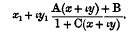
“The following is, of course, substantially well-known, but it strikes me as rather pretty:—to find the Orthomorphic transformation of the circle

into itself. Assume this to be

Contributions to genetic algebras
-
- Journal:
- Proceedings of the Edinburgh Mathematical Society / Volume 17 / Issue 4 / December 1971
- Published online by Cambridge University Press:
- 20 January 2009, pp. 289-298
-
- Article
-
- You have access
- Export citation
PEM volume 36 issue 2 Cover and Back matter
-
- Journal:
- Proceedings of the Edinburgh Mathematical Society / Volume 36 / Issue 2 / June 1993
- Published online by Cambridge University Press:
- 20 January 2009, pp. b1-b2
-
- Article
-
- You have access
- Export citation
Hermitian operators and isometries on sums of Banach spaces
-
- Journal:
- Proceedings of the Edinburgh Mathematical Society / Volume 32 / Issue 2 / June 1989
- Published online by Cambridge University Press:
- 20 January 2009, pp. 169-191
-
- Article
-
- You have access
- Export citation
On Certain Projective Configurations in Space of n Dimensions and a Related Problem in Arrangements
-
- Journal:
- Proceedings of the Edinburgh Mathematical Society / Volume 25 / February 1906
- Published online by Cambridge University Press:
- 20 January 2009, pp. 80-90
-
- Article
-
- You have access
- Export citation
On the expansion of
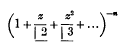 in positive integral powers of z, when n is a positive integer
-
- Journal:
- Proceedings of the Edinburgh Mathematical Society / Volume 31 / February 1912
- Published online by Cambridge University Press:
- 20 January 2009, pp. 2-8
-
- Article
-
- You have access
- Export citation
-
The radius of convergence of the power series is 2π.
The function
 is regular within a circle whose centre is the origin of the z plane and radius 2π, and can be expanded in a Taylor's series converging at all points within the circle.
 in positive integral powers of z, when n is a positive integer
 is regular within a circle whose centre is the origin of the z plane and radius 2π, and can be expanded in a Taylor's series converging at all points within the circle.
A Note about Functions in Lip α
-
- Journal:
- Proceedings of the Edinburgh Mathematical Society / Volume 10 / Issue 2 / December 1954
- Published online by Cambridge University Press:
- 20 January 2009, p. 100
-
- Article
-
- You have access
- Export citation
-
This note gives a proof of the result:
A necessary and sufficient condition that a trigonometrical series T (x) be the Fourier series of a function
 is that σn – σm = O(n-n) uniformly in [0, 2π] for all m≤n, where σn is the nth (C, l) mean of T (x).
 is that σ
W. K. Hayman, Multivalent Functions (Cambridge University Press, 1958), 168 pp., 27s. 6d.
-
- Journal:
- Proceedings of the Edinburgh Mathematical Society / Volume 11 / Issue 3 / May 1959
- Published online by Cambridge University Press:
- 20 January 2009, pp. 185-186
-
- Article
-
- You have access
- Export citation
PEM volume 30 issue 1 Cover and Back matter
-
- Journal:
- Proceedings of the Edinburgh Mathematical Society / Volume 30 / Issue 1 / February 1987
- Published online by Cambridge University Press:
- 20 January 2009, p. b1
-
- Article
-
- You have access
- Export citation
Radial growth and exceptional sets for Cauchy–Stieltjes integrals
-
- Journal:
- Proceedings of the Edinburgh Mathematical Society / Volume 37 / Issue 1 / February 1994
- Published online by Cambridge University Press:
- 20 January 2009, pp. 73-89
-
- Article
-
- You have access
- Export citation
-
This paper considers the radial and nontangential growth of a function f given by

where α>0 and μ is a complex-valued Borel measure on the unit circle. The main theorem shows how certain local conditions on μ near eiθ affect the growth of f(z) as z→eiθ in Stolz angles. This result leads to estimates on the nontangential growth of f where exceptional sets occur having zero β-capacity.
PEM volume 34 issue 3 Cover and Front matter
-
- Journal:
- Proceedings of the Edinburgh Mathematical Society / Volume 34 / Issue 3 / October 1991
- Published online by Cambridge University Press:
- 20 January 2009, pp. f1-f2
-
- Article
-
- You have access
- Export citation
PEM volume 35 issue 2 Cover and Front matter
-
- Journal:
- Proceedings of the Edinburgh Mathematical Society / Volume 35 / Issue 2 / June 1992
- Published online by Cambridge University Press:
- 20 January 2009, pp. f1-f2
-
- Article
-
- You have access
- Export citation
On radicals of infinite matrix rings
-
- Journal:
- Proceedings of the Edinburgh Mathematical Society / Volume 16 / Issue 3 / June 1969
- Published online by Cambridge University Press:
- 20 January 2009, pp. 195-203
-
- Article
-
- You have access
- Export citation
The subnormal subgroup structure of the infinite general linear group
-
- Journal:
- Proceedings of the Edinburgh Mathematical Society / Volume 25 / Issue 1 / February 1982
- Published online by Cambridge University Press:
- 20 January 2009, pp. 81-86
-
- Article
-
- You have access
- Export citation
Composition algebras of degree two
-
- Journal:
- Proceedings of the Edinburgh Mathematical Society / Volume 42 / Issue 3 / October 1999
- Published online by Cambridge University Press:
- 20 January 2009, pp. 641-653
-
- Article
-
- You have access
- Export citation
Twenty-Ninth Session, 1910–1911
-
- Journal:
- Proceedings of the Edinburgh Mathematical Society / Volume 29 / February 1910
- Published online by Cambridge University Press:
- 20 January 2009, p. v
-
- Article
-
- You have access
- Export citation
G. J. O. Jameson, Summing and nuclear norms in Banach space theory (London Mathematical Society Student Texts 8, Cambridge University Press, 1987), xii + 172 pp., hard cover 0 521 34134 5, £27.50; paper 0 521 34937 0, £8.50.
-
- Journal:
- Proceedings of the Edinburgh Mathematical Society / Volume 34 / Issue 2 / June 1991
- Published online by Cambridge University Press:
- 20 January 2009, pp. 333-334
-
- Article
-
- You have access
- Export citation
Factorial Moments and Frequencies of Charlier's Type B
-
- Journal:
- Proceedings of the Edinburgh Mathematical Society / Volume 3 / Issue 2 / July 1932
- Published online by Cambridge University Press:
- 20 January 2009, pp. 99-106
-
- Article
-
- You have access
- Export citation
-
When a given frequency distribution is to be graduated, it is customary to express the constants of the fitted curve in terms of the moments of the frequency distribution. The rth moment of the distribution, in which the relative frequency of a measure x is φ(x) or, in the case of a continuous variable, the differential of frequency is φ(x)dx, is defined in the respective cases by

the summation or integration being taken over the whole range of possible values of x. In the present paper we make use of another kind of moment, the factorial moment, which has already been considered by several writers, and which is specially suited to the case when the frequencies of the distribution are given for discrete, equidistant values of the variable. The (r + 1)th factorial moment, for the case where x, measured from some arbitrary origin, can increase by increments h, 2h, 3h,.…, will be defined to be

where the summation extends over all possible values of x; it will be denoted by m(r+1). By a suitable choice of scale the increments of x may be taken as equal to unity in any given case.
A note on small vibrations
-
- Journal:
- Proceedings of the Edinburgh Mathematical Society / Volume 7 / Issue 1 / October 1942
- Published online by Cambridge University Press:
- 20 January 2009, pp. 31-38
-
- Article
-
- You have access
- Export citation
-
This note exhibits some old results in what is possibly a new form.
The simple harmonic oscillator, whose kinetic and potential energies are given in terms of a single coordinate x by

where b is a positive constant, has the equation of motion

The solution, appropriate to the initial conditions
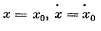 at t = 0 is conveniently written


 at t = 0 is conveniently written
The enumeration of tree-like polyhexes†
-
- Journal:
- Proceedings of the Edinburgh Mathematical Society / Volume 17 / Issue 1 / June 1970
- Published online by Cambridge University Press:
- 20 January 2009, pp. 1-13
-
- Article
-
- You have access
- Export citation
