Refine search
Actions for selected content:
26078 results in Abstract analysis
Inequalities Involving the Inverses of Positive Definite Matrices1
-
- Journal:
- Proceedings of the Edinburgh Mathematical Society / Volume 22 / Issue 1 / February 1979
- Published online by Cambridge University Press:
- 20 January 2009, pp. 11-15
-
- Article
-
- You have access
- Export citation
-
Let G be a permutation group of degree m. Let x be an irreducible complex character of G. If A = (aij) is an m-square matrix, the generalised matrix function of A based on G and x is defined by
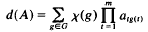
For example if G = Sm, the full symmetric group, and x is the alternating character, then d = determinant. If G = Sm and x is identically 1, then d = permanent.
Numerical ranges of derivations
-
- Journal:
- Proceedings of the Edinburgh Mathematical Society / Volume 21 / Issue 1 / March 1978
- Published online by Cambridge University Press:
- 20 January 2009, pp. 33-39
-
- Article
-
- You have access
- Export citation
PEM volume 37 issue 3 Cover and Back matter
-
- Journal:
- Proceedings of the Edinburgh Mathematical Society / Volume 37 / Issue 3 / October 1994
- Published online by Cambridge University Press:
- 20 January 2009, pp. b1-b6
-
- Article
-
- You have access
- Export citation
M. Bruckheimer, N. W. Gowar, and R. E. Scraton, Mathematics for Technology: A New Approach (Chatto and Windus, London, 1968), xiv+558 pp., 48s.
-
- Journal:
- Proceedings of the Edinburgh Mathematical Society / Volume 16 / Issue 3 / June 1969
- Published online by Cambridge University Press:
- 20 January 2009, p. 266
-
- Article
-
- You have access
- Export citation
Note on the Transformations of the Equations of Hydrodynamics
-
- Journal:
- Proceedings of the Edinburgh Mathematical Society / Volume 16 / February 1897
- Published online by Cambridge University Press:
- 20 January 2009, pp. 36-38
-
- Article
-
- You have access
- Export citation
On the Foundations of Dynamics
-
- Journal:
- Proceedings of the Edinburgh Mathematical Society / Volume 14 / February 1895
- Published online by Cambridge University Press:
- 20 January 2009, p. 174
-
- Article
-
- You have access
- Export citation
A simplistic approach to inverse transversals*
-
- Journal:
- Proceedings of the Edinburgh Mathematical Society / Volume 39 / Issue 1 / February 1996
- Published online by Cambridge University Press:
- 20 January 2009, pp. 57-69
-
- Article
-
- You have access
- Export citation
Twenty-Sixth Session, 1907–1908
-
- Journal:
- Proceedings of the Edinburgh Mathematical Society / Volume 26 / February 1907
- Published online by Cambridge University Press:
- 20 January 2009, p. v
-
- Article
-
- You have access
- Export citation
Two Enumerative Proofs of an Identity of Jacobi
-
- Journal:
- Proceedings of the Edinburgh Mathematical Society / Volume 15 / Issue 1 / June 1966
- Published online by Cambridge University Press:
- 20 January 2009, pp. 67-71
-
- Article
-
- You have access
- Export citation
-
In (7), Wright gives an enumerative proof of an identity algebraically equivalent to that of Jacobi, namely

Here, and in the sequel, products run from 1 to oo and sums from - oo to oo unless otherwise indicated. We give here a simplified version of his argument by working directly with (1), the substitution leading to equation (3) of his paper being omitted. We then supply an alternative proof of (1) by means of a generalisation of the Durfee square concept utilising the rectangle of dimensions v by v + r for fixed r and maximal v contained in the Ferrers graph of a partition.
The mean value theorem and analytic functions
-
- Journal:
- Proceedings of the Edinburgh Mathematical Society / Volume 26 / Issue 3 / October 1983
- Published online by Cambridge University Press:
- 20 January 2009, pp. 289-295
-
- Article
-
- You have access
- Export citation
PEM volume 42 issue 2 Cover and Front matter
-
- Journal:
- Proceedings of the Edinburgh Mathematical Society / Volume 42 / Issue 2 / June 1999
- Published online by Cambridge University Press:
- 20 January 2009, pp. f1-f2
-
- Article
-
- You have access
- Export citation
Generalized Hensel's lemma
-
- Journal:
- Proceedings of the Edinburgh Mathematical Society / Volume 42 / Issue 3 / October 1999
- Published online by Cambridge University Press:
- 20 January 2009, pp. 469-480
-
- Article
-
- You have access
- Export citation
-
Let (K, v) be a complete, rank-1 valued field with valuation ring Rv, and residue field kv. Let vx be the Gaussian extension of the valuation v to a simple transcendental extension K(x) defined by
 The classical Hensel's lemma asserts that if polynomials F(x), G0(x), H0(x) in Rv[x] are such that (i) vx(F(x) – G0(x)H0(x)) > 0, (ii) the leading coefficient of G0(x) has v-valuation zero, (iii) there are polynomials A(x), B(x) belonging to the valuation ring of vx satisfying vx(A(x)G0(x) + B(x)H0(x) – 1) > 0, then there exist G(x), H(x) in K[x] such that (a) F(x) = G(x)H(x), (b) deg G(x) = deg G0(x), (c) vx(G(x)–G0(x)) > 0, vx(H(x) – H0(x)) > 0. In this paper, our goal is to prove an analogous result when vx is replaced by any prolongation w of v to K(x), with the residue field of wa transcendental extension of kv.
 The classical Hensel's lemma asserts that if polynomials F(x), G
Various Questions relative to the Triangle
-
- Journal:
- Proceedings of the Edinburgh Mathematical Society / Volume 25 / February 1906
- Published online by Cambridge University Press:
- 20 January 2009, pp. 5-14
-
- Article
-
- You have access
- Export citation
D. V. Kletenik, A Collection of Problems in Analytical Geometry (Pergamon Press, 1966): Part I, Analytical Geometry in the Plane, ix + 186 pp., 18s. 6d.; Part II, Three-dimensional Analytical Geometry, ix+ 137 pp., 15s.
-
- Journal:
- Proceedings of the Edinburgh Mathematical Society / Volume 16 / Issue 1 / June 1968
- Published online by Cambridge University Press:
- 20 January 2009, p. 86
-
- Article
-
- You have access
- Export citation
PEM volume 34 issue 2 Cover and Back matter
-
- Journal:
- Proceedings of the Edinburgh Mathematical Society / Volume 34 / Issue 2 / June 1991
- Published online by Cambridge University Press:
- 20 January 2009, p. b1
-
- Article
-
- You have access
- Export citation
Stability theorems for wedges
-
- Journal:
- Proceedings of the Edinburgh Mathematical Society / Volume 17 / Issue 3 / June 1971
- Published online by Cambridge University Press:
- 20 January 2009, pp. 201-214
-
- Article
-
- You have access
- Export citation
-
We are concerned with the stability properties of uniformly closed wedges in C(E) (resp. C+(E)), the real-valued (resp. non-negative) continuous functionson a compact space E, and solve the following problems in this area:
(a) Let A be a closed semi-algebra in C+(E) such that

The Treatment of Arithmetic Progressions by Archimedes
-
- Journal:
- Proceedings of the Edinburgh Mathematical Society / Volume 16 / February 1897
- Published online by Cambridge University Press:
- 20 January 2009, pp. 2-12
-
- Article
-
- You have access
- Export citation
On Tubes of Force in a special class of electromagnetic fields
-
- Journal:
- Proceedings of the Edinburgh Mathematical Society / Volume 41 / February 1922
- Published online by Cambridge University Press:
- 20 January 2009, pp. 100-107
-
- Article
-
- You have access
- Export citation
PEM volume 20 issue 1 Cover and Front matter
-
- Journal:
- Proceedings of the Edinburgh Mathematical Society / Volume 20 / Issue 1 / March 1976
- Published online by Cambridge University Press:
- 20 January 2009, pp. f1-f2
-
- Article
-
- You have access
- Export citation
PEM volume 9 issue 4 Cover and Front matter
-
- Journal:
- Proceedings of the Edinburgh Mathematical Society / Volume 9 / Issue 4 / May 1958
- Published online by Cambridge University Press:
- 20 January 2009, pp. f1-f2
-
- Article
-
- You have access
- Export citation
