Refine search
Actions for selected content:
26078 results in Abstract analysis
Geometrical Constructions for Refraction and Reflection in a Prism
-
- Journal:
- Proceedings of the Edinburgh Mathematical Society / Volume 31 / February 1912
- Published online by Cambridge University Press:
- 20 January 2009, pp. 101-104
-
- Article
-
- You have access
- Export citation
HIGHER CONJUGATION COHOMOLOGY IN COMMUTATIVE HOPF ALGEBRAS
-
- Journal:
- Proceedings of the Edinburgh Mathematical Society / Volume 44 / Issue 1 / February 2001
- Published online by Cambridge University Press:
- 20 January 2009, pp. 19-26
-
- Article
-
- You have access
- Export citation
PEM volume 7 issue 3 Cover and Front matter
-
- Journal:
- Proceedings of the Edinburgh Mathematical Society / Volume 7 / Issue 3 / February 1946
- Published online by Cambridge University Press:
- 20 January 2009, pp. f1-f2
-
- Article
-
- You have access
- Export citation
F. Kasch Modules and rings (translated by D. A. R. Wallace) (Academic Press, London1982), xiii + 372 pp. £33.80.
-
- Journal:
- Proceedings of the Edinburgh Mathematical Society / Volume 26 / Issue 2 / June 1983
- Published online by Cambridge University Press:
- 20 January 2009, pp. 286-287
-
- Article
-
- You have access
- Export citation
On functions and equations in distributive lattices
-
- Journal:
- Proceedings of the Edinburgh Mathematical Society / Volume 16 / Issue 1 / June 1968
- Published online by Cambridge University Press:
- 20 January 2009, pp. 49-54
-
- Article
-
- You have access
- Export citation
Special train algebras arising in genetics II
-
- Journal:
- Proceedings of the Edinburgh Mathematical Society / Volume 14 / Issue 4 / December 1965
- Published online by Cambridge University Press:
- 20 January 2009, pp. 333-338
-
- Article
-
- You have access
- Export citation
Note on Topics of regions separated by boundaries
-
- Journal:
- Proceedings of the Edinburgh Mathematical Society / Volume 43 / February 1924
- Published online by Cambridge University Press:
- 20 January 2009, pp. 111-114
-
- Article
-
- You have access
- Export citation
R. Zurmühl, Matrizen und ihre technischen Anwendung, 3rd edition (Springer-Verlag, Berlin, Berlin, 1961), 459 pp., DM 36.
-
- Journal:
- Proceedings of the Edinburgh Mathematical Society / Volume 13 / Issue 2 / December 1962
- Published online by Cambridge University Press:
- 20 January 2009, p. 199
-
- Article
-
- You have access
- Export citation
On the relations between the numbers of standard tableaux
-
- Journal:
- Proceedings of the Edinburgh Mathematical Society / Volume 7 / Issue 1 / October 1942
- Published online by Cambridge University Press:
- 20 January 2009, pp. 51-54
-
- Article
-
- You have access
- Export citation
-
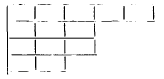
§ 1. Corresponding to any partition

which we denote by [a1, . …, ak] or briefly by [a], of the integer n, we can construct a shape which has a1 spaces in the first row, a2 in the second row, . …, ak in the kth and last row. Thus the shape corresponding to the partition [5, 3, 3, 2] of 13 has the form:
Edwin M. Hemmerling, Fundamentals of College Geometry (John Wiley & Sons, 1964).
-
- Journal:
- Proceedings of the Edinburgh Mathematical Society / Volume 15 / Issue 1 / June 1966
- Published online by Cambridge University Press:
- 20 January 2009, p. 84
-
- Article
-
- You have access
- Export citation
Note on M. Collignon's Paper on the Integration of ancosa da and an sina da
-
- Journal:
- Proceedings of the Edinburgh Mathematical Society / Volume 22 / February 1903
- Published online by Cambridge University Press:
- 20 January 2009, p. 11
-
- Article
-
- You have access
- Export citation
-
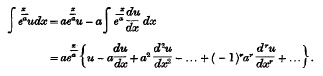
The properties of the functions Pn, Qn may also be determined very briefly as follows:—
Let u be a function of x; then by integration by parts we have
PEM volume 1 Front matter and Errata
-
- Journal:
- Proceedings of the Edinburgh Mathematical Society / Volume 1 / February 1883
- Published online by Cambridge University Press:
- 20 January 2009, pp. f1-f4
-
- Article
-
- You have access
- Export citation
A note on Taskinen's counterexamples on the problem of topologies of Grothendieck
-
- Journal:
- Proceedings of the Edinburgh Mathematical Society / Volume 32 / Issue 2 / June 1989
- Published online by Cambridge University Press:
- 20 January 2009, pp. 281-283
-
- Article
-
- You have access
- Export citation
-
By the work of Taskinen (see [4, 5]), we know that there is a Fréchet space E such that Lb(E, l2) is not a (DF)-space. Moreover there is a Fréchet–Montel space F such that
 is not (DF). In this second example, the duality theorem of Buchwalter (cf. [2, §45.3]) can be applied to obtain that
  and hence
  is a (gDF)-space (cf. [1, Ch. 12 or 3, Ch. 8]). The (gDF)-spaces were introduced by several authors to extend the (DF)-spaces of Grothendieck and to provide an adequate frame to consider strict topologies.
 is not (DF). In this second example, the duality theorem of Buchwalter (cf. [2, §45.3]) can be applied to obtain that
  and hence
  is a (gDF)-space (cf. [1, Ch. 12 or 3, Ch. 8]). The (gDF)-spaces were introduced by several authors to extend the (DF)-spaces of Grothendieck and to provide an adequate frame to consider strict topologies.
Three counterexamples concerning ω-chain completeness and fixed point properties
-
- Journal:
- Proceedings of the Edinburgh Mathematical Society / Volume 24 / Issue 2 / June 1981
- Published online by Cambridge University Press:
- 20 January 2009, pp. 141-146
-
- Article
-
- You have access
- Export citation
Characterizations of linear differential systems with a regular singular point
-
- Journal:
- Proceedings of the Edinburgh Mathematical Society / Volume 18 / Issue 2 / December 1972
- Published online by Cambridge University Press:
- 20 January 2009, pp. 93-98
-
- Article
-
- You have access
- Export citation
-
The linear differential system

where w is a vector with n components and A is an n by n matrix is said to have z = 0 as a regular singular point if there exists a fundamental matrix of the form

such that S is holomorphic at z = 0 and R is a constant matrix ((1), p. 111; (2), p. 73). For such systems A will have at most a pole at z = 0 and we may write

where p is an integer, Ã is holomorphic at z = 0, and Ã(0) ≠ 0. However, the converse is not true. When p ≦ − 1, A is holomorphic at z = 0, and every fundamental matrix is holomorphic at z = 0. If p ≧ 1, the non-negative integer p is called (after Poincaré) the rank of the singularity and there is a significant difference between the cases p = 0 and p ≧ 1. If p = 0 the linear differential system (1) is known to have z = 0 as a regular singular point ((1), p. 111) ; whereas, if p ≧ 1, z = 0 may or may not be a regular singular point.
On the Eight Queens Problem
-
- Journal:
- Proceedings of the Edinburgh Mathematical Society / Volume 17 / February 1898
- Published online by Cambridge University Press:
- 20 January 2009, pp. 43-68
-
- Article
-
- You have access
- Export citation
M. Hamermesh, Group Theory and its Application to Physical Problems (Pergamon Press, 1962), 509 pp.,105s.
-
- Journal:
- Proceedings of the Edinburgh Mathematical Society / Volume 13 / Issue 4 / December 1963
- Published online by Cambridge University Press:
- 20 January 2009, p. 346
-
- Article
-
- You have access
- Export citation
PEM volume 20 issue 2 Cover and Front matter
-
- Journal:
- Proceedings of the Edinburgh Mathematical Society / Volume 20 / Issue 2 / September 1976
- Published online by Cambridge University Press:
- 20 January 2009, pp. f1-f2
-
- Article
-
- You have access
- Export citation
School Mathematics Project, Book 1 (Cambridge University Press, 1965), 281 pp., 18s. 6d. - Books T and 74 (1964), 296 pp., 17s. 6d.; and (1965), 330 pp., 21s. - Teacher's Guides to Book 1 and Book T4 (1965), 204 pp., 21s.; and 208 pp., 21s
-
- Journal:
- Proceedings of the Edinburgh Mathematical Society / Volume 16 / Issue 1 / June 1968
- Published online by Cambridge University Press:
- 20 January 2009, p. 81
-
- Article
-
- You have access
- Export citation
G. K. Pedersen, (ed) C*-algebras and their automorphism groups (London Mathematical Society Monographs No. 14, Academic Press, 1979) ix + 416 pp. £26.
-
- Journal:
- Proceedings of the Edinburgh Mathematical Society / Volume 25 / Issue 3 / October 1982
- Published online by Cambridge University Press:
- 20 January 2009, pp. 279-280
-
- Article
-
- You have access
- Export citation
