Refine search
Actions for selected content:
26079 results in Abstract analysis
Advances in Mathematics, volume 1, fascicle 1, 1961, edited by H. Busemann, Academic Press, New York and London, 30s. 6d.
-
- Journal:
- Proceedings of the Edinburgh Mathematical Society / Volume 13 / Issue 1 / June 1962
- Published online by Cambridge University Press:
- 20 January 2009, p. 114
-
- Article
-
- You have access
- Export citation
PEM volume 36 issue 1 Cover and Front matter
-
- Journal:
- Proceedings of the Edinburgh Mathematical Society / Volume 36 / Issue 1 / February 1993
- Published online by Cambridge University Press:
- 20 January 2009, pp. f1-f2
-
- Article
-
- You have access
- Export citation
On valuations of K(x)
-
- Journal:
- Proceedings of the Edinburgh Mathematical Society / Volume 35 / Issue 3 / October 1992
- Published online by Cambridge University Press:
- 20 January 2009, pp. 419-426
-
- Article
-
- You have access
- Export citation
Groups generated by elements with rational fixed points
-
- Journal:
- Proceedings of the Edinburgh Mathematical Society / Volume 40 / Issue 1 / February 1997
- Published online by Cambridge University Press:
- 20 January 2009, pp. 19-30
-
- Article
-
- You have access
- Export citation
On certain semigroups arising from radicals of matrix rings
-
- Journal:
- Proceedings of the Edinburgh Mathematical Society / Volume 28 / Issue 1 / February 1985
- Published online by Cambridge University Press:
- 20 January 2009, pp. 67-72
-
- Article
-
- You have access
- Export citation
-
By a ring we shall mean an associative ring not necessarily containing an identity element. The fundamental definitions and properties of radicals may be found in Divinsky [2]. Similarly we refer to Howie [3] for the semigroup concepts.
If R is a ring Mn(R) will denote the ring of n × n matrices with entries from R. For many important radicals α it has been shown that α(Mn(R)) = Mn(α(R)) for all rings R and all positive integers n. However this is not the case for all radicals α. Associated with each radical α we define a set of positive integers S(α) by

PEM volume 19 issue 3 Cover and Front matter
-
- Journal:
- Proceedings of the Edinburgh Mathematical Society / Volume 19 / Issue 3 / March 1975
- Published online by Cambridge University Press:
- 20 January 2009, pp. f1-f2
-
- Article
-
- You have access
- Export citation
PEM volume 10 issue 2 Cover and Front matter
-
- Journal:
- Proceedings of the Edinburgh Mathematical Society / Volume 10 / Issue 2 / December 1954
- Published online by Cambridge University Press:
- 20 January 2009, pp. f1-f2
-
- Article
-
- You have access
- Export citation
Sketch of the History of Mathematics in Scotland to the end of the 18th Century: Part I.
-
- Journal:
- Proceedings of the Edinburgh Mathematical Society / Volume 1 / Issue 1 / May 1927
- Published online by Cambridge University Press:
- 20 January 2009, pp. 1-18
-
- Article
-
- You have access
- Export citation
List of Members
-
- Journal:
- Proceedings of the Edinburgh Mathematical Society / Volume 41 / February 1922
- Published online by Cambridge University Press:
- 20 January 2009, pp. 153-160
-
- Article
-
- You have access
- Export citation
Quaternion Synopsis of Hertz' View of the Electrodynamical Equations
-
- Journal:
- Proceedings of the Edinburgh Mathematical Society / Volume 8 / February 1889
- Published online by Cambridge University Press:
- 20 January 2009, p. 92
-
- Article
-
- You have access
- Export citation
S. W. P. Steen, Mathematical Logic with special reference to the natural numbers (Cambridge University Press, 1972) xvi+638 pp., £15.
-
- Journal:
- Proceedings of the Edinburgh Mathematical Society / Volume 18 / Issue 2 / December 1972
- Published online by Cambridge University Press:
- 20 January 2009, pp. 165-166
-
- Article
-
- You have access
- Export citation
N. Steinmetz Rational iteration: complex analytic dynamical systems (de Gruyter Studies in Mathematics Vol. 16, de Gruyter, Berlin, New York1993) x + 190 pp., 3 11 013765 8, about £60.
-
- Journal:
- Proceedings of the Edinburgh Mathematical Society / Volume 38 / Issue 2 / June 1995
- Published online by Cambridge University Press:
- 20 January 2009, p. 357
-
- Article
-
- You have access
- Export citation
A Reduction Formula for Indefinite Integrals
-
- Journal:
- Proceedings of the Edinburgh Mathematical Society / Volume 14 / February 1895
- Published online by Cambridge University Press:
- 20 January 2009, pp. 27-30
-
- Article
-
- You have access
- Export citation
-
On p. 403 of Greenhill's Calculus (2nd Ed.) the following sentence occurs:— “By differentiation of the integral

with respect to A, B, or C we can deduce the results of

For the evaluation of tlie typical form in which f(x) is a linear function, especially when A, B, etc., are given numbers, the method of differentiation does not seem very suitable; be that as it may, it may perhaps be of some interest to investigate a formula of reduction analogous to those in use for the integrals in which Ax2 + 2Bx + C is replaced by a linear function and f(x) is a constant.
A “Cubical” Universe
-
- Journal:
- Proceedings of the Edinburgh Mathematical Society / Volume 2 / Issue 3 / January 1931
- Published online by Cambridge University Press:
- 20 January 2009, pp. 158-163
-
- Article
-
- You have access
- Export citation
-
Einstein has studied a universe in which the time coordinate t is uncurved and the spatial section is the surface of a sphere

in four dimensions. Some interest attaches to the case where this surface is replaced by

where n is a positive integer.
On the absolute summability of series by Rieszian means
-
- Journal:
- Proceedings of the Edinburgh Mathematical Society / Volume 5 / Issue 1 / October 1936
- Published online by Cambridge University Press:
- 20 January 2009, pp. 46-54
-
- Article
-
- You have access
- Export citation
-
I begin by recalling the well known definitions for summability by the methods of Cesaro and Riesz.
The series Σan is said to be summable (C, K), k> – 1, to the sum s if, as n → ∞
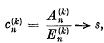
where
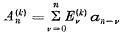
and
 is defined formally by the relation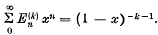
 is defined formally by the relation
Further Considerations of the Elastic Inclusion Problem
-
- Journal:
- Proceedings of the Edinburgh Mathematical Society / Volume 14 / Issue 1 / June 1964
- Published online by Cambridge University Press:
- 20 January 2009, pp. 61-70
-
- Article
-
- You have access
- Export citation
Geometry of the Rule
-
- Journal:
- Proceedings of the Edinburgh Mathematical Society / Volume 3 / February 1884
- Published online by Cambridge University Press:
- 20 January 2009, p. 70
-
- Article
-
- You have access
- Export citation
Lower bounds for the radical of the group algebra of a finite p-soluble group
-
- Journal:
- Proceedings of the Edinburgh Mathematical Society / Volume 16 / Issue 2 / December 1968
- Published online by Cambridge University Press:
- 20 January 2009, pp. 127-134
-
- Article
-
- You have access
- Export citation
The minimal operator module of a Banach module
-
- Journal:
- Proceedings of the Edinburgh Mathematical Society / Volume 42 / Issue 1 / February 1999
- Published online by Cambridge University Press:
- 20 January 2009, pp. 191-208
-
- Article
-
- You have access
- Export citation
On Compact Riemannian Manifolds with Zero Ricci Curvature
-
- Journal:
- Proceedings of the Edinburgh Mathematical Society / Volume 10 / Issue 3 / January 1956
- Published online by Cambridge University Press:
- 20 January 2009, pp. 131-133
-
- Article
-
- You have access
- Export citation
