Refine search
Actions for selected content:
26078 results in Abstract analysis
On inequalities of Hilbert and Widder
-
- Journal:
- Proceedings of the Edinburgh Mathematical Society / Volume 34 / Issue 3 / October 1991
- Published online by Cambridge University Press:
- 20 January 2009, pp. 411-414
-
- Article
-
- You have access
- Export citation
On the Riemann P Equation with Integral Exponent differences
-
- Journal:
- Proceedings of the Edinburgh Mathematical Society / Volume 43 / February 1924
- Published online by Cambridge University Press:
- 20 January 2009, pp. 39-47
-
- Article
-
- You have access
- Export citation
-
The differential equation in question is of the second order and has three regular singular points. It is usually denoted by
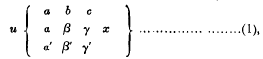
where a, b, c are the singular points, a, a′ etc. the exponents at those singularities. The solution when no one of the numbers α – α′, β – β′, γ – γ′ is an integer or zero is well known; all types of solution are expressible in terms of the hypergeometric functions.
Harmonic morphisms between spaces of constant curvature
-
- Journal:
- Proceedings of the Edinburgh Mathematical Society / Volume 36 / Issue 1 / February 1993
- Published online by Cambridge University Press:
- 20 January 2009, pp. 133-143
-
- Article
-
- You have access
- Export citation
Proof that every rational algebraic equation has a root
-
- Journal:
- Proceedings of the Edinburgh Mathematical Society / Volume 26 / February 1907
- Published online by Cambridge University Press:
- 20 January 2009, pp. 13-14
-
- Article
-
- You have access
- Export citation
Automorphism groups of laminated near-rings
-
- Journal:
- Proceedings of the Edinburgh Mathematical Society / Volume 23 / Issue 1 / February 1980
- Published online by Cambridge University Press:
- 20 January 2009, pp. 97-102
-
- Article
-
- You have access
- Export citation
J. Duncan, The Elements of Complex Analysis (Wiley, 1968), 313 pp., £4·25; paper, £2·25.
-
- Journal:
- Proceedings of the Edinburgh Mathematical Society / Volume 18 / Issue 1 / June 1972
- Published online by Cambridge University Press:
- 20 January 2009, p. 85
-
- Article
-
- You have access
- Export citation
Herman Meyer, Precalculus Mathematics (The University Series in Undergraduate Mathematics, Van Nostrand), xi+365 pp., 58s. 6d.
-
- Journal:
- Proceedings of the Edinburgh Mathematical Society / Volume 15 / Issue 4 / December 1967
- Published online by Cambridge University Press:
- 20 January 2009, p. 321
-
- Article
-
- You have access
- Export citation
Note of Newton's Theorem of Symmetric Functions
-
- Journal:
- Proceedings of the Edinburgh Mathematical Society / Volume 11 / February 1892
- Published online by Cambridge University Press:
- 20 January 2009, p. 61
-
- Article
-
- You have access
- Export citation
O. Zariski, and P. Samuel, with the cooperation of I. S. Cohen, Commutative Algebra, vol. i (D. van Nostrand Co., London, 1958), 320 pp., 32s. 6d.
-
- Journal:
- Proceedings of the Edinburgh Mathematical Society / Volume 11 / Issue 3 / May 1959
- Published online by Cambridge University Press:
- 20 January 2009, pp. 183-184
-
- Article
-
- You have access
- Export citation
Asymptotic Solutions of Integral Equations with Convolution Kernels
-
- Journal:
- Proceedings of the Edinburgh Mathematical Society / Volume 14 / Issue 1 / June 1964
- Published online by Cambridge University Press:
- 20 January 2009, pp. 5-19
-
- Article
-
- You have access
- Export citation
R. V. Churchill, Operational Mathematics, 2nd ed. (McGraw-Hill Book Co., New York, 1958), 306 pp., 41s.
-
- Journal:
- Proceedings of the Edinburgh Mathematical Society / Volume 11 / Issue 3 / May 1959
- Published online by Cambridge University Press:
- 20 January 2009, pp. 187-188
-
- Article
-
- You have access
- Export citation
The Fundamental Notions of the Differential Calculus
-
- Journal:
- Proceedings of the Edinburgh Mathematical Society / Volume 1 / February 1883
- Published online by Cambridge University Press:
- 20 January 2009, p. 129
-
- Article
-
- You have access
- Export citation
J. M. Howie Fundamentals of semigroup theory (London Mathematical Society Monographs No. 12, Clarendon Press, Oxford, 1995), x + 351 pp., 0 19 851194 9, (hardback) £45.00.
-
- Journal:
- Proceedings of the Edinburgh Mathematical Society / Volume 40 / Issue 2 / June 1997
- Published online by Cambridge University Press:
- 20 January 2009, pp. 407-408
-
- Article
-
- You have access
- Export citation
H. Cramér, Random Variables and Probability Distributions (Third Edition, Cambridge University Press, 1970), vi+118 pp.
-
- Journal:
- Proceedings of the Edinburgh Mathematical Society / Volume 17 / Issue 3 / June 1971
- Published online by Cambridge University Press:
- 20 January 2009, pp. 287-288
-
- Article
-
- You have access
- Export citation
Locally nilpotent skew linear groups
-
- Journal:
- Proceedings of the Edinburgh Mathematical Society / Volume 29 / Issue 1 / February 1986
- Published online by Cambridge University Press:
- 20 January 2009, pp. 101-113
-
- Article
-
- You have access
- Export citation
PEM volume 35 issue 3 Cover and Back matter
-
- Journal:
- Proceedings of the Edinburgh Mathematical Society / Volume 35 / Issue 3 / October 1992
- Published online by Cambridge University Press:
- 20 January 2009, pp. b1-b6
-
- Article
-
- You have access
- Export citation
PEM volume 43 issue 3 Cover and Front matter
-
- Journal:
- Proceedings of the Edinburgh Mathematical Society / Volume 43 / Issue 3 / October 2000
- Published online by Cambridge University Press:
- 20 January 2009, pp. f1-f8
-
- Article
-
- You have access
- Export citation
The Singular Solutions of a Certain Differential Equation of the Second Order
-
- Journal:
- Proceedings of the Edinburgh Mathematical Society / Volume 16 / February 1897
- Published online by Cambridge University Press:
- 20 January 2009, pp. 64-67
-
- Article
-
- You have access
- Export citation
Pascal's Essais pour les Coniques
-
- Journal:
- Proceedings of the Edinburgh Mathematical Society / Volume 2 / February 1883
- Published online by Cambridge University Press:
- 20 January 2009, pp. 19-24
-
- Article
-
- You have access
- Export citation
Waclaw Sierpiński A Selection of Problems in the Theory of Numbers, translated from the Polish by A. Sharma (Popular Lectures in Mathematics, Vol. 11, Pergamon Press, 1964), 126 pp., 30s.
-
- Journal:
- Proceedings of the Edinburgh Mathematical Society / Volume 15 / Issue 1 / June 1966
- Published online by Cambridge University Press:
- 20 January 2009, p. 79
-
- Article
-
- You have access
- Export citation
