Refine search
Actions for selected content:
26078 results in Abstract analysis
H. S. W. Massey, and H. Kestelman, Ancillary Mathematics (Sir Isaac Pitman & Sons, London, 1959), 990 pp., 75s.
-
- Journal:
- Proceedings of the Edinburgh Mathematical Society / Volume 12 / Issue 1 / June 1960
- Published online by Cambridge University Press:
- 20 January 2009, pp. 63-64
-
- Article
-
- You have access
- Export citation
Dense sets and far field patterns for acoustic waves in an inhomogeneous medium*
-
- Journal:
- Proceedings of the Edinburgh Mathematical Society / Volume 31 / Issue 3 / October 1988
- Published online by Cambridge University Press:
- 20 January 2009, pp. 401-407
-
- Article
-
- You have access
- Export citation
Weak and cyclic amenability for non-commutative Banach algebras
-
- Journal:
- Proceedings of the Edinburgh Mathematical Society / Volume 35 / Issue 2 / June 1992
- Published online by Cambridge University Press:
- 20 January 2009, pp. 315-328
-
- Article
-
- You have access
- Export citation
-
This paper is concerned with two notions of cohomological triviality for Banach algebras, weak amenability and cyclic amenability. The first is defined within Hochschild cohomology and the latter within cyclic cohomology. Our main result is that
 where ℱ is a Banach algebraic free product of two Banach algebras
  and ℬ. It follows that cyclic amenability is preserved under the formation of free products.
 where ℱ is a Banach algebraic free product of two Banach algebras
  and ℬ. It follows that cyclic amenability is preserved under the formation of free products.
Some Theorems in Group Velocity
-
- Journal:
- Proceedings of the Edinburgh Mathematical Society / Volume 9 / Issue 3 / July 1956
- Published online by Cambridge University Press:
- 20 January 2009, pp. 122-127
-
- Article
-
- You have access
- Export citation
Invariants for reducible systems of meromorphic differential equations
-
- Journal:
- Proceedings of the Edinburgh Mathematical Society / Volume 23 / Issue 2 / June 1980
- Published online by Cambridge University Press:
- 20 January 2009, pp. 163-186
-
- Article
-
- You have access
- Export citation
Concentration of the error between a function and its polynomial of best uniform approximation
-
- Journal:
- Proceedings of the Edinburgh Mathematical Society / Volume 41 / Issue 3 / October 1998
- Published online by Cambridge University Press:
- 20 January 2009, pp. 447-463
-
- Article
-
- You have access
- Export citation
-
Let f be a continuous real valued function defined on [−1, 1] and let En(f) denote the degree of best uniform approximation to f by algebraic polynomial of degree at most n. The supremum norm on [a, b] is denoted by ∥.∥[a, b] and the polynomial of degree n of best uniform approximation is denoted by Pn. We find a class of functions f such that there exists a fixed a ∈(−1, 1) with the following property

for some positive constants C and N independent of n. Moreover the sequence
 is optimal in the sense that if
  is replaced by
  then the above inequality need not hold no matter how small C > 0 is chosen.
We also find another, more general class a functions f for which
 infinitely often.
 is optimal in the sense that if
  is replaced by
  then the above inequality need not hold no matter how small C > 0 is chosen.
On a Simple Type of Integro-differential Equation
-
- Journal:
- Proceedings of the Edinburgh Mathematical Society / Volume 4 / Issue 2 / January 1935
- Published online by Cambridge University Press:
- 20 January 2009, pp. 80-84
-
- Article
-
- You have access
- Export citation
-
In a previous paper in these Proceedings the author discussed conditions for a maximum or minimum of functions of integrals of the type

using the methods of the Calculus of Variations. In the effort to establish a third necessary condition for a minimum—the analogue of Jacobi's condition in the ordinary variational problem—it was found that the analogue of Jacobi's Equation was an integrodifferential equation of the form

On a problem of R. G. D. Richardson
-
- Journal:
- Proceedings of the Edinburgh Mathematical Society / Volume 35 / Issue 3 / October 1992
- Published online by Cambridge University Press:
- 20 January 2009, pp. 337-348
-
- Article
-
- You have access
- Export citation
PEM volume 15 issue 1 Cover and Front matter
-
- Journal:
- Proceedings of the Edinburgh Mathematical Society / Volume 15 / Issue 1 / June 1966
- Published online by Cambridge University Press:
- 20 January 2009, pp. f1-f2
-
- Article
-
- You have access
- Export citation
Enumeration of Indices of given Altitude and Potency
-
- Journal:
- Proceedings of the Edinburgh Mathematical Society / Volume 11 / Issue 4 / November 1959
- Published online by Cambridge University Press:
- 20 January 2009, pp. 207-209
-
- Article
-
- You have access
- Export citation
-
Indices of the free logarithmetic
 correspond to bifurcating root-trees (cf.(4)), to Evans' non-associative numbers (3) and to Etherington's partitive numbers (2). The free commutative logarithmetic
  is the homomorph of f determined by the congruence relation P + Q ∼ Q + P. Formulæ for aδ and pα, i.e. the numbers of indices of of a given potency* δ and the number of indices of a given altitude α respectively, were given by Etherington (1), who also gave corresponding formulæ for commutative indices of . Other enumeration formulæ are contained in (5).
 correspond to bifurcating root-trees (cf.(4)), to Evans' non-associative numbers (3) and to Etherington's partitive numbers (2). The free commutative logarithmetic
  is the homomorph of f
 Systems of Conics connected with the Triangle
-
- Journal:
- Proceedings of the Edinburgh Mathematical Society / Volume 17 / February 1898
- Published online by Cambridge University Press:
- 20 January 2009, pp. 99-107
-
- Article
-
- You have access
- Export citation
A Determinantal Expansion for a Class of Definite Integral: Part 5. Recurrence Relations
-
- Journal:
- Proceedings of the Edinburgh Mathematical Society / Volume 10 / Issue 4 / June 1957
- Published online by Cambridge University Press:
- 20 January 2009, pp. 167-188
-
- Article
-
- You have access
- Export citation
Diagonals of nilpotent operators
-
- Journal:
- Proceedings of the Edinburgh Mathematical Society / Volume 29 / Issue 2 / June 1986
- Published online by Cambridge University Press:
- 20 January 2009, pp. 221-224
-
- Article
-
- You have access
- Export citation
An Analogue of the Radon-Nikodym Property for Non-Locally Convex Quasi-Banach Spaces
-
- Journal:
- Proceedings of the Edinburgh Mathematical Society / Volume 22 / Issue 1 / February 1979
- Published online by Cambridge University Press:
- 20 January 2009, pp. 49-60
-
- Article
-
- You have access
- Export citation
-
In recent years there has been considerable interest in Banach spaces with the Radon-Nikodym Property; see (1) for a summary of the main known results on this class of spaces.We may define this property as follows: a Banach space X has the Radon-Nikodym Property if whenever T ∈ ℒ (L1, X)(where L1 = L1(0, 1)) then T is differentiable i.e.
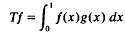
where g:(0, 1)→X is an essentially bounded strongly measurable function. In this paper we examine analogues of the Radon-Nikodym Property for quasi-Banach spaces. If 0>p > 1, there are several possible ways of defining “differentiable” operators on Lp, but they inevitably lead to the conclusion that the only differentiable operator is zero.
N. Bourbaki, Éléments de Mathématique XXIII, Les Structures Fondamentales de L'Analyse Livre II, Algèbre, Chapitre 8, Modules et Anneaux Semi-Simples (Hermann, Paris, 1958), 189 pp., 38s. 3d.
-
- Journal:
- Proceedings of the Edinburgh Mathematical Society / Volume 12 / Issue 1 / June 1960
- Published online by Cambridge University Press:
- 20 January 2009, p. 55
-
- Article
-
- You have access
- Export citation
On the plane representation of the homaloidal surfaces which have a twisted cubic as multiple curve
-
- Journal:
- Proceedings of the Edinburgh Mathematical Society / Volume 36 / February 1917
- Published online by Cambridge University Press:
- 20 January 2009, pp. 2-16
-
- Article
-
- You have access
- Export citation
J. R. Giles, Convex analysis with application in the differentiation of convex functions (Research Notes in Mathematics No. 58, Pitman, 1982), £9.95.
-
- Journal:
- Proceedings of the Edinburgh Mathematical Society / Volume 26 / Issue 1 / February 1983
- Published online by Cambridge University Press:
- 20 January 2009, p. 113
-
- Article
-
- You have access
- Export citation
On groups which are residually
 -commutative
-
- Journal:
- Proceedings of the Edinburgh Mathematical Society / Volume 20 / Issue 1 / March 1976
- Published online by Cambridge University Press:
- 20 January 2009, pp. 7-13
-
- Article
-
- You have access
- Export citation
-
In this paper we study a property which we call residual
-commutativity. This idea was kindled by a paper of Ayoub (1) and one of Stanley (6). Durbin has defined a similar property in (2) which has also been studied by Slotterbeck in (4). Durbin's property implies residual -commutativity but we have not been able to decide if they are equivalent. However, we have shown that they coincide in certain circumstances. The notation, unless otherwise stated, is that of Robinson (3).
 -commutative
Eigenvalues of complex tridiagonal matrices
-
- Journal:
- Proceedings of the Edinburgh Mathematical Society / Volume 17 / Issue 4 / December 1971
- Published online by Cambridge University Press:
- 20 January 2009, pp. 317-319
-
- Article
-
- You have access
- Export citation
A Note on the Capelli Operators associated with a Symmetric Matrix
-
- Journal:
- Proceedings of the Edinburgh Mathematical Society / Volume 9 / Issue 1 / October 1953
- Published online by Cambridge University Press:
- 20 January 2009, pp. 7-12
-
- Article
-
- You have access
- Export citation
-
In the Proceedings of the Edinburgh Mathematical Society, 1948, there appear two papers by Lars Gårding and Turnbull respectively (Gårding [1], Turnbull [2]) which formulate the theory of Cayley and Capelli operators associated with symmetric matrices. Turnbull derives the modification, appropriate to symmetric matrices, of Capelli's Theorem, which states that (taking a third order operator for the sake of ease in writing)
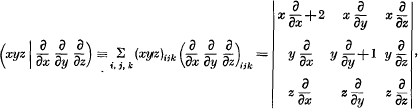
where the symbol (xyz)ijk stands for the determinant

with a similar meaning for the determinantal differential operator, while the symbols
 are polarisations (Capelli [1]; cf. Turnbull [1], p. 116). Gårding's theorem deals with the effect of such modified Capelli operators on powers of the determinant of the symmetric matrix in question. The subject of this note is an alternative derivation of the modified Capelli theorem and of Gårding's theorem.

 are polarisations (Capelli [1]; cf. Turnbull [1], p. 116). Gårding's theorem deals with the effect of such modified Capelli operators on powers of the determinant of the symmetric matrix in question. The subject of this note is an alternative derivation of the modified Capelli theorem and of Gårding's theorem.