Refine search
Actions for selected content:
26078 results in Abstract analysis
V. V. Petrov Limit theorems of probability theory: sequences of independent random variables (Oxford Studies in Probability, Vol. 4, Clarendon Press, Oxford, 1995), x + 292pp., 0 19 853499 X, £50.
-
- Journal:
- Proceedings of the Edinburgh Mathematical Society / Volume 39 / Issue 3 / October 1996
- Published online by Cambridge University Press:
- 20 January 2009, pp. 591-592
-
- Article
-
- You have access
- Export citation
C. G. Gibson, Singular Points of Smooth Mappings (Pitman, 1979), £8·00.
-
- Journal:
- Proceedings of the Edinburgh Mathematical Society / Volume 23 / Issue 1 / February 1980
- Published online by Cambridge University Press:
- 20 January 2009, p. 141
-
- Article
-
- You have access
- Export citation
PEM volume 21 issue 1 Cover and Front matter
-
- Journal:
- Proceedings of the Edinburgh Mathematical Society / Volume 21 / Issue 1 / March 1978
- Published online by Cambridge University Press:
- 20 January 2009, pp. f1-f2
-
- Article
-
- You have access
- Export citation
The Solution of Mathteu's Differential Equation
-
- Journal:
- Proceedings of the Edinburgh Mathematical Society / Volume 34 / February 1915
- Published online by Cambridge University Press:
- 20 January 2009, pp. 176-196
-
- Article
-
- You have access
- Export citation
On the Number of Crossings in a Complete Graph
-
- Journal:
- Proceedings of the Edinburgh Mathematical Society / Volume 13 / Issue 4 / December 1963
- Published online by Cambridge University Press:
- 20 January 2009, pp. 333-338
-
- Article
-
- You have access
- Export citation
Minimally strong digraphs
-
- Journal:
- Proceedings of the Edinburgh Mathematical Society / Volume 17 / Issue 1 / June 1970
- Published online by Cambridge University Press:
- 20 January 2009, pp. 15-22
-
- Article
-
- You have access
- Export citation
The maximum idempotent-separating congruence on a regular semigroup
-
- Journal:
- Proceedings of the Edinburgh Mathematical Society / Volume 18 / Issue 2 / December 1972
- Published online by Cambridge University Press:
- 20 January 2009, pp. 159-163
-
- Article
-
- You have access
- Export citation
-
It has been established by G. Lallement (3) that the set of idempotent-separating congruences on a regular semigroup S coincides with the set ∑(
 ) of congruences on S which are contained in Green's equivalence on S. In view of this and Lemma 10.3 of A. H. Clifford and G. B. Preston (1) it is obvious that the maximum idempotent-separating congruence on a regular semigroup S is given by
 ) of congruences on S which are contained in Green's equivalence
On the Solution of some Axisymmetric Boundary Value Problems by Means of Integral Equations. IV. The Electrostatic Potential due to a Spherical Cap between Two Infinite Conducting Planes
-
- Journal:
- Proceedings of the Edinburgh Mathematical Society / Volume 12 / Issue 2 / December 1960
- Published online by Cambridge University Press:
- 20 January 2009, pp. 95-106
-
- Article
-
- You have access
- Export citation
The Fundamental Formula for the Area of a Triangle in Analytical Geometry
-
- Journal:
- Proceedings of the Edinburgh Mathematical Society / Volume 30 / February 1911
- Published online by Cambridge University Press:
- 20 January 2009, pp. 67-68
-
- Article
-
- You have access
- Export citation
A class of factorable topological algebras
-
- Journal:
- Proceedings of the Edinburgh Mathematical Society / Volume 33 / Issue 1 / February 1990
- Published online by Cambridge University Press:
- 20 January 2009, pp. 53-59
-
- Article
-
- You have access
- Export citation
A. Y. Khinchin, Three Pearls of Number Theory (Graylock Press, Rochester, N.Y., 1956), $2.00, 64 pp., 16s.
-
- Journal:
- Proceedings of the Edinburgh Mathematical Society / Volume 11 / Issue 3 / May 1959
- Published online by Cambridge University Press:
- 20 January 2009, pp. 184-185
-
- Article
-
- You have access
- Export citation
Monoid gradings on algebras and the cartan determinant conjecture*
-
- Journal:
- Proceedings of the Edinburgh Mathematical Society / Volume 41 / Issue 3 / October 1998
- Published online by Cambridge University Press:
- 20 January 2009, pp. 539-551
-
- Article
-
- You have access
- Export citation
S. Lang, Diophantine Geometry (Interscience Tracts in Pure and Applied Mathematics, No. 11, John Wiley & Sons Ltd., 1962), 170 pp., 57s.
-
- Journal:
- Proceedings of the Edinburgh Mathematical Society / Volume 13 / Issue 3 / June 1963
- Published online by Cambridge University Press:
- 20 January 2009, pp. 255-256
-
- Article
-
- You have access
- Export citation
Real Linear Substitutions with Equimodular Multipliers, and their expression in terms of their Invariants
-
- Journal:
- Proceedings of the Edinburgh Mathematical Society / Volume 34 / February 1915
- Published online by Cambridge University Press:
- 20 January 2009, pp. 18-40
-
- Article
-
- You have access
- Export citation
-
§1. Let

denote a linear substitution of non-vanishing determinant; and let the roots k∈ of its characteristic equation

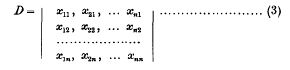
be for the present assumed distinct. Then with each root k∈ is associated an invariant point or pole P∈, and a linear invariant, or invariant (n−2)-plane ξ∈. If the n points P∈ do not lie on an (n−2)-plane, the determinant of their coordinates,
The states of a Banach algebra generate the dual
-
- Journal:
- Proceedings of the Edinburgh Mathematical Society / Volume 17 / Issue 4 / December 1971
- Published online by Cambridge University Press:
- 20 January 2009, pp. 341-344
-
- Article
-
- You have access
- Export citation
PEM volume 42 issue 3 Cover and Back matter
-
- Journal:
- Proceedings of the Edinburgh Mathematical Society / Volume 42 / Issue 3 / October 1999
- Published online by Cambridge University Press:
- 20 January 2009, pp. b1-b2
-
- Article
-
- You have access
- Export citation
Parabolic Note: Co-Normal Points
-
- Journal:
- Proceedings of the Edinburgh Mathematical Society / Volume 13 / February 1894
- Published online by Cambridge University Press:
- 20 January 2009, pp. 29-35
-
- Article
-
- You have access
- Export citation
-
1. If the coordinates of a point on a parabola,

he (am2, 2am), in which I call m the parameter, then the equations to the tangent and normal at the point are

and

and to the chord through (m),(m′) is



Existence of solutions of extremal problems in H1
-
- Journal:
- Proceedings of the Edinburgh Mathematical Society / Volume 34 / Issue 1 / February 1991
- Published online by Cambridge University Press:
- 20 January 2009, pp. 99-112
-
- Article
-
- You have access
- Export citation
The Cesàro Summability of Fourier Integrals
-
- Journal:
- Proceedings of the Edinburgh Mathematical Society / Volume 7 / Issue 2 / April 1945
- Published online by Cambridge University Press:
- 20 January 2009, pp. 84-92
-
- Article
-
- You have access
- Export citation
Advances in Mathematics, volume 1, fascicle 1, 1961, edited by H. Busemann, Academic Press, New York and London, 30s. 6d.
-
- Journal:
- Proceedings of the Edinburgh Mathematical Society / Volume 13 / Issue 1 / June 1962
- Published online by Cambridge University Press:
- 20 January 2009, p. 114
-
- Article
-
- You have access
- Export citation
