Refine search
Actions for selected content:
26079 results in Abstract analysis
Brief Mention - E. T. Copson, An Introduction to the Theory of Functions of a Complex Variable (Clarendon Press: Oxford University Press, 1970), viii+448 pp., 30s. paper bound.
-
- Journal:
- Proceedings of the Edinburgh Mathematical Society / Volume 17 / Issue 3 / June 1971
- Published online by Cambridge University Press:
- 20 January 2009, p. 288
-
- Article
-
- You have access
- Export citation
Modularity* in Lie algebras
-
- Journal:
- Proceedings of the Edinburgh Mathematical Society / Volume 40 / Issue 1 / February 1997
- Published online by Cambridge University Press:
- 20 January 2009, pp. 99-110
-
- Article
-
- You have access
- Export citation
U. Krengel Ergodic theorems (de Gruyter Studies in Mathematics 6, de Gruyter, Berlin-New York, 1985), viii + 357 pp. £39.40.
-
- Journal:
- Proceedings of the Edinburgh Mathematical Society / Volume 29 / Issue 2 / June 1986
- Published online by Cambridge University Press:
- 20 January 2009, p. 287
-
- Article
-
- You have access
- Export citation
On radicals of finite near-rings
-
- Journal:
- Proceedings of the Edinburgh Mathematical Society / Volume 27 / Issue 3 / October 1984
- Published online by Cambridge University Press:
- 20 January 2009, pp. 247-259
-
- Article
-
- You have access
- Export citation
Scalar and matrix complex nonoscillation criteria
-
- Journal:
- Proceedings of the Edinburgh Mathematical Society / Volume 18 / Issue 3 / June 1973
- Published online by Cambridge University Press:
- 20 January 2009, pp. 173-189
-
- Article
-
- You have access
- Export citation
-
In his recent book on ordinary differential equations Hille (3) devotes a chapter to complex oscillation theory. Drawing upon his own work in this area and the work of Nehari, Schwarz, Taam, and others, he gives a variety of oscil-lation and nonoscillation theorems for solutions of the differential equation

where z is a complex variable and p is regular in some appropriate domain. There are a number of results for (1.1) with an arbitrary coefficient o and some discussions for special cases of classical interest, such as the Bessel and Mathieu equations. There is a bibliography at the end of the chapter. For other recent work in this area attention is directed to papers by Herold (1, 2) Kim (4, 5) and Lavie (6) where other references are given.
J. Fauvel, R. Flood, M. Shortland and R. Wilson, Let Newton be! (Clarendon Press, Oxford, 1989), 288 pp., cloth 0 19 853 924 X, £17.50; paper 0 19 853937 1, £8.95.
-
- Journal:
- Proceedings of the Edinburgh Mathematical Society / Volume 33 / Issue 1 / February 1990
- Published online by Cambridge University Press:
- 20 January 2009, pp. 166-168
-
- Article
-
- You have access
- Export citation
The geometrical construction of Maschke's quartic surfaces
-
- Journal:
- Proceedings of the Edinburgh Mathematical Society / Volume 7 / Issue 2 / April 1945
- Published online by Cambridge University Press:
- 20 January 2009, pp. 93-103
-
- Article
-
- You have access
- Export citation
A Graphic Method of Solving n Simultaneous Linear Equations involving n Unknowns
-
- Journal:
- Proceedings of the Edinburgh Mathematical Society / Volume 26 / February 1907
- Published online by Cambridge University Press:
- 20 January 2009, pp. 30-36
-
- Article
-
- You have access
- Export citation
Decomposition of a Von Neumann Algebra Relative to a*-Automorphism
-
- Journal:
- Proceedings of the Edinburgh Mathematical Society / Volume 22 / Issue 1 / February 1979
- Published online by Cambridge University Press:
- 20 January 2009, pp. 9-10
-
- Article
-
- You have access
- Export citation
-
Let X be any real or complex Banach space. If T is a bounded linear operator on X then denote by N(T) the null space of T and by R(T) the range space of T.
Now if X is finite dimensional and N(T) = N(T2) then also R(T) = R(T2). Therefore X admits a direct sum decomposition
 .
.Indeed it is easy to see that N(T) = N(T2) implies that
 and, using dimension theory of finite dimensional spaces, that N(T) and R(T) span the whole space (see, for example, (2, pp. 271–73))
 and, using dimension theory of finite dimensional spaces, that N(T) and R(T) span the whole space (see, for example, (2, pp. 271–73))
A system of nonagons nonuply in perspective
-
- Journal:
- Proceedings of the Edinburgh Mathematical Society / Volume 31 / February 1912
- Published online by Cambridge University Press:
- 20 January 2009, pp. 90-93
-
- Article
-
- You have access
- Export citation
Numerical Values of Some Integrals involving Bessel Functions
-
- Journal:
- Proceedings of the Edinburgh Mathematical Society / Volume 13 / Issue 1 / June 1962
- Published online by Cambridge University Press:
- 20 January 2009, pp. 87-113
-
- Article
-
- You have access
- Export citation
-
In the solution of boundary value problems in mathematical physics by means of integral transforms, we often find that the solution of a particular problem can be expressed in terms of integrals of the type


where r and z are positive, and v and n are integers satisfying the convergencecondition v+n>−1.

Note on the Cooling of a Sphere in a mass of well-stirred Liquid
-
- Journal:
- Proceedings of the Edinburgh Mathematical Society / Volume 19 / February 1900
- Published online by Cambridge University Press:
- 20 January 2009, pp. 34-35
-
- Article
-
- You have access
- Export citation
-
If the original distribution of temperature be symmetrical about the centre, the equation of conduction has the well-known form

with the condition

v being the temperature; and the initial condition gives

Note on Mr Tweedie's Theorem in Geometry
-
- Journal:
- Proceedings of the Edinburgh Mathematical Society / Volume 22 / February 1903
- Published online by Cambridge University Press:
- 20 January 2009, p. 27
-
- Article
-
- You have access
- Export citation
-
Let ABC, A′B′C′ (Fig. 4) be two triangles equiangular in the same sense. Let BC, B′C′ meet in X. Describe circles round BXB′, CXC′ to meet again in O. Then it is easy to see that the triangles BOC, COA, AOB are equiangular in the same sense to the triangles B′OC′, C′OA′, A′OB′ respectively. Hence the triangles AOA′, BOB′, COC′ are similar;

∴ a. AA′, b. BB′, c. CC′ are proportional to a. AO, b. BO, c. CO, where a, b, c are the sides of the triangle ABC.

Amsler's Planimeter
-
- Journal:
- Proceedings of the Edinburgh Mathematical Society / Volume 7 / February 1888
- Published online by Cambridge University Press:
- 20 January 2009, pp. 25-26
-
- Article
-
- You have access
- Export citation
Obituary: R. O. Street
-
- Journal:
- Proceedings of the Edinburgh Mathematical Society / Volume 16 / Issue 2 / December 1968
- Published online by Cambridge University Press:
- 20 January 2009, p. 177
-
- Article
-
- You have access
- Export citation
Joseph Lehner, A Short Course in Automorphic Functions (Holt, Rinehart and Winston, London, 1966), vii + 144pp., 40s.
-
- Journal:
- Proceedings of the Edinburgh Mathematical Society / Volume 16 / Issue 2 / December 1968
- Published online by Cambridge University Press:
- 20 January 2009, pp. 182-183
-
- Article
-
- You have access
- Export citation
The exponent of certain finite p-groups
-
- Journal:
- Proceedings of the Edinburgh Mathematical Society / Volume 33 / Issue 3 / October 1990
- Published online by Cambridge University Press:
- 20 January 2009, pp. 483-490
-
- Article
-
- You have access
- Export citation
-
In this paper, for R a commutative ring, with identity, of characteristic p, we look at the group G(R) of formal power series with coefficients in R, of the form
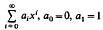
and the group operation being substitution. The results obtained give the exponent of the quotient groups Gn(R) of this group, n∈ℕ.
A Bernstein-Gabber-Joseph theorem for affine algebras*
-
- Journal:
- Proceedings of the Edinburgh Mathematical Society / Volume 42 / Issue 2 / June 1999
- Published online by Cambridge University Press:
- 20 January 2009, pp. 311-332
-
- Article
-
- You have access
- Export citation
Geometrical Problem
-
- Journal:
- Proceedings of the Edinburgh Mathematical Society / Volume 13 / February 1894
- Published online by Cambridge University Press:
- 20 January 2009, p. 36
-
- Article
-
- You have access
- Export citation
Pseudo-rings of infinite matrices
-
- Journal:
- Proceedings of the Edinburgh Mathematical Society / Volume 17 / Issue 4 / December 1971
- Published online by Cambridge University Press:
- 20 January 2009, pp. 325-336
-
- Article
-
- You have access
- Export citation
