Refine search
Actions for selected content:
26079 results in Abstract analysis
Some Properties of Parabolic Curves
-
- Journal:
- Proceedings of the Edinburgh Mathematical Society / Volume 14 / February 1895
- Published online by Cambridge University Press:
- 20 January 2009, pp. 31-34
-
- Article
-
- You have access
- Export citation
A Problem in Voting
-
- Journal:
- Proceedings of the Edinburgh Mathematical Society / Volume 28 / February 1909
- Published online by Cambridge University Press:
- 20 January 2009, pp. 23-24
-
- Article
-
- You have access
- Export citation
K. Austwick, Logarithms (Pergamon Press, 1962), xiii + 102 pp., 8s. 6d.
-
- Journal:
- Proceedings of the Edinburgh Mathematical Society / Volume 13 / Issue 3 / June 1963
- Published online by Cambridge University Press:
- 20 January 2009, p. 260
-
- Article
-
- You have access
- Export citation
The representation of linear operators on spaces of finitely additive set functions
-
- Journal:
- Proceedings of the Edinburgh Mathematical Society / Volume 20 / Issue 3 / March 1977
- Published online by Cambridge University Press:
- 20 January 2009, pp. 233-242
-
- Article
-
- You have access
- Export citation
An Approximation connected with e-x
-
- Journal:
- Proceedings of the Edinburgh Mathematical Society / Volume 3 / Issue 3 / February 1933
- Published online by Cambridge University Press:
- 20 January 2009, pp. 201-206
-
- Article
-
- You have access
- Export citation
Nevanlinna-type characterizations for the Bloch space and related spaces
-
- Journal:
- Proceedings of the Edinburgh Mathematical Society / Volume 33 / Issue 1 / February 1990
- Published online by Cambridge University Press:
- 20 January 2009, pp. 123-141
-
- Article
-
- You have access
- Export citation
A Geometrical Interpretation of the Symmetrical Invariant of Three Ternary Quadratics
-
- Journal:
- Proceedings of the Edinburgh Mathematical Society / Volume 4 / Issue 4 / April 1936
- Published online by Cambridge University Press:
- 20 January 2009, pp. 258-261
-
- Article
-
- You have access
- Export citation
PEM volume 17 issue 2 Cover and Front matter
-
- Journal:
- Proceedings of the Edinburgh Mathematical Society / Volume 17 / Issue 2 / December 1970
- Published online by Cambridge University Press:
- 20 January 2009, pp. f1-f2
-
- Article
-
- You have access
- Export citation
The Use of Green's Functions in the Mathematical Theory of the Conduction of Heat
-
- Journal:
- Proceedings of the Edinburgh Mathematical Society / Volume 21 / February 1902
- Published online by Cambridge University Press:
- 20 January 2009, pp. 40-64
-
- Article
-
- You have access
- Export citation
-
The use of Green's Functions in the Theory of Potential is well known. The function is most conveniently defined, for the closed surface S, as the potential which vanishes over S and is infinite as
 when r is zero, at the point P(x0, y0, z0), inside the surface. If this is represented by G(P), the solution with no infinity inside S and an arbitrary value V over the surface, is given by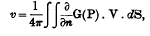
 denoting differentiation along the outward drawn normal.
 when r is zero, at the point P(x
 denoting differentiation along the outward drawn normal.
A generalisation of the Erdélyi-Kober operators
-
- Journal:
- Proceedings of the Edinburgh Mathematical Society / Volume 17 / Issue 2 / December 1970
- Published online by Cambridge University Press:
- 20 January 2009, pp. 139-148
-
- Article
-
- You have access
- Export citation
A Trigonometric Dial: a Teaching Appliance
-
- Journal:
- Proceedings of the Edinburgh Mathematical Society / Volume 24 / February 1905
- Published online by Cambridge University Press:
- 20 January 2009, p. 6
-
- Article
-
- You have access
- Export citation
PEM volume 10 issue 4 Cover and Back matter
-
- Journal:
- Proceedings of the Edinburgh Mathematical Society / Volume 10 / Issue 4 / June 1957
- Published online by Cambridge University Press:
- 20 January 2009, pp. b1-b2
-
- Article
-
- You have access
- Export citation
Torsion in K0 of unit-regular rings*
-
- Journal:
- Proceedings of the Edinburgh Mathematical Society / Volume 38 / Issue 2 / June 1995
- Published online by Cambridge University Press:
- 20 January 2009, pp. 331-341
-
- Article
-
- You have access
- Export citation
A. W. Chatters and C. R. Hajarnavis, Rings with chain conditions (Pitman, 1980), £8·00.
-
- Journal:
- Proceedings of the Edinburgh Mathematical Society / Volume 25 / Issue 1 / February 1982
- Published online by Cambridge University Press:
- 20 January 2009, p. 105
-
- Article
-
- You have access
- Export citation
SUR LA STABILITÉ POUR L’ÉQUATION MONODIMENSIONNELLE D’UN GAZ VISQUEUX ET CALORIFÈRE AVEC LA FRONTIÈRE VARIABLE
-
- Journal:
- Proceedings of the Edinburgh Mathematical Society / Volume 44 / Issue 2 / June 2001
- Published online by Cambridge University Press:
- 20 January 2009, pp. 295-315
-
- Article
-
- You have access
- Export citation
W. W. Sawyer, A First Look at Numerical Functional Analysis (Oxford Applied Mathematics and Computing Science Series, 1978), £9·00 (boards) and £4·25 (paper).
-
- Journal:
- Proceedings of the Edinburgh Mathematical Society / Volume 23 / Issue 3 / October 1980
- Published online by Cambridge University Press:
- 20 January 2009, p. 342
-
- Article
-
- You have access
- Export citation
Index According to Subjects
-
- Journal:
- Proceedings of the Edinburgh Mathematical Society / Volume 2 / Issue 4 / June 1931
- Published online by Cambridge University Press:
- 20 January 2009, pp. 274-276
-
- Article
-
- You have access
- Export citation
Some combinatorial problems of finite abstract algebra
-
- Journal:
- Proceedings of the Edinburgh Mathematical Society / Volume 6 / Issue 1 / May 1939
- Published online by Cambridge University Press:
- 20 January 2009, pp. 46-50
-
- Article
-
- You have access
- Export citation
The number of conjugacy classes in some quotients of the Nottingham group
-
- Journal:
- Proceedings of the Edinburgh Mathematical Society / Volume 41 / Issue 2 / June 1998
- Published online by Cambridge University Press:
- 20 January 2009, pp. 369-384
-
- Article
-
- You have access
- Export citation
Note on the application of complex integration to the equation of Conduction of Heat, with special reference to Dr Peddie's problem
-
- Journal:
- Proceedings of the Edinburgh Mathematical Society / Volume 19 / February 1900
- Published online by Cambridge University Press:
- 20 January 2009, pp. 50-56
-
- Article
-
- You have access
- Export citation
-
1. In Dr Peddie's problem of a sphere cooling in a well-stirred liquid, the conditions to be satisfied by the temperature v(r, t) are
(i) For every positive t, and every r from 0 to a, v is to be finite and one-valued, and is to possess finite derivatives
 , satisfying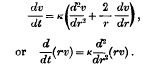
(ii) For every positive t, and r = a,

where p = ⅓ (capacity of liquid)/(capacity of sphere).
(iii)
 = a given arbitrary function f(r), for every r less than a.
(iv)
 = initial temperature of liquid = 0 suppose.
 , satisfying

 = a given arbitrary function f(r), for every r less than a.
 = initial temperature of liquid = 0 suppose.