Refine search
Actions for selected content:
26079 results in Abstract analysis
On the semiprimitivity of skew polynomial rings
-
- Journal:
- Proceedings of the Edinburgh Mathematical Society / Volume 36 / Issue 2 / June 1993
- Published online by Cambridge University Press:
- 20 January 2009, pp. 169-178
-
- Article
-
- You have access
- Export citation
Some Integrals involving Legendre Functions
-
- Journal:
- Proceedings of the Edinburgh Mathematical Society / Volume 11 / Issue 3 / May 1959
- Published online by Cambridge University Press:
- 20 January 2009, pp. 161-165
-
- Article
-
- You have access
- Export citation
On a relation between the topology and the intrinsic and extrinsic geometries of a compact submanifold
-
- Journal:
- Proceedings of the Edinburgh Mathematical Society / Volume 28 / Issue 3 / October 1985
- Published online by Cambridge University Press:
- 20 January 2009, pp. 305-311
-
- Article
-
- You have access
- Export citation
-
Let Mn be an n-dimensional smooth compact Riemannian manifold. By a theorem of Nash, we can think of it as an isometrically immersed submanifold in some higher dimensional Euclidean space ℝn+m. Viewing in this way we can compare the intrinsic geometry of M to its extrinsic geometry. Classically, the Gauss equation

where K(X,Y) denotes the sectional curvature in M corresponding to the plane spanned by the two orthonormal vectors X, Y and B denotes the second fundamental form gives one of the most important relations between the intrinsic and extrinsic geometries of M. In this note we shall prove the following.
Presentations of faithful d.g. near-rings
-
- Journal:
- Proceedings of the Edinburgh Mathematical Society / Volume 23 / Issue 1 / February 1980
- Published online by Cambridge University Press:
- 20 January 2009, pp. 49-56
-
- Article
-
- You have access
- Export citation
-
Many basic definitions and results in the theory of near-rings can be found in G. Pilz (4). We follow these for the most part, except that we use left near-rings rather than right near-rings. We follow exactly an earlier paper, Meldrum (2), where there are detailed definitions and many results relating to faithful d.g. near-rings. Let R be a d.g. near-ring, distributively generated by the semigroup S, which need not be the semigroup of all distributive elements. Denote such a d.g. near-ring by (R, S). Then (R, +) = Gp < S;
 > where is a set of defining relations in S. Let (T, U) be a d.g. near-ring. Then a d.g. homomorphism θ from (R, S) to (T, U) is a near-ring homomorphism from R to T which satisfies Sθ ⊆ U. If (G, +) is a group, let T0(G) be the near-ring of all maps from G to itself with pointwise addition and map composition. Let End G be the semigroup of all endomorphisms of G. Then (E(G), End G) is a d.g. near-ring. A d.g. near-ring (R, S) is faithful if there exists a d.g. monomorphism θ:(R, S) → (E(G), End G) for some group G.
 > where
 An application of Sturm's Functions
-
- Journal:
- Proceedings of the Edinburgh Mathematical Society / Volume 15 / February 1896
- Published online by Cambridge University Press:
- 20 January 2009, p. 85
-
- Article
-
- You have access
- Export citation
Notes on Spherical Harmonics
-
- Journal:
- Proceedings of the Edinburgh Mathematical Society / Volume 32 / February 1913
- Published online by Cambridge University Press:
- 20 January 2009, pp. 30-35
-
- Article
-
- You have access
- Export citation
PEM volume 4 issue 4 Cover and Front matter
-
- Journal:
- Proceedings of the Edinburgh Mathematical Society / Volume 4 / Issue 4 / April 1936
- Published online by Cambridge University Press:
- 20 January 2009, pp. f1-f5
-
- Article
-
- You have access
- Export citation
Problème de la section de raison
-
- Journal:
- Proceedings of the Edinburgh Mathematical Society / Volume 18 / February 1900
- Published online by Cambridge University Press:
- 20 January 2009, p. 99
-
- Article
-
- You have access
- Export citation
PEM volume 19 issue 4 Cover and Front matter
-
- Journal:
- Proceedings of the Edinburgh Mathematical Society / Volume 19 / Issue 4 / September 1975
- Published online by Cambridge University Press:
- 20 January 2009, pp. f1-f2
-
- Article
-
- You have access
- Export citation
A Class of Integral Equations Involving Laguerre Polynomials as Kernel
-
- Journal:
- Proceedings of the Edinburgh Mathematical Society / Volume 15 / Issue 1 / June 1966
- Published online by Cambridge University Press:
- 20 January 2009, pp. 33-36
-
- Article
-
- You have access
- Export citation
A general proof of the Addition Theorems in Trigonometry
-
- Journal:
- Proceedings of the Edinburgh Mathematical Society / Volume 18 / February 1900
- Published online by Cambridge University Press:
- 20 January 2009, pp. 103-105
-
- Article
-
- You have access
- Export citation
On a problem in permutations
-
- Journal:
- Proceedings of the Edinburgh Mathematical Society / Volume 8 / February 1889
- Published online by Cambridge University Press:
- 20 January 2009, pp. 64-69
-
- Article
-
- You have access
- Export citation
Distributive elements in centralizer near-rings
-
- Journal:
- Proceedings of the Edinburgh Mathematical Society / Volume 30 / Issue 3 / October 1987
- Published online by Cambridge University Press:
- 20 January 2009, pp. 401-413
-
- Article
-
- You have access
- Export citation
-
Let <G,+> be a group with identity 0 and let S be a semigroup of endomorphisms of G. The set Ms(G)={f:G→G; f(0)=0, fσ=σf, for all σ∈S} with the operations of unction addition and composition is a zero-symmetric near-ring with identity called the centralizer near-ring determined by the pair (S, G). Centralizer near-rings have been studied for many classes of semigroups of endomorphisms. (See [8] and the references given there.) In this paper we continue these investigations into the structure of centralizer near-rings via our study of the relationship between distributive elements in Ms(G) and endomorphisms in Ms(G). More specifically, let N = Ms(G) and let Nd={f∈N; f(g1+g2)=fg1+fg2}, the set of distributive elements in N. Under the operation of function composition, Nd is a semigroup containing the identity map, id. Moreover, Nd contains as a submonoid
 = {α ∈ End G; ασ=σα for all σ∈S}. Here we determine for certain semigroups S, whether or not = Nd.
 = {α ∈ End G; ασ=σα for all σ∈S}. Here we determine for certain semigroups S, whether or not
 Geometrical Illustrations of Cyclant Substitutions
-
- Journal:
- Proceedings of the Edinburgh Mathematical Society / Volume 35 / February 1916
- Published online by Cambridge University Press:
- 20 January 2009, pp. 74-77
-
- Article
-
- You have access
- Export citation
-
§1. The following three illustrations of cyclant substitutions are supplementary to those given in § 5 of a previous paper.
In the cyclant substitution in three variables with equimodular multipliers
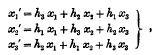
in which the coefficients are real and satisfy the relations

the following expressions, as may at once be verified, are absolute invariants:

A. Sard, Linear Approximation (Mathematical Surveys, Vol. 9, American Mathematical Society, 1963), 544 pp., $16.80.
-
- Journal:
- Proceedings of the Edinburgh Mathematical Society / Volume 14 / Issue 2 / December 1964
- Published online by Cambridge University Press:
- 20 January 2009, p. 167
-
- Article
-
- You have access
- Export citation
A family of crystallographic groups with 2-torsion in K0 of the rational group algebra
-
- Journal:
- Proceedings of the Edinburgh Mathematical Society / Volume 34 / Issue 2 / June 1991
- Published online by Cambridge University Press:
- 20 January 2009, pp. 325-331
-
- Article
-
- You have access
- Export citation
An easier enumeration of self-complementary graphs
-
- Journal:
- Proceedings of the Edinburgh Mathematical Society / Volume 27 / Issue 2 / June 1984
- Published online by Cambridge University Press:
- 20 January 2009, pp. 181-183
-
- Article
-
- You have access
- Export citation
Robert R. Stoll, Set Theory and Logic (W. H. Freeman and Company, San Francisco and London, 1963), xiv + 474 pp., 64s.
-
- Journal:
- Proceedings of the Edinburgh Mathematical Society / Volume 15 / Issue 3 / June 1967
- Published online by Cambridge University Press:
- 20 January 2009, p. 245
-
- Article
-
- You have access
- Export citation
Boundary behaviour of harmonic functions and solutions of parabolic systems
-
- Journal:
- Proceedings of the Edinburgh Mathematical Society / Volume 31 / Issue 2 / June 1988
- Published online by Cambridge University Press:
- 20 January 2009, pp. 267-270
-
- Article
-
- You have access
- Export citation
Double Binary Forms IV.*
-
- Journal:
- Proceedings of the Edinburgh Mathematical Society / Volume 42 / February 1923
- Published online by Cambridge University Press:
- 20 January 2009, pp. 69-80
-
- Article
-
- You have access
- Export citation
