Refine search
Actions for selected content:
26079 results in Abstract analysis
The Bourgain algebra of a nest algebra
-
- Journal:
- Proceedings of the Edinburgh Mathematical Society / Volume 40 / Issue 1 / February 1997
- Published online by Cambridge University Press:
- 20 January 2009, pp. 151-166
-
- Article
-
- You have access
- Export citation
Gilbert's Method of Treating Tangents to Confocal Conicoids
-
- Journal:
- Proceedings of the Edinburgh Mathematical Society / Volume 3 / February 1884
- Published online by Cambridge University Press:
- 20 January 2009, pp. 61-70
-
- Article
-
- You have access
- Export citation
On the extension of Fermat's theorem to matrices of order n
-
- Journal:
- Proceedings of the Edinburgh Mathematical Society / Volume 6 / Issue 2 / October 1939
- Published online by Cambridge University Press:
- 20 January 2009, pp. 85-91
-
- Article
-
- You have access
- Export citation
Geoffrey Timms, O.B.E., Ph.D., F.R.S.E.
-
- Journal:
- Proceedings of the Edinburgh Mathematical Society / Volume 26 / Issue 3 / October 1983
- Published online by Cambridge University Press:
- 20 January 2009, pp. 393-394
-
- Article
-
- You have access
- Export citation
On the number of eigenvalues in the spectral gap of a Dirac system
-
- Journal:
- Proceedings of the Edinburgh Mathematical Society / Volume 29 / Issue 3 / October 1986
- Published online by Cambridge University Press:
- 20 January 2009, pp. 367-378
-
- Article
-
- You have access
- Export citation
-
We consider the one-dimensional operator,

on 0<x<∞ with
 . The coefficients p, V1 and V2 are assumed to be real, locally Lebesgue integrable functions; c1 and c2 are positive numbers. The operator L acts in the Hilbert space H of all equivalence classes of complex vector-value functions
  such that
  . L has domain D(L) consisting of ally∈H such that y is locally absolutely continuous and Ly∈H; thus in the language of differential operators L is a maximal operator. Associated with L is the minimal operator L0 defined as the closure of
  where is the restriction of L to the functions with compact support in (0,∞).
 . The coefficients p, V
 such that
  . L has domain D(L) consisting of ally∈H such that y is locally absolutely continuous and Ly∈H; thus in the language of differential operators L is a maximal operator. Associated with L is the minimal operator L
 where
where PEM volume 3 issue 3 Cover and Back matter
-
- Journal:
- Proceedings of the Edinburgh Mathematical Society / Volume 3 / Issue 3 / February 1933
- Published online by Cambridge University Press:
- 20 January 2009, pp. b1-b2
-
- Article
-
- You have access
- Export citation
The syntactic near-ring of a linear sequential machine
-
- Journal:
- Proceedings of the Edinburgh Mathematical Society / Volume 26 / Issue 1 / February 1983
- Published online by Cambridge University Press:
- 20 January 2009, pp. 15-24
-
- Article
-
- You have access
- Export citation
Note on the Peano-Baker Method of solving Linear Differential Equations
-
- Journal:
- Proceedings of the Edinburgh Mathematical Society / Volume 34 / February 1915
- Published online by Cambridge University Press:
- 20 January 2009, pp. 41-44
-
- Article
-
- You have access
- Export citation
-
In Mathematische Annalen, Vol. 32 (1888) Peano discusses the solution of a system of homogeneous linear differential equations
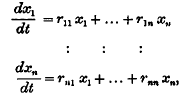
where rij denotes a real function of the variable t, and shows how, by a series of repeated substitutions, this system of equations may be replaced by the equivalent equation

where X denotes the complex [x1, x2, … xn] and R the matrix
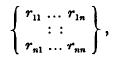
of which equation the solution X can be represented as a sum of integrals.

E. Hewitt and K. A. Ross, Abstract harmonic analysis, volume 1 (die Grundlehren der mathematischen Wissenschaften, Band 115: Springer-Verlag, Berlin-Göttingen-Heidelberg, 1963), viii+519 pp., 76 DM.
-
- Journal:
- Proceedings of the Edinburgh Mathematical Society / Volume 13 / Issue 4 / December 1963
- Published online by Cambridge University Press:
- 20 January 2009, pp. 345-346
-
- Article
-
- You have access
- Export citation
PEM volume 40 issue 1 Cover and Back matter
-
- Journal:
- Proceedings of the Edinburgh Mathematical Society / Volume 40 / Issue 1 / February 1997
- Published online by Cambridge University Press:
- 20 January 2009, pp. b1-b2
-
- Article
-
- You have access
- Export citation
Extensions, crossed modules and internal categories in categories of groups with operations
-
- Journal:
- Proceedings of the Edinburgh Mathematical Society / Volume 30 / Issue 3 / October 1987
- Published online by Cambridge University Press:
- 20 January 2009, pp. 373-381
-
- Article
-
- You have access
- Export citation
Canonical bases and standard monomials
-
- Journal:
- Proceedings of the Edinburgh Mathematical Society / Volume 41 / Issue 3 / October 1998
- Published online by Cambridge University Press:
- 20 January 2009, pp. 611-623
-
- Article
-
- You have access
- Export citation
Solution of a Geometrical Problem
-
- Journal:
- Proceedings of the Edinburgh Mathematical Society / Volume 22 / February 1903
- Published online by Cambridge University Press:
- 20 January 2009, pp. 74-75
-
- Article
-
- You have access
- Export citation
On four Inequalities in Symmetric Functions
-
- Journal:
- Proceedings of the Edinburgh Mathematical Society / Volume 11 / Issue 4 / November 1959
- Published online by Cambridge University Press:
- 20 January 2009, pp. 211-219
-
- Article
-
- You have access
- Export citation
U. Grenander, and G. Szegö, Toeplitz Forms and their Applications (University of California Press, 1958), 246 pp., $6.00.
-
- Journal:
- Proceedings of the Edinburgh Mathematical Society / Volume 11 / Issue 3 / May 1959
- Published online by Cambridge University Press:
- 20 January 2009, pp. 186-187
-
- Article
-
- You have access
- Export citation
On Certain Equations to the Cubic Surface, with Extensions to Higher Space
-
- Journal:
- Proceedings of the Edinburgh Mathematical Society / Volume 4 / Issue 1 / March 1934
- Published online by Cambridge University Press:
- 20 January 2009, pp. 1-11
-
- Article
-
- You have access
- Export citation
W. E. Baylis Theoretical methods in the physical sciences: an introduction to problem solving using Maple V (Birkhäuser, Basel, Berlin, Boston1994) 304 pp, (a floppy disk is included), softcover, 3 7643 3715 X, £36.
-
- Journal:
- Proceedings of the Edinburgh Mathematical Society / Volume 38 / Issue 2 / June 1995
- Published online by Cambridge University Press:
- 20 January 2009, pp. 359-360
-
- Article
-
- You have access
- Export citation
Finitarily linear wreath products
-
- Journal:
- Proceedings of the Edinburgh Mathematical Society / Volume 43 / Issue 1 / February 2000
- Published online by Cambridge University Press:
- 20 January 2009, pp. 27-41
-
- Article
-
- You have access
- Export citation
On extensions of Pascal's theorem (Second paper) Paul Serret's theorem
-
- Journal:
- Proceedings of the Edinburgh Mathematical Society / Volume 5 / Issue 3 / February 1938
- Published online by Cambridge University Press:
- 20 January 2009, pp. 155-158
-
- Article
-
- You have access
- Export citation
Plücker's first equation connecting the singularities of Curves
-
- Journal:
- Proceedings of the Edinburgh Mathematical Society / Volume 1 / February 1883
- Published online by Cambridge University Press:
- 20 January 2009, pp. 130-136
-
- Article
-
- You have access
- Export citation
