Refine search
Actions for selected content:
26079 results in Abstract analysis
Index of Papers Published in this Volume Arranged According to Names of Authors
-
- Journal:
- Proceedings of the Edinburgh Mathematical Society / Volume 3 / Issue 4 / August 1933
- Published online by Cambridge University Press:
- 20 January 2009, pp. 301-302
-
- Article
-
- You have access
- Export citation
PEM volume 4 issue 3 Cover and Front matter
-
- Journal:
- Proceedings of the Edinburgh Mathematical Society / Volume 4 / Issue 3 / August 1935
- Published online by Cambridge University Press:
- 20 January 2009, pp. f1-f2
-
- Article
-
- You have access
- Export citation
Optimal control of a nonlinear elliptic population system
-
- Journal:
- Proceedings of the Edinburgh Mathematical Society / Volume 43 / Issue 2 / June 2000
- Published online by Cambridge University Press:
- 20 January 2009, pp. 225-241
-
- Article
-
- You have access
- Export citation
Note on the Problem: To draw through a given point a transversal to (a) a given triangle (b) a given quadrilateral so that the intercepted segments may have (a) a given ratio (b) a given cross ratio
-
- Journal:
- Proceedings of the Edinburgh Mathematical Society / Volume 22 / February 1903
- Published online by Cambridge University Press:
- 20 January 2009, p. 89
-
- Article
-
- You have access
- Export citation
Annihilators in semiprime right Goldie rings
-
- Journal:
- Proceedings of the Edinburgh Mathematical Society / Volume 35 / Issue 1 / February 1992
- Published online by Cambridge University Press:
- 20 January 2009, pp. 133-137
-
- Article
-
- You have access
- Export citation
Wilhelm Blaschke, Gesammelte Werke, Band I ed. by W. Burau, S. S. Chern et al. (Thales-Verlag, Essen1982), pp. 365.
-
- Journal:
- Proceedings of the Edinburgh Mathematical Society / Volume 27 / Issue 3 / October 1984
- Published online by Cambridge University Press:
- 20 January 2009, pp. 347-349
-
- Article
-
- You have access
- Export citation
On the space of matrices of given rank
-
- Journal:
- Proceedings of the Edinburgh Mathematical Society / Volume 32 / Issue 1 / February 1989
- Published online by Cambridge University Press:
- 20 January 2009, pp. 99-105
-
- Article
-
- You have access
- Export citation
A PROJECTIVE DESCRIPTION OF THE SPACE OF HOLOMORPHIC GERMS
-
- Journal:
- Proceedings of the Edinburgh Mathematical Society / Volume 44 / Issue 2 / June 2001
- Published online by Cambridge University Press:
- 20 January 2009, pp. 407-416
-
- Article
-
- You have access
- Export citation
Semi-embeddings of Banach spaces which are hereditarily c0
-
- Journal:
- Proceedings of the Edinburgh Mathematical Society / Volume 26 / Issue 2 / June 1983
- Published online by Cambridge University Press:
- 20 January 2009, pp. 163-167
-
- Article
-
- You have access
- Export citation
E. I. Khukhro Nilpotent groups and their automorphisms (de Gruyter Expositions in Mathematics Vol. 8, de Gruyter, Berlin, New York1993) 252pp., 3 11 013672 4, about £90.
-
- Journal:
- Proceedings of the Edinburgh Mathematical Society / Volume 38 / Issue 3 / October 1995
- Published online by Cambridge University Press:
- 20 January 2009, p. 543
-
- Article
-
- You have access
- Export citation
L. Hörmander Notions of convexity (Progress in Mathematics Vol. 127, Birkhäuser, Basel, Berlin, Boston1994) 424 pp., 3 7643 3799 0, £38.
-
- Journal:
- Proceedings of the Edinburgh Mathematical Society / Volume 38 / Issue 3 / October 1995
- Published online by Cambridge University Press:
- 20 January 2009, pp. 543-544
-
- Article
-
- You have access
- Export citation
List of Members
-
- Journal:
- Proceedings of the Edinburgh Mathematical Society / Volume 28 / February 1909
- Published online by Cambridge University Press:
- 20 January 2009, pp. 1-8
-
- Article
-
- You have access
- Export citation
Generators for the sporadic group Co3 as a (2, 3, 7) group
-
- Journal:
- Proceedings of the Edinburgh Mathematical Society / Volume 25 / Issue 1 / February 1982
- Published online by Cambridge University Press:
- 20 January 2009, pp. 65-68
-
- Article
-
- You have access
- Export citation
PEM volume 22 issue 1 Cover and Front matter
-
- Journal:
- Proceedings of the Edinburgh Mathematical Society / Volume 22 / Issue 1 / February 1979
- Published online by Cambridge University Press:
- 20 January 2009, pp. f1-f2
-
- Article
-
- You have access
- Export citation
Pro-C completions of crossed modules
-
- Journal:
- Proceedings of the Edinburgh Mathematical Society / Volume 33 / Issue 1 / February 1990
- Published online by Cambridge University Press:
- 20 January 2009, pp. 39-51
-
- Article
-
- You have access
- Export citation
PEM volume 33 issue 1 Cover and Front matter
-
- Journal:
- Proceedings of the Edinburgh Mathematical Society / Volume 33 / Issue 1 / February 1990
- Published online by Cambridge University Press:
- 20 January 2009, pp. f1-f2
-
- Article
-
- You have access
- Export citation
Quadratic Equations in a Cyclic Number System
-
- Journal:
- Proceedings of the Edinburgh Mathematical Society / Volume 2 / Issue 3 / January 1931
- Published online by Cambridge University Press:
- 20 January 2009, pp. 151-157
-
- Article
-
- You have access
- Export citation
A Note on L-Groups
-
- Journal:
- Proceedings of the Edinburgh Mathematical Society / Volume 13 / Issue 1 / June 1962
- Published online by Cambridge University Press:
- 20 January 2009, pp. 123-124
-
- Article
-
- You have access
- Export citation
Extension of the “Medial Section” Problem (Euclid II :11, VI: 30, etc.) and derivation of a Hyperbolic Graph
-
- Journal:
- Proceedings of the Edinburgh Mathematical Society / Volume 15 / February 1896
- Published online by Cambridge University Press:
- 20 January 2009, pp. 65-69
-
- Article
-
- You have access
- Export citation
-
To divide the straight line AB (containing a units) at C so that
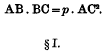
By algebra, taking the positive root,

The number p may therefore have any positive value, integral or fractional, and when negative cannot exceed ¼. Secondly, AC and AB are incommensurable except when 4p +1 is a square:– e.g., if 4p = (q – l)(q +1) or if p = q(q+l), q being any positive integer or fraction.
Historical notes on a geometrical problem and theorem
-
- Journal:
- Proceedings of the Edinburgh Mathematical Society / Volume 8 / February 1889
- Published online by Cambridge University Press:
- 20 January 2009, pp. 93-94
-
- Article
-
- You have access
- Export citation
