Refine search
Actions for selected content:
26079 results in Abstract analysis
On the set of periodic solutions of differential equations of Riccati type
-
- Journal:
- Proceedings of the Edinburgh Mathematical Society / Volume 27 / Issue 2 / June 1984
- Published online by Cambridge University Press:
- 20 January 2009, pp. 195-208
-
- Article
-
- You have access
- Export citation
-
The purpose of this paper is to expand upon the results obtained in [4]. We consider the set H of differential equations

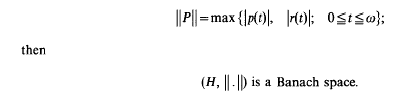
where p and r are continuous real-valued functions of period ω (ω being fixed throughout). The equation (1.1) is denoted by P or (p,r), and we regard H as the set of pairs of continuous functions of period ω.On H we define a norm:
Balser, W. Formal power series and linear systems of meromorphic ordinary differential equations (Universitext, Springer, 2000), xviii+299 pp., 0 387 98690 1 (hardcover), £32.50
-
- Journal:
- Proceedings of the Edinburgh Mathematical Society / Volume 44 / Issue 1 / February 2001
- Published online by Cambridge University Press:
- 20 January 2009, pp. 222-224
-
- Article
-
- You have access
- Export citation
Products of idempotents in certain semigroups of transformations
-
- Journal:
- Proceedings of the Edinburgh Mathematical Society / Volume 17 / Issue 3 / June 1971
- Published online by Cambridge University Press:
- 20 January 2009, pp. 223-236
-
- Article
-
- You have access
- Export citation
-
In an earlier paper (5) a description was given in set-theoretic terms of the semigroup generated by the idempotents of a full transformation semigroup
 , one of the results being that if X is finite then every element of that is not bijective is expressible as a product of idempotents. In view of this it was natural to ask whether by analogy every singular square matrix is expressibleas a product of idempotent matrices. This is indeed the case, as was shown by J. A. Erdos (2). Magill (6) has considered products of idempotents in thesemigroup of all continuous self-maps of a topological space X, but a comparable characterization of products of idempotents in this case appears to be extremelydifficult, and no solution is available yet.
 , one of the results being that if X is finite then every element of
 The Intrinsic Properties of Curves
-
- Journal:
- Proceedings of the Edinburgh Mathematical Society / Volume 26 / February 1907
- Published online by Cambridge University Press:
- 20 January 2009, pp. 87-92
-
- Article
-
- You have access
- Export citation
On certain Integrals
-
- Journal:
- Proceedings of the Edinburgh Mathematical Society / Volume 4 / February 1885
- Published online by Cambridge University Press:
- 20 January 2009, pp. 23-24
-
- Article
-
- You have access
- Export citation
A Simple Method of Finding any Number of Square Numbers whose Sum is a Square
-
- Journal:
- Proceedings of the Edinburgh Mathematical Society / Volume 14 / February 1895
- Published online by Cambridge University Press:
- 20 January 2009, pp. 113-115
-
- Article
-
- You have access
- Export citation
-
I.—Take the well-known identity

Now if we can transform 4wz into a square we shall have two square numbers whose sum is a square. This will be effected by taking w = p2, z = q2, for then 4wz = 4p2q2 = (2pq)2 and we have

See Mathematical Magazine, Vol. II., No. 5, p.
Finitely presented ordered groups
-
- Journal:
- Proceedings of the Edinburgh Mathematical Society / Volume 33 / Issue 2 / June 1990
- Published online by Cambridge University Press:
- 20 January 2009, pp. 299-301
-
- Article
-
- You have access
- Export citation
Soluble groups with a finite rewriting system
-
- Journal:
- Proceedings of the Edinburgh Mathematical Society / Volume 36 / Issue 2 / June 1993
- Published online by Cambridge University Press:
- 20 January 2009, pp. 283-288
-
- Article
-
- You have access
- Export citation
On the positive roots of an equation involving a Bessel function
-
- Journal:
- Proceedings of the Edinburgh Mathematical Society / Volume 32 / Issue 1 / February 1989
- Published online by Cambridge University Press:
- 20 January 2009, pp. 157-164
-
- Article
-
- You have access
- Export citation
-
In this paper we shall discuss the positive roots of the equation

where Iq is the modified Bessel function of the first kind. By means of a recurrence relation for Iq(r) [2, (5.7.9)], equation (1.1a) can also be written in the form

Polynomial expansions in the Borel region
-
- Journal:
- Proceedings of the Edinburgh Mathematical Society / Volume 5 / Issue 2 / June 1937
- Published online by Cambridge University Press:
- 20 January 2009, pp. 82-89
-
- Article
-
- You have access
- Export citation
Associativity of the tensor product of semilattices
-
- Journal:
- Proceedings of the Edinburgh Mathematical Society / Volume 27 / Issue 3 / October 1984
- Published online by Cambridge University Press:
- 20 January 2009, pp. 337-340
-
- Article
-
- You have access
- Export citation
Averaging the sum of digits function to an even base
-
- Journal:
- Proceedings of the Edinburgh Mathematical Society / Volume 35 / Issue 3 / October 1992
- Published online by Cambridge University Press:
- 20 January 2009, pp. 449-455
-
- Article
-
- You have access
- Export citation
-
For a fixed integer q≧2, every positive integer
 where each ar(q, k) ∈ {0, 1, 2, …, q–1}. The sum of digits function α(q, k) =
  behaves rather erratically but on averaging has a uniform behaviour. In particular if A(q, n) =
  , where n > 1, then it is well known that A(q, n)∼½ ((q – 1)/log q) n log n as n→∞. For even values of q, a lower bound is now given for the difference ½S(q, n) = A(q, n)–½(q–1)[logn/logq] n, where [log n/log q] denotes the greatest integer ≦ log n/log q, complementing an earlier result for odd values of q.
 where each a
 behaves rather erratically but on averaging has a uniform behaviour. In particular if A(q, n) =
  , where n > 1, then it is well known that A(q, n)∼½ ((q – 1)/log q) n log n as n→∞. For even values of q, a lower bound is now given for the difference ½S(q, n) = A(q, n)–½(q–1)[logn/logq] n, where [log n/log q] denotes the greatest integer ≦ log n/log q, complementing an earlier result for odd values of q.
L. J. Slater, Confluent Hypergeometric Functions (Cambridge University Press, 1960), 247 pp., 65s.
-
- Journal:
- Proceedings of the Edinburgh Mathematical Society / Volume 12 / Issue 3 / June 1961
- Published online by Cambridge University Press:
- 20 January 2009, p. 169
-
- Article
-
- You have access
- Export citation
On the use of the Hyperbolic Sine and Cosine in connection with the Hyperbola
-
- Journal:
- Proceedings of the Edinburgh Mathematical Society / Volume 13 / February 1894
- Published online by Cambridge University Press:
- 20 January 2009, pp. 153-155
-
- Article
-
- You have access
- Export citation
The positive cones of k0-groups of crossed products associated with Furstenberg transformations on the 2-torus
-
- Journal:
- Proceedings of the Edinburgh Mathematical Society / Volume 43 / Issue 1 / February 2000
- Published online by Cambridge University Press:
- 20 January 2009, pp. 167-175
-
- Article
-
- You have access
- Export citation
-
Let θ be an irrational number in (0,1) and f a real-valued continuous function on the 1-torus T. Letφθ, f be a Furstenberg transformation on the 2-torus T2 defined by
 for any (t, s) ∈ T2, where ρ is a non-zero integer, and we identify a function on T or T2 with a function on R or R2 with period 1, respectively. Let Aθ, f be the crossed product associated with φθ, f. In this paper we wiil compute the positive cone of the K0-group of Aθ, f.
 for any (t, s) ∈ T
On a Geometrical Problem
-
- Journal:
- Proceedings of the Edinburgh Mathematical Society / Volume 16 / February 1897
- Published online by Cambridge University Press:
- 20 January 2009, pp. 47-48
-
- Article
-
- You have access
- Export citation
Japanese Arithmetic
-
- Journal:
- Proceedings of the Edinburgh Mathematical Society / Volume 11 / February 1892
- Published online by Cambridge University Press:
- 20 January 2009, p. 167
-
- Article
-
- You have access
- Export citation
Presents to the Library
-
- Journal:
- Proceedings of the Edinburgh Mathematical Society / Volume 41 / February 1922
- Published online by Cambridge University Press:
- 20 January 2009, pp. vii-viii
-
- Article
-
- You have access
- Export citation
A Note on Double Limits
-
- Journal:
- Proceedings of the Edinburgh Mathematical Society / Volume 1 / Issue 4 / July 1929
- Published online by Cambridge University Press:
- 20 January 2009, pp. 197-198
-
- Article
-
- You have access
- Export citation
-
Let umn, vmn be functions of m and n, vmn being real and positive for all positive values of m and n. Suppose that either vmn increases steadily to infinity with n, or that umn both tend to zero (the latter steadily) as n → ∞, for any fixed value of m. Denote
 by wmn, and assume that
  wmn exists for every value of m, being denoted by lm. Then from Stolz' extension of a result proved by Cauchy, and an allied theorem, we have
  , for all values of m. It follows from Pringsheim's Theorem that if the double limit of
  exists, being l, then lm → l as m → ∞.
 by w
by w w
w , for all values of m. It follows from Pringsheim's Theorem that if the double limit of
  exists, being l, then l
HIGHER-ORDER ESTIMATES FOR FULLY NONLINEAR DIFFERENCE EQUATIONS. II
-
- Journal:
- Proceedings of the Edinburgh Mathematical Society / Volume 44 / Issue 1 / February 2001
- Published online by Cambridge University Press:
- 20 January 2009, pp. 87-102
-
- Article
-
- You have access
- Export citation
