Refine search
Actions for selected content:
26079 results in Abstract analysis
The motion of a rigid sphere embedded in an adhering elastic or viscoelastic medium
-
- Journal:
- Proceedings of the Edinburgh Mathematical Society / Volume 16 / Issue 1 / June 1968
- Published online by Cambridge University Press:
- 20 January 2009, pp. 55-69
-
- Article
-
- You have access
- Export citation
Obituary
-
- Journal:
- Proceedings of the Edinburgh Mathematical Society / Volume 13 / Issue 3 / June 1963
- Published online by Cambridge University Press:
- 20 January 2009, pp. 273-276
-
- Article
-
- You have access
- Export citation
Michael Aschbacher, The Finite Simple Groups and Their Classification (Yale Mathematical Monographs 7, Yale University Press, 1980) ix + 61 pp., £4.40.
-
- Journal:
- Proceedings of the Edinburgh Mathematical Society / Volume 26 / Issue 1 / February 1983
- Published online by Cambridge University Press:
- 20 January 2009, pp. 116-117
-
- Article
-
- You have access
- Export citation
A. N. Kolmogorov, and S. V. Fomin, Elements of the Theory of Functions and Functional Analysis, vol. i: Metric and Normed Spaces, translated by Leo F. Boron (Graylock Press, Rochester, N.Y., 1957), 129 pp., 32s.
-
- Journal:
- Proceedings of the Edinburgh Mathematical Society / Volume 11 / Issue 3 / May 1959
- Published online by Cambridge University Press:
- 20 January 2009, p. 188
-
- Article
-
- You have access
- Export citation
The Temperature Distribution in a Semi-Infinite Solid whose Surface is Maintained at an Arbitrary Temperature
-
- Journal:
- Proceedings of the Edinburgh Mathematical Society / Volume 14 / Issue 2 / December 1964
- Published online by Cambridge University Press:
- 20 January 2009, pp. 143-148
-
- Article
-
- You have access
- Export citation
An Application of Abel's Lemma to Double Series1
-
- Journal:
- Proceedings of the Edinburgh Mathematical Society / Volume 1 / Issue 4 / July 1929
- Published online by Cambridge University Press:
- 20 January 2009, pp. 193-196
-
- Article
-
- You have access
- Export citation
-
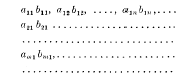
Let bmn be a positive function of m and n which decreases steadily with n, so that bmn ≥ bm, n+1 for all values of m and n. Assume also that |am1 + am+2 + … + bmn| < K for all values of m and n, K being finite. Denote bySmn the sum of the first n terms in the first m rows of the double series
M. M. Nicolson (edited by D. R. Hartree and D. G. Padfield), Fundamentals and Techniques of Mathematics for Scientists (Longmans, 1961), 526 pp., 45s.
-
- Journal:
- Proceedings of the Edinburgh Mathematical Society / Volume 13 / Issue 1 / June 1962
- Published online by Cambridge University Press:
- 20 January 2009, p. 120
-
- Article
-
- You have access
- Export citation
PEM volume 11 Back matter, errata and figures
-
- Journal:
- Proceedings of the Edinburgh Mathematical Society / Volume 11 / February 1892
- Published online by Cambridge University Press:
- 20 January 2009, pp. b1-b18
-
- Article
-
- You have access
- Export citation
PEM volume 25 issue 3 Cover and Back matter
-
- Journal:
- Proceedings of the Edinburgh Mathematical Society / Volume 25 / Issue 3 / October 1982
- Published online by Cambridge University Press:
- 20 January 2009, pp. b1-b5
-
- Article
-
- You have access
- Export citation
Semigroups of high rank II doubly noble semigroups
-
- Journal:
- Proceedings of the Edinburgh Mathematical Society / Volume 28 / Issue 3 / October 1985
- Published online by Cambridge University Press:
- 20 January 2009, pp. 409-417
-
- Article
-
- You have access
- Export citation
M. F. Atiyah , Representation Theory of Lie Groups (L.M.S. Lecture Note Series No. 34, C.U.P., 1980). £10.95.
-
- Journal:
- Proceedings of the Edinburgh Mathematical Society / Volume 25 / Issue 1 / February 1982
- Published online by Cambridge University Press:
- 20 January 2009, p. 106
-
- Article
-
- You have access
- Export citation
Formulae connected with the Radii of the Incircle and the Excircles of a Triangle
-
- Journal:
- Proceedings of the Edinburgh Mathematical Society / Volume 13 / February 1894
- Published online by Cambridge University Press:
- 20 January 2009, pp. 103-104
-
- Article
-
- You have access
- Export citation
-
The following formulae may be added to the list given in the Proceedings of the Edinburgh Mathematical Society, Vol. XII., pp. 86-102 (1894).
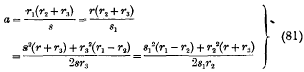
and also on.
The Elementary Divisors, Associated with 0, of a Singular M-matrix
-
- Journal:
- Proceedings of the Edinburgh Mathematical Society / Volume 10 / Issue 3 / January 1956
- Published online by Cambridge University Press:
- 20 January 2009, pp. 108-122
-
- Article
-
- You have access
- Export citation
Hyperbolic travelling fronts
-
- Journal:
- Proceedings of the Edinburgh Mathematical Society / Volume 31 / Issue 1 / February 1988
- Published online by Cambridge University Press:
- 20 January 2009, pp. 89-97
-
- Article
-
- You have access
- Export citation
-
Since the work of R. A. Fisher [2] and Kolmogorov, Petrovskij and Piskunov [7] (see [6] for further references) the problem of travelling fronts in reaction–diffusion equations has been extensively studied. For the equation

with F(0) = F(1) = 0 a travelling front is a solution

where the function of one variable φ is decreasing and satisfies φ(−∞) = 1, φ(+∞) = 0. The function φ describes the shape of the front and the constant c is the speed of propagation. There are two main types of the problem. In the all-positive case, where the function F satisfies

there is a half-line [c0, ∞), c0>0, of speeds. For each c∈[c0, ∞) there is, up to translation, a unique travelling front. Fronts for different c can be distinguished by the rate of decay towards +∞. In the threshold case, where F has the property, for some λ∈(0, 1),

there is a unique speed c0 with a travelling front, which is unique up to translation. In this case the sign of c0 is determined by the sign of the integral


Finite p-soluble groups with irreducible modular representations of given degrees
-
- Journal:
- Proceedings of the Edinburgh Mathematical Society / Volume 20 / Issue 3 / March 1977
- Published online by Cambridge University Press:
- 20 January 2009, pp. 219-223
-
- Article
-
- You have access
- Export citation
-
Let G be a finite group, p be a prime and K be a field of characteristic p. Let

be a decomposition of the group ring of G over K as a sum of indecomposable two-sided ideals. An irreducible K(G)-module is said to be in the block Bi if it occurs as a composition factor of Bi. The block containing the trivial K(G)-module is called the principal block of G.
URS AND URSIMS FOR P-ADIC MEROMORPHIC FUNCTIONS INSIDE A DISC
-
- Journal:
- Proceedings of the Edinburgh Mathematical Society / Volume 44 / Issue 3 / October 2001
- Published online by Cambridge University Press:
- 20 January 2009, pp. 485-504
-
- Article
-
- You have access
- Export citation
A Theorem on Alternants
-
- Journal:
- Proceedings of the Edinburgh Mathematical Society / Volume 4 / Issue 4 / April 1936
- Published online by Cambridge University Press:
- 20 January 2009, p. 261
-
- Article
-
- You have access
- Export citation
-
The following is a direct proof of a theorem by Zia-ud-Din.
Let {ν} ≡ {ν1, ν2, …, νp)} be any S-function of weight r + s such that

in the alternant denoted in the theorem by A(αβγ….). Let {μ} be an S-function of weight s, equal to
 and let {λ} be an S-function of weight r, such that {λ}δ(x1, …,xp) is obtained with coefficient gλμν by diminishing the indices in the alternant {ν}δ(x1, …,xp) according to the theorem.
 and let {λ} be an S-function of weight r, such that {λ}δ(x
H. J. Ryser, Combinatorial Mathematics (Carus Mathematical Monographs, No. 14; published by The Mathematical Association of America, distributed by John Wiley and Sons, 1963), xiv + 154 pp., 30s.
-
- Journal:
- Proceedings of the Edinburgh Mathematical Society / Volume 14 / Issue 1 / June 1964
- Published online by Cambridge University Press:
- 20 January 2009, pp. 82-83
-
- Article
-
- You have access
- Export citation
An Interpolation Series for Integral Functions
-
- Journal:
- Proceedings of the Edinburgh Mathematical Society / Volume 9 / Issue 1 / October 1953
- Published online by Cambridge University Press:
- 20 January 2009, pp. 1-6
-
- Article
-
- You have access
- Export citation
-
1. The Gontcharoff interpolation series

where

has been studied in various special cases. For example, if an = a0 (all n), (1.0) reduces to the Taylor expansion of F(z). If an = (−1)n, J. M. Whittaker showed that the series (1.0) converges to F(z) provided F(z) is an integral function whose maximum modulus satisfies
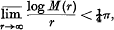
the constant ¼π being the “best possible”. In the case |an| ≤ 1, I have shown that the series converges to F(z) provided F(z) is an integral function whose maximum modulus satisfies
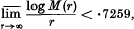
and that while ·7259 is not the “best possible” constant here, it cannot be replaced by a number as great as ·7378.
COMPARISON OF MULTIGRADED AND UNGRADED COUSIN COMPLEXES
-
- Journal:
- Proceedings of the Edinburgh Mathematical Society / Volume 44 / Issue 2 / June 2001
- Published online by Cambridge University Press:
- 20 January 2009, pp. 365-378
-
- Article
-
- You have access
- Export citation
